How Will Bengal's Interim Budget Affect Tax Revenue Growth?
Synopsis
West Bengal's interim budget forecasts a 6.20% increase in tax revenue by March 2027, driven primarily by SGST and state excise. This article explores the implications of these projections and the potential economic challenges they present.
Key Takeaways
Projected tax revenue increase of 6.20 percent by March 2027.
SGST to contribute 47.42 percent of total tax revenue.
State excise's contribution estimated at 20.39 percent .
Concerns about over-reliance on state excise for revenue generation.
Union government grants expected to rise significantly.
Kolkata, Feb 5 (NationPress) The tax revenue of West Bengal is anticipated to see a growth of 6.20 percent by March 31, 2027, primarily driven by two of the twelve revenue components: State Goods and Services Tax (SGST) and state excise.
According to the budget projections for the fiscal year 2026-27, the state's own tax revenue is expected to rise to Rs 1,18,668.78 crore, marking a 6.20 percent increase compared to the revised estimates of Rs 1,11,737.13 crore for 2025-26.
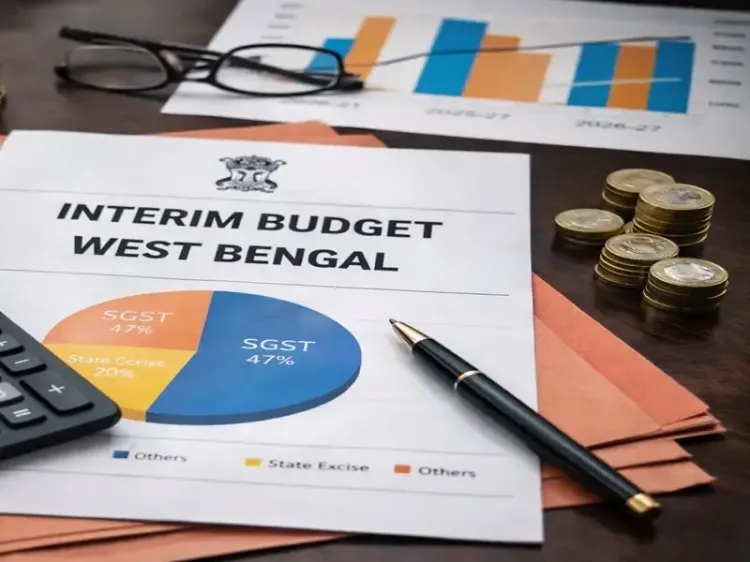
The documents indicate that the SGST is set to account for 47.42 percent of the total own tax revenue for the fiscal year under consideration.
Conversely, the state excise is projected to contribute 20.39 percent of the total state tax revenue collection for 2026-27.
As per these budget estimates, SGST collections are expected to grow to Rs 56,279.17 crore by March 31, 2027, an increase from Rs 53,829.37 crore as of March 31, 2026, based on the revised estimates for 2025-26.
Similarly, state excise collections are forecasted to increase to Rs 24,200.74 crore by the end of March 2027, up from Rs 22,223.16 crore in March 2026, according to revised estimates.
Economists warn that while West Bengal is not unique in its reliance on state excise for tax revenue, such dependence may be indicative of an unhealthy economic landscape.
“States relying heavily on state excise often lack other viable sources of tax revenue due to insufficient large-scale investments,” commented a local economist.
In terms of non-tax revenue, the largest contributor for 2026-27 is expected to be other non-tax revenue, estimated at Rs 3,177.24 crore.
Additionally, grants-in-aid from the Union government are projected to see a significant rise, reaching Rs 47,615.46 crore in the 2026-27 budget estimates, up from Rs 22,068.85 crore according to revised estimates for the previous fiscal year.
Point of View
I believe it's vital to acknowledge the implications of West Bengal's tax revenue projections. While the projected growth may appear promising, the state's reliance on excise duties raises concerns about sustainable economic development. We must ensure that the focus remains on diversifying revenue sources to foster long-term stability.
NationPress
21 Sept 2026
Frequently Asked Questions
What is the projected increase in West Bengal's tax revenue?
The tax revenue is projected to increase by 6.20 percent by March 31, 2027.
Which components are driving this revenue growth?
The growth is primarily driven by State Goods and Services Tax (SGST) and state excise.
How much is the SGST expected to contribute?
SGST is expected to contribute 47.42 percent of the total state's own tax revenue.
What are the concerns regarding state excise dependence?
Dependence on state excise may indicate a lack of diverse revenue sources and economic stability.
How much will grants-in-aid from the Union government increase?
Grants-in-aid are projected to rise to Rs 47,615.46 crore from Rs 22,068.85 crore.