Delhi High Court Denies Bail to Foreign National in Heroin Case

Synopsis
In a significant ruling, the Delhi High Court has denied bail to a foreign national accused of heroin possession. The court emphasized the stringent requirements of the NDPS Act while addressing the case's complexities.
Key Takeaways
The Delhi High Court denied bail citing stringent NDPS Act requirements.
The accused possessed over 500 grams of heroin, exceeding commercial thresholds.
Arguments regarding procedural flaws in the arrest were deemed insufficient.
Judicial emphasis was placed on the seriousness of drug-related offenses.
The ruling underscores the commitment to combat narcotics trafficking.
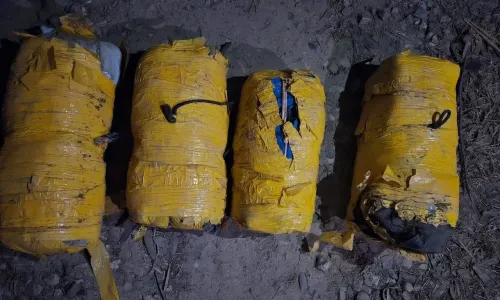
New Delhi, April 3 (NationPress) The Delhi High Court has rejected the bail request of a foreign national accused of having in excess of 500 grams of heroin, determining that the stringent provisions of Section 37 of the Narcotic Drugs and Psychotropic Substances (NDPS) Act were applicable in this instance.
The individual, identified as Chibuzor, was apprehended in relation to FIR No. 578/2022 filed at the Vikaspuri police station under Section 21 of the NDPS Act and Section 14 of the Foreigners Act.
A single-judge Bench led by Justice Girish Kathpalia observed that the amount of heroin allegedly seized from the individual was more than twice the commercial threshold, thus invoking the strict criteria for bail under Section 37 of the NDPS Act.
As per the prosecution, based on confidential information, the police set up a trap and detained the accused, recovering the illegal substance from a bag he was carrying after adhering to procedural requirements.
In defense of the bail application, the accused's counsel presented several arguments, including the claim that the reasons for arrest were not verbally conveyed to the accused, inconsistencies in the statements of prosecution witnesses, and doubts regarding the chain of custody of the confiscated drugs.
Furthermore, it was asserted that the Head Constable who received the confidential tip lacked the authority to execute the raid.
Countering the bail request, the prosecution maintained that the recovery was conducted following proper protocol after a trap was established based on secret intelligence, and the contraband was found in a bag belonging to the accused.
In its ruling, the Delhi High Court commented that at the bail stage, an exhaustive review of evidence is not required.
“It is a well-established principle that at the bail stage, the court should not conduct a detailed examination of the evidence available. Only the general outlines of the evidence need to be considered,” Justice Kathpalia remarked.
Addressing the argument regarding the officer's competence, the Delhi High Court noted that the FIR demonstrated compliance with legal procedures. “The Head Constable, after receiving the confidential information, presented the informer to the Sub Inspector, who confirmed the information after conversing with the informer and then relayed the details to the concerned ACP. It was this ACP who sanctioned the raid,” Justice Kathpalia stated.
The Delhi High Court concluded that none of the arguments put forth by the accused met the necessary dual conditions outlined in Section 37 of the NDPS Act.
“Arguments and evidence must be presented before the bail court to convince it that there are reasonable grounds for believing that the accused is not guilty of the alleged offense and that he is not likely to commit any further offenses while on bail,” the order clarified.
In dismissing the application, Justice Kathpalia remarked: “In my considered judgment, the defense presented by the accused/applicant in this case does not satisfy the dual conditions specified under Section 37 of the NDPS Act; hence, the bail request is denied.”
Point of View
The ruling by the Delhi High Court reinforces the seriousness of drug offenses under the NDPS Act. It highlights the judicial system's commitment to upholding stringent regulations to combat narcotic-related crimes, reflecting a broader societal imperative to deter drug trafficking.
NationPress
7 Oct 2026
Frequently Asked Questions
What was the basis for the bail denial?
The bail was denied due to the significant quantity of heroin involved, which exceeded the commercial threshold, triggering stringent conditions under Section 37 of the NDPS Act.
Who is the accused in this case?
The accused is identified as Chibuzor, a foreign national arrested for possessing over 500 grams of heroin.
What legal provisions were cited in the ruling?
The ruling primarily referenced Section 37 of the Narcotic Drugs and Psychotropic Substances Act, which imposes strict conditions for granting bail in narcotics cases.
What arguments were made in support of the bail application?
The defense argued that the reasons for arrest were not communicated, there were inconsistencies in witness statements, and doubts about the chain of custody of the seized drugs.
What did the court say about the evidence at the bail stage?
The court stated that a detailed examination of evidence is not necessary at the bail stage and only the broad contours of the evidence need to be considered.