Gujarat's 'Sugam Digital Gujarat' Initiative: A Leap Toward a Faceless, Cashless, and Paperless Future
Synopsis
Gujarat's Chief Minister Bhupendra Patel unveils the 'Sugam Digital Gujarat' initiative, aimed at digitizing high-transaction public services. This revolutionary program promises a faceless, cashless, and paperless approach, ensuring citizens can access essential services conveniently and efficiently.
Key Takeaways
Faceless, cashless, and paperless services for citizens.
Transition of high-volume public services online .
Enhanced accessibility via phone and WhatsApp .
Authentication through barcodes and Aadhaar .
Significant improvement in government service delivery efficiency.
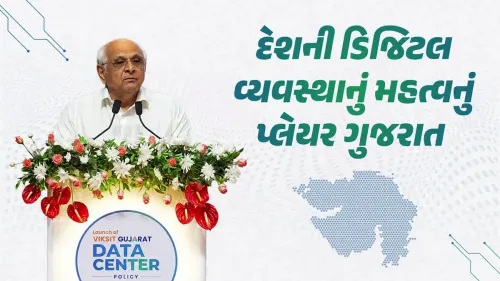
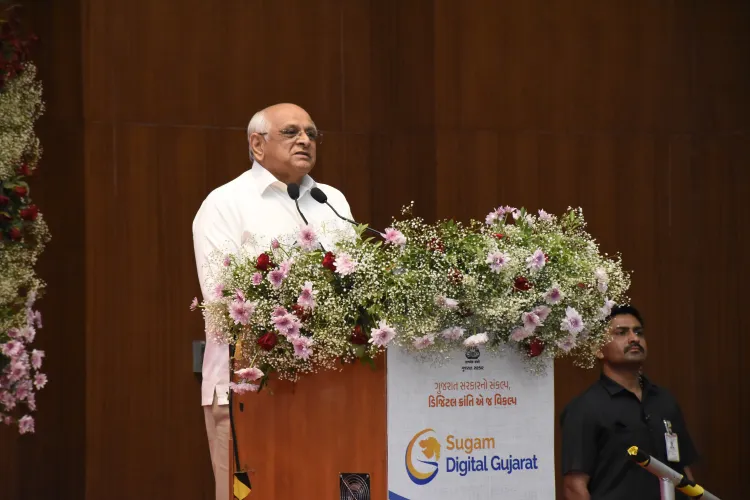
Gandhinagar, March 24 (NationPress) The Chief Minister of Gujarat, Bhupendra Patel, highlighted the essential goal of government digital reforms on Tuesday, stating that the main focus is to simplify the processes for citizens. He asserted, “The more convenient it is for people to accomplish tasks, the greater the satisfaction both the system and the government will experience.”
These comments were made during the official unveiling of the ‘Sugam Digital Gujarat’ initiative in Gandhinagar.
This initiative aims to modernize Gujarat's administrative framework, making it more centered around the needs of citizens by shifting high-volume public services from traditional methods to online platforms.
Launched with the presence of senior state administration officials, this program is considered a crucial move towards fulfilling Prime Minister Narendra Modi's vision of a developed India.
During the event, the Chief Minister revealed that, in line with the recommendations from the fifth report of the Gujarat Administrative Reforms Commission (GARC), 20 high-transaction services across five key departments will now be offered online.
These services, which include income certificates, caste certificates, ration cards, and affidavits, will be faceless, cashless, and paperless, minimizing the necessity for citizens to repeatedly visit government offices.
Speaking on the advantages of this initiative, CM Patel remarked: “We operate numerous programs, and these initiatives serve as a channel through which the government's efforts reach the public. If households are informed about these services, eligible citizens can fully benefit from government schemes.”
He emphasized the importance of local officials in assisting citizens, stating: “When villagers first engage with government services, they interact with the Talati or Village Computer Entrepreneur (VCE). The more we promote online access to these services, the greater the advantage for both citizens and the administration.”
Furthermore, the Chief Minister underscored the significance of cooperation among officials and representatives, saying: “When citizens, elected representatives, and government officials collaborate effectively, the outcomes are impressive and precise. In Gujarat, we have observed that collective efforts yield successful results, regardless of the situation.”
On the subject of digital payments, Patel noted: “When the Prime Minister advocated for digital payments, many were skeptical about its feasibility. Today, even small vendors are widely adopting digital payment methods. The support from citizens has been instrumental in this transition. When the government strives to address issues, citizens consistently back these initiatives.”
He also assured that fuel supplies in the state are stable, adding: “Together, we can ensure that no one faces challenges; there is no shortage of diesel, petrol, or gas.”
Science and Technology Minister, Arjun Modhwadia, described digitization as “a present-day gift from India, Gujarat, and its leadership.”
He reminisced about past efforts to bridge the gap between citizens and the government, including the establishment of single-window systems and citizen service centers in both rural and urban regions.
Chief Secretary, Manoj Kumar Das, stressed the urgency of reducing waiting times in government offices: “It is the priority of both the Prime Minister and the Chief Minister that citizens should not endure long waits for income, caste, and other certificates. It is unacceptable for millions of people to queue annually. Government departments such as revenue, health, and energy are already benefiting from technology.”
Das added that the Sugam Digital Gujarat platform enables citizens to complete most forms from the comfort of their homes, with services accessible via phone or WhatsApp.
Authentication will rely on barcodes and Aadhaar, with the system designed to handle up to one million concurrent users.
The Chief Minister also announced the launch of a digital locker system, ensuring that citizens won't need to repeatedly submit identical documents for various services. “Our goal is to ensure technology benefits reach every citizen,” he stated.
Officials noted that the system is expected to enhance the efficiency of ration distribution, student scholarships, widow pensions, and other services, making them more transparent and faster, primarily through digital means.
Point of View
The launch of the 'Sugam Digital Gujarat' initiative represents a crucial step in modernizing public service delivery. This initiative aligns with broader national goals of digitization and transparency in governance, showcasing a commitment to enhancing citizen engagement and satisfaction.
NationPress
21 Sept 2026
Frequently Asked Questions
What is the 'Sugam Digital Gujarat' initiative?
The 'Sugam Digital Gujarat' initiative is a program launched by Gujarat's Chief Minister Bhupendra Patel to digitize high-transaction public services, making them accessible online, thereby eliminating the need for physical visits to government offices.
What services will be digitized under this initiative?
The initiative will digitize 20 high-transaction services from five key departments, including income certificates, caste certificates, ration cards, and affidavits.
How will citizens access these services?
Citizens will be able to access these services online, through a dedicated platform, allowing them to complete forms from home via phone or WhatsApp.
What benefits does this initiative offer?
The initiative aims to make services faceless, cashless, and paperless, reducing the need for citizens to visit government offices repeatedly and streamlining the delivery of essential services.
How will the system ensure security and efficiency?
The system will utilize barcodes and Aadhaar for authentication and is designed to accommodate up to one million concurrent users, ensuring security and efficiency in service delivery.