Has Gujarat launched 'Operation Mule Hunt' to combat cybercrime networks?

Synopsis
In a bold move to combat rising cybercrime, Gujarat has launched 'Operation Mule Hunt'. This initiative aims to dismantle networks of cybercriminals using mule bank accounts. Directed by Deputy Chief Minister Harsh Sanghavi, the operation emphasizes protecting innocent account holders while aggressively pursuing fraudsters. Discover how Gujarat is fortifying its digital defenses.
Key Takeaways
Operation Mule Hunt aims to dismantle cybercriminal networks.
Deputy Chief Minister Harsh Sanghavi emphasizes thorough investigations.
Protection of innocent account holders is a priority.
Gujarat's Cyber Centre of Excellence employs advanced technology.
Public awareness initiatives are critical to the operation's success.
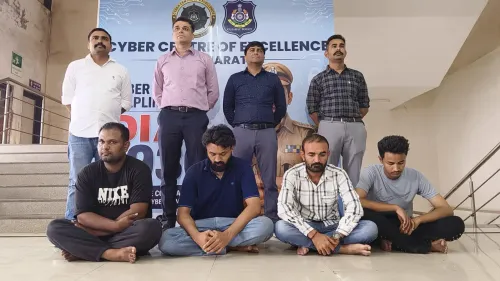
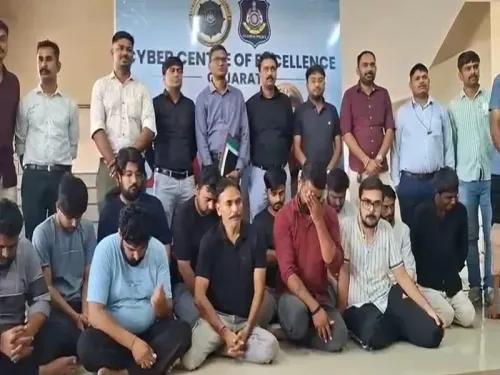
Ahmedabad, Dec 8 (NationPress) In an aggressive initiative to tackle the growing issue of cyber fraud, the Gujarat Police's Cyber Centre of Excellence has initiated 'Operation Mule Hunt'. This comprehensive action strategy is designed to dismantle the entire framework of cybercriminals who are exploiting mule bank accounts.
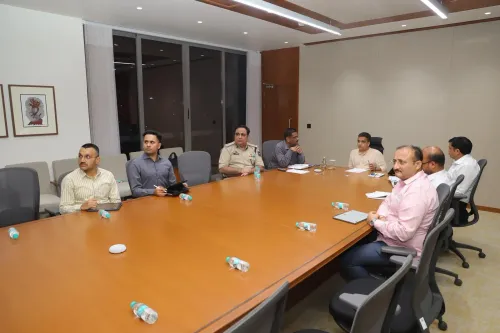
This operation was discussed in a high-profile meeting led by Deputy Chief Minister Harsh Sanghavi, who urged police divisions throughout the state to enhance their verification efforts — from banks to local police stations — based on thorough cybercrime analysis.
Sanghavi emphasized that the campaign should extend beyond just identifying account operators; it must also trace back to the masterminds orchestrating these scams. Additionally, he instructed that no innocent account holder should face undue harassment. Individuals whose accounts are unwittingly involved in these scams should be meticulously verified and treated with care.
High-ranking officials, including the CID Crime DGP, police commissioners, range IGs, and district police chiefs participated in the meeting via video conferencing to bolster inter-departmental collaboration and expedite the prevention and detection of cyber fraud across Gujarat.
With a consistent rise in cybercrime over the past few years, including incidents of online financial fraud, phishing, identity theft, and OTP scams, the state is enhancing its digital security apparatus. Gujarat has established one of the most proactive responses to cybercrime in India, supported by a combination of advanced technology, infrastructure, and coordinated law enforcement.
The Cyber Centre of Excellence (CCoE) serves as the central command, applying sophisticated data analytics, AI-driven monitoring, and inter-agency collaboration to identify fraud patterns and dismantle organized cybercriminal networks. The Gujarat Police has also set up dedicated cyber police stations across various districts, established cyber investigation labs, and trained officers in digital forensics to improve the efficiency and quality of their investigations.
Initiatives aimed at the public include statewide cyber awareness campaigns, workshops in schools and colleges, and efforts to encourage citizens to utilize the national helpline 1930 for prompt fraud reporting, significantly enhancing the likelihood of recovery of lost funds.
The government has also integrated its systems with the Indian Cyber Crime Coordination Centre (I4C), which facilitates quicker freezing of fraudulent accounts and improved coordination across states.
Point of View
I believe that Gujarat's proactive measures against cybercrime through 'Operation Mule Hunt' reflect a necessary evolution in law enforcement's approach to emerging threats. The emphasis on protecting innocent citizens while aggressively pursuing criminals demonstrates a balanced strategy that other states could learn from.
NationPress
30 Sept 2026
Frequently Asked Questions
What is 'Operation Mule Hunt'?
Operation Mule Hunt is an initiative by the Gujarat Police aimed at dismantling cybercrime networks that operate through mule bank accounts, enhancing efforts to combat cyber fraud.
Who is leading the operation?
The operation is led by Deputy Chief Minister Harsh Sanghavi, who has instructed police units across the state to intensify their verification efforts.
What measures are being taken to protect innocent account holders?
The initiative includes strict instructions to ensure that no innocent account holder is harassed, with careful verification of individuals whose accounts are unknowingly involved in cybercrime.
How is Gujarat addressing the rise in cybercrime?
Gujarat is enhancing its digital security framework, improving inter-departmental coordination, and utilizing advanced technology to trace and dismantle cybercrime networks.
What public initiatives are part of this operation?
The operation includes statewide cyber awareness drives, workshops in educational institutions, and campaigns encouraging citizens to report fraud using the national helpline 1930.