Improved Risk-Reward Dynamics in Indian Markets Amidst Growing Economic Momentum: Insights
Synopsis
The latest report indicates a favorable shift in the risk-reward balance for long-term government securities in India, driven by strong domestic growth and strategic trade agreements. This sets the stage for potential growth in various sectors as consumption rises.
Key Takeaways
Long-term government securities are becoming more attractive due to reduced uncertainty.
The risk-reward balance in Indian markets is improving.
India's manufacturing sector is positioned for growth due to cost advantages .
The RBI's inflation forecast indicates a transition to a growth recovery.
Consumption momentum and capacity utilization are expected to drive investments in FY27.
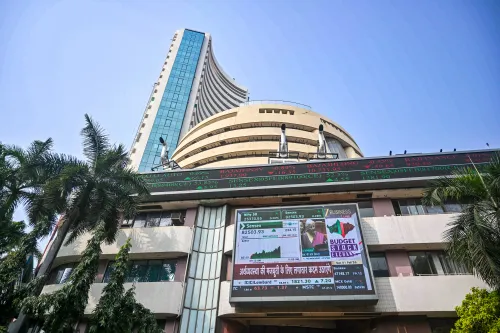
New Delhi, March 4 (NationPress) Longer-term government securities are becoming increasingly appealing as much of the “uncertainty has already been factored in,” and the risk-reward dynamics in Indian markets are improving due to robust domestic growth, according to a report released on Wednesday.
The analysis by Bajaj Finserv AMC highlighted that the combination of strong domestic growth, favorable policy adjustments, and enhanced global exposure via trade agreements has resulted in “a significantly improved risk-reward balance.”
While the asset management firm is inclined towards long-term government securities, it noted that yields might remain stable in the short run due to substantial supply.
On the topic of recent trade agreements, the firm mentioned that India’s inherent cost advantages in manufacturing are likely to mitigate the effects of opening certain sectors to imports from the US, impacting only select areas such as luxury vehicles and premium alcoholic beverages, rather than the wider industrial landscape.
Sorbh Gupta, Head of Equity at Bajaj Finserv AMC, remarked that recent trade agreements, the Union Budget, and RBI policies all signal India's readiness for a more robust domestic growth cycle driven by manufacturing and investment, as stated in the report.
“The RBI has indicated a slightly higher inflation trajectory, adjusting its FY26 estimate to 2.1% from 2%, along with raised expectations for the first half of FY27,” said Siddharth Chaudhary, Head of Fixed Income at Bajaj Finserv AMC. “This aligns with an economy transitioning from a very low-inflation phase to experiencing a cyclical growth recovery.”
The Indian equity markets have started 2026 with volatility, reflecting the sharp corrections and risk avoidance observed in early 2025, albeit within a stronger domestic macroeconomic context, the report noted.
“Nonetheless, sentiment has significantly improved following consecutive developments, especially the recent announcements regarding India-US trade,” it added.
As consumption trends strengthen and capacity utilization rates increase, a further uptick in investments can be anticipated in FY27, with notable growth already seen in the manufacturing, financial, real estate, and hospitality sectors, as per a recent report.
aar/pk
Point of View
The report provides a balanced analysis of the evolving risk-reward landscape in Indian markets, emphasizing the importance of domestic growth and policy support in driving economic momentum. It reflects a nation-first approach, highlighting the potential for robust growth across various sectors as India navigates trade agreements and economic reforms.
NationPress
16 Sept 2026
Frequently Asked Questions
What is the current outlook for long-term government securities in India?
Long-term government securities are currently viewed as attractive investments due to improved risk-reward dynamics influenced by strong domestic growth and favorable policy changes.
How do recent trade agreements impact India's manufacturing sector?
Recent trade agreements are expected to enhance India's structural cost advantages in manufacturing, limiting adverse effects primarily to select sectors like premium cars and high-end alcohol.
What does the RBI's inflation forecast indicate?
The RBI has adjusted its inflation forecast for FY26 to 2.1%, suggesting an economy transitioning from low inflation to experiencing a cyclical growth recovery.
What sectors are expected to see growth in FY27?
Sectors such as manufacturing, financial services, real estate, and hospitality are anticipated to experience growth momentum in FY27.
What has driven the volatility in Indian equity markets at the start of 2026?
The volatility in Indian equity markets is attributed to a reflection of past corrections and risk aversion, although it is set against a stronger domestic macroeconomic backdrop.