Historic Census 2027: India Launches First Digital Enumeration Drive

Synopsis
India's Census 2027 — the country's first fully digital enumeration — will use mobile-based data collection, real-time CMMS monitoring, and geo-referenced mapping, backed by ₹11,718 crore. For the first time, caste enumeration beyond SCs and STs is included, ending a 14-year data drought that has distorted welfare delivery for over 1.4 billion Indians.
Key Takeaways
Census 2027 will be India's first fully digital enumeration , using mobile-based data collection and replacing all paper-based methods.
The exercise is backed by an approved budget of ₹11,718.24 crore and secured by Critical Information Infrastructure (CII)-designated data centres .
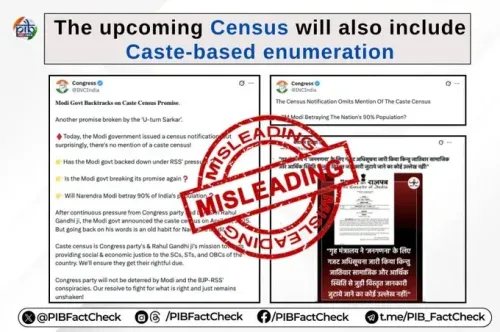
The Cabinet Committee on Political Affairs has approved caste enumeration beyond SCs and STs — a historic first in post-independence census history.
Key digital innovations include the CMMS portal for real-time monitoring, an optional self-enumeration facility , and geo-referenced jurisdictional mapping .
It will be the eighth census since independence and is expected to be the largest census exercise in the world by scale.
The last census was conducted in 2011 , meaning India has relied on 14-year-old demographic data for critical planning and welfare delivery decisions.
New Delhi — India's Census 2027 is set to make history as the country's first fully digital population enumeration, replacing traditional paper-based methods with mobile-based data collection to generate accurate, real-time demographic data for evidence-based governance. An official fact-sheet released on Saturday, April 25, confirmed the landmark exercise will be conducted in a structured two-phase format, covering every corner of the nation.
What Makes Census 2027 a Landmark Exercise
Census 2027 introduces several groundbreaking features that set it apart from all previous enumeration drives since India's independence. These include near real-time monitoring through the Census Management & Monitoring System (CMMS) portal, an optional self-enumeration facility for citizens, and extensive use of geo-referenced jurisdictions to map data with geographic precision.
The exercise is backed by an approved financial outlay of ₹11,718.24 crore and is supported by strengthened data-security infrastructure, including Critical Information Infrastructure (CII)-designated data centres. This makes it not only the most technologically advanced census India has ever conducted but also one of the most secure.
It will be the eighth census since India's independence and is widely expected to be the largest census exercise in the world by scope and scale.
Caste Enumeration: A Politically Significant Addition
One of the most consequential decisions surrounding Census 2027 is the inclusion of caste enumeration, approved by the Cabinet Committee on Political Affairs. This marks a significant departure from decades of practice — until the 2011 Census, only Scheduled Castes (SCs) and Scheduled Tribes (STs) were systematically enumerated by caste category.
The decision to include a broader caste count has been a long-standing demand from Other Backward Classes (OBC) groups and opposition parties, who argue that accurate caste data is essential for proportional representation and targeted welfare delivery. Critics, however, caution that caste-based data could deepen social divisions if not handled with sensitivity and transparency.
Notably, the last comprehensive Socio-Economic and Caste Census (SECC) was conducted in 2011, but its caste data was never made fully public — making the 2027 exercise an opportunity to finally fill that critical data gap.
How Digital Integration Will Transform Data Collection
The shift from paper to mobile-based enumeration is expected to dramatically reduce data-entry errors, accelerate processing timelines, and enable real-time tracking of field operations via the CMMS portal. Enumerators across the country will use dedicated mobile applications to record household-level data, which will be transmitted securely to central servers.
The optional self-enumeration facility allows digitally literate citizens to fill in their own details online, reducing the burden on field workers and improving data accuracy. This feature mirrors practices adopted in advanced economies like the United Kingdom and Canada during their recent census exercises.
Geo-referenced jurisdictions will allow planners to map population density, infrastructure gaps, and resource needs with far greater spatial precision than ever before — a critical upgrade for a country managing over 1.4 billion people across diverse geographies.
Impact on Policymaking and Public Welfare
Census data forms the backbone of India's planning architecture — from delimitation of parliamentary constituencies to allocation of funds under flagship schemes like PM Awas Yojana, MGNREGS, and National Food Security Act. The last census was conducted in 2011, meaning India has been operating on 14-year-old data for critical decisions — a gap that has distorted resource allocation and welfare targeting.
The updated data from Census 2027 will enable accurate assessment of population trends, urbanisation patterns, literacy rates, and household amenities. It will also support effective planning across sectors including food security, water management, energy infrastructure, and public health.
According to the official statement, the census will help in targeted delivery of government schemes and optimal resource allocation by offering granular, local-level insights — a significant improvement over the broad-brush estimates currently in use.
The Road Ahead: Timeline and Expectations
While the Census 2027 timeline is now officially confirmed, the government is expected to release detailed phase-wise schedules and enumerator training protocols in the coming months. Civil society organisations and demographers have already called for maximum transparency in data release, particularly regarding the caste enumeration component.
As India prepares for one of its most ambitious administrative exercises, the success of Census 2027 will depend not only on technological infrastructure but also on public trust, enumerator training, and the government's commitment to releasing complete and unredacted data — lessons drawn from the incomplete disclosure of the 2011 SECC. The findings, once published, are expected to reshape India's political, social, and economic policy landscape for the next decade.
Point of View
A democratic and administrative failure that has quietly skewed welfare delivery, constituency delimitation, and infrastructure planning. The inclusion of caste enumeration is politically explosive but statistically necessary; the real test will be whether the government releases the data in full, unlike the 2011 SECC whose caste findings were buried. The digital shift is commendable, but the deeper question is accountability: will this census finally force a reckoning with how India's resources are distributed — or will the data once again be selectively used to serve political convenience?
NationPress
19 Sept 2026
Frequently Asked Questions
What is Census 2027 and why is it significant?
Census 2027 is India's first fully digital population enumeration, using mobile-based data collection and real-time monitoring tools. It is significant because it ends a 14-year data gap since the last census in 2011 and introduces caste enumeration beyond SCs and STs for the first time.
Will caste be counted in Census 2027?
Yes, the Cabinet Committee on Political Affairs has approved the inclusion of caste enumeration in Census 2027. Previously, only Scheduled Castes and Scheduled Tribes were systematically counted by caste in the census exercise.
What is the budget approved for Census 2027?
The government has approved a financial outlay of ₹11,718.24 crore for Census 2027. The exercise will also be supported by CII-designated secure data centres to protect sensitive population data.
What is the CMMS portal in Census 2027?
The Census Management & Monitoring System (CMMS) portal is a digital platform that enables near real-time monitoring of field enumeration activities across India. It is one of the pioneering features introduced in Census 2027 to ensure transparency and operational efficiency.
How will Census 2027 affect government schemes and welfare delivery?
Updated census data will directly influence the targeting and funding of major government schemes like PM Awas Yojana and the National Food Security Act. Granular, local-level data will help ensure more accurate and equitable resource allocation across states and districts.