Asiatic black bear cubs released into wild after rehab at Kaziranga's CWRC
Synopsis
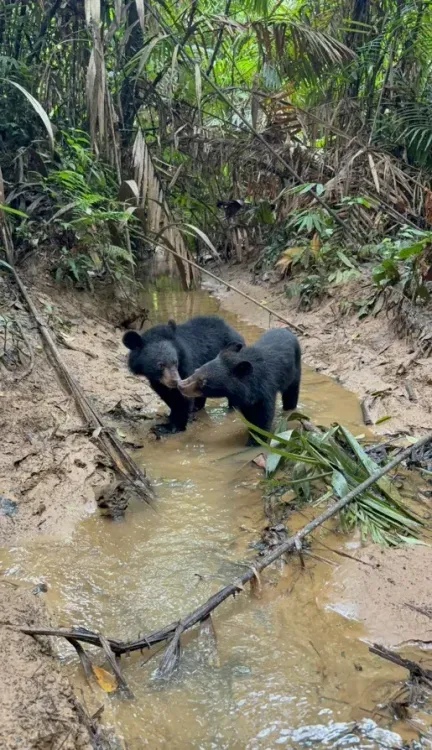
Two orphaned Asiatic black bear cubs, rescued from a forest in Jorhat at just four to six weeks old, have been released into Dehing Patkai National Park after months of scientific rehabilitation — a first-of-its-kind conservation outcome in Assam, timed to World Environment Day 2025.
Key Takeaways
Two orphaned Asiatic black bear cubs were released into Dehing Patkai National Park , Assam , on 5 June 2025 .
The cubs were rescued from Dissoi Reserved Forest , Jorhat district , on 26 February 2025 , when they were estimated to be four to six weeks old .
Rehabilitation was carried out at CWRC, Kaziranga , under wildlife veterinarian Bhaskar Choudhury , following protocols from the Centre for Bear Rehabilitation and Conservation in Arunachal Pradesh.
Dissoi Reserved Forest was ruled out as a release site due to human disturbance; Dehing Patkai was chosen for its dense cover and food availability.
The release was approved by Chief Wildlife Warden Vinay Gupta and described as a first-of-its-kind conservation achievement in Assam.
CWRC , established in 2002 , is a joint initiative of the Assam Forest Department, International Fund for Animal Welfare, and Wildlife Trust of India.
Two orphaned Asiatic black bear cubs were successfully released into the wild at Dehing Patkai National Park in Assam on Friday, 5 June 2025, following months of scientific rehabilitation at the Centre for Wildlife Rehabilitation and Conservation (CWRC) in Kaziranga National Park. Officials described the release as a first-of-its-kind conservation achievement in the state.
How the Cubs Were Rescued
The two cubs were estimated to be between four and six weeks old when they were discovered alone in the Dissoi Reserved Forest in Jorhat district on 26 February 2025. A local youth found the cubs and handed them over to forest officials. Subsequent searches by authorities failed to locate their mother, prompting a decision to transfer the animals to the CWRC for specialised care.
At the centre, the cubs were treated for mild dehydration and hand-reared under the supervision of wildlife veterinarian Bhaskar Choudhury and his team. Rehabilitation protocols were drawn from guidelines developed by the Centre for Bear Rehabilitation and Conservation in Arunachal Pradesh, with emphasis on proper nutrition, retention of natural behaviour, and minimising human imprinting.
Why Dehing Patkai Was Chosen
A scientific assessment was conducted to identify a suitable release site. Dissoi Reserved Forest, where the cubs were originally found, was initially considered but ruled out due to its proximity to human settlements and high levels of disturbance. Dehing Patkai National Park was ultimately selected for its dense forest cover, abundant food resources, and limited human interference — conditions considered optimal for the cubs' long-term survival.
Following approval from the state's Chief Wildlife Warden Vinay Gupta, a coordinated team of veterinarians, forest personnel, and animal keepers carried out the translocation and release.
What the Government Said
The Chief Minister's Office marked the milestone on World Environment Day with a post on social media platform X, stating that the successful release reflected Assam's growing commitment to wildlife conservation under Chief Minister Himanta Biswa Sarma. 'After months of dedicated care and rehabilitation at CWRC, two orphaned Asiatic black bear cubs were successfully released into Dehing Patkai National Park, where they now have a second chance to thrive in the wild,' the post read.
About CWRC and Its Role
Established in 2002, the CWRC is a joint initiative of the Assam Forest Department, the International Fund for Animal Welfare, and the Wildlife Trust of India. The centre has been instrumental in rehabilitating and releasing injured and orphaned wildlife across the region. Officials noted that this release demonstrates how science-based rehabilitation and coordinated inter-agency efforts can enable orphaned wildlife to return to their natural habitat.
The release marks a significant step in Assam's broader wildlife conservation agenda, with the state's protected forest network increasingly serving as a refuge for recovering species.
Point of View
But the harder question is systemic: how many such cubs never reach a CWRC because forest-edge communities lack the awareness or access to report them in time. Assam's wildlife infrastructure — CWRC included — is among the most capable in India, yet it remains concentrated around a few flagship protected areas. Scaling this model to the state's wider forest mosaic, where human-wildlife contact is constant and mother-loss events are underreported, is the next frontier. The political framing around Chief Minister Sarma's leadership is understandable on World Environment Day, but durable conservation outcomes depend on field-level capacity, not optics.
NationPress
21 Oct 2026
Frequently Asked Questions
What happened to the two Asiatic black bear cubs in Assam?
Two orphaned Asiatic black bear cubs, rescued from Dissoi Reserved Forest in Jorhat in February 2025, were successfully released into Dehing Patkai National Park on 5 June 2025 after months of rehabilitation at the CWRC in Kaziranga. It is the first such conservation achievement of its kind in Assam.
Where were the bear cubs rehabilitated and who cared for them?
The cubs were rehabilitated at the Centre for Wildlife Rehabilitation and Conservation (CWRC) in Kaziranga National Park. Wildlife veterinarian Bhaskar Choudhury and his team oversaw their care, treating them for mild dehydration and hand-rearing them using protocols from the Centre for Bear Rehabilitation and Conservation in Arunachal Pradesh.
Why was Dehing Patkai chosen as the release site instead of where they were found?
Dissoi Reserved Forest, where the cubs were originally discovered, was ruled out because of its proximity to human settlements and high disturbance levels. Dehing Patkai National Park was selected for its dense forest cover, abundant food resources, and limited human interference — conditions better suited for the cubs' survival.
What is the CWRC and who runs it?
The Centre for Wildlife Rehabilitation and Conservation (CWRC) was established in 2002 as a joint initiative of the Assam Forest Department, the International Fund for Animal Welfare, and the Wildlife Trust of India. It specialises in the rescue, treatment, and rehabilitation of injured and orphaned wildlife in the region.
Why is this release significant for Assam's wildlife conservation?
Officials described it as a first-of-its-kind achievement in Assam, demonstrating that science-based rehabilitation protocols can successfully prepare orphaned wild animals for independent survival. The release, announced on World Environment Day, highlights the potential of coordinated inter-agency conservation efforts in the state.