PLI-Auto investments hit ₹44,326 crore, beating 2027 target; 463 EV stations live in West Bengal
Synopsis
India's PLI-Auto scheme has crossed ₹44,326 crore in investments — beating a March 2027 target by nearly a year. Meanwhile, West Bengal has 463 of 482 sanctioned EV charging stations live, but no funds have yet been released under the PM E-DRIVE Scheme, and no adequacy assessment has been done. The gap between headline numbers and ground-level readiness is the real story.
Key Takeaways
PLI-Auto scheme attracted ₹44,326 crore in cumulative investments as of 31 March 2026 , surpassing the ₹42,500 crore target set for March 2027 .
The scheme was approved on 23 September 2021 with a budgetary outlay of ₹25,938 crore , targeting Advanced Automotive Technology (AAT) products.
463 of 482 sanctioned public EV charging stations in West Bengal under FAME-II were operational as of 1 July 2026 .
The West Bengal government's PM E-DRIVE proposal covers five stations in South 24 Parganas but excludes Mathurapur ; no funds released yet.
National EV charging allocations — ₹912.50 crore under FAME-II and ₹2,000 crore under PM E-DRIVE — are distributed on a pan-India basis , not state-wise.
Setting up EV charging stations remains an unlicensed activity in India, open to government, private, and institutional players.
India's Production-Linked Incentive (PLI) scheme for the automobile and auto component sector has drawn cumulative investments of ₹44,326 crore as of 31 March 2026 — already surpassing the ₹42,500 crore target set for March 2027, the Ministry of Heavy Industries said on Tuesday. The milestone, achieved nearly a year ahead of schedule, signals accelerating private-sector confidence in India's automotive manufacturing push.
PLI-Auto Scheme: What Has Been Achieved
The PLI scheme for the automobile and auto component industry was approved on 23 September 2021 with a budgetary outlay of ₹25,938 crore. Its stated objective is to strengthen India's domestic manufacturing capabilities for Advanced Automotive Technology (AAT) products — a category spanning electric vehicles, hybrid drivetrains, and next-generation auto components.
Approved applicants under the scheme have collectively reported investments that exceed the original target by more than ₹1,800 crore, according to the ministry. This makes the auto PLI one of the few sectoral schemes to breach its investment benchmark ahead of the stipulated deadline.
EV Charging Infrastructure in West Bengal
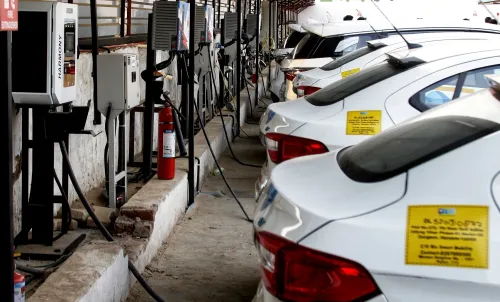
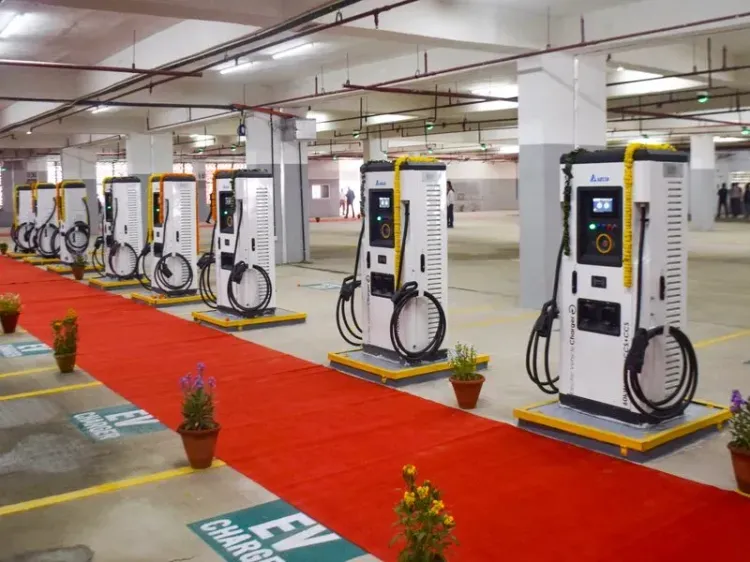
On the electric vehicle charging front, the ministry disclosed that oil marketing companies — Indian Oil Corporation Limited (IOCL), Bharat Petroleum Corporation Limited (BPCL), and Hindustan Petroleum Corporation Limited (HPCL) — had together sanctioned 482 public EV charging stations in West Bengal under the FAME-II Scheme. Of these, 463 stations were operational as of 1 July 2026, representing a deployment rate of approximately 96%.
The ministry noted, however, that no formal assessment has been undertaken to evaluate the adequacy of the existing charging infrastructure within the state — a gap that could become significant as EV adoption accelerates.
PM E-DRIVE Scheme and Mathurapur Gap
Under the newer PM E-DRIVE Scheme, a proposal received from the West Bengal government does not include any EV charging stations for Mathurapur. The state's proposal instead covers five public charging stations in South 24 Parganas district, at Canning, Bakkhali, Diamond Harbour, Kakdwip, and Namkhana.
The ministry confirmed that no financial assistance has been released to West Bengal under the PM E-DRIVE Scheme so far.
National Allocations and Licensing Framework
At the national level, ₹912.50 crore has been allocated under FAME-II and ₹2,000 crore under PM E-DRIVE specifically for the deployment of public EV charging stations. The ministry clarified that these allocations are made on a pan-India basis and are not earmarked state-wise.
The ministry also reiterated that setting up EV charging stations is an unlicensed activity in India, meaning government agencies, private entities, and other institutions can establish, operate, and maintain charging infrastructure without requiring a licence — a policy designed to lower entry barriers and accelerate network buildout.
With PLI-Auto investments already past target and EV charging infrastructure expanding across states, the broader question of whether deployment pace can match rising EV demand will define the next phase of India's automotive transition.
Point of View
Neither of which the ministry has detailed here. On EV charging, the 96% deployment rate in West Bengal looks impressive, but the ministry's own admission that no adequacy assessment has been done raises a pointed question: are these stations in the right locations, at the right density, to actually serve EV users? The exclusion of Mathurapur from PM E-DRIVE proposals and the absence of any state-wise fund allocation suggest that EV infrastructure planning remains reactive rather than demand-led — a structural gap that will widen as EV penetration rises.
NationPress
27 Oct 2026
Frequently Asked Questions
What is the PLI scheme for the automobile sector and how much has been invested?
The Production-Linked Incentive (PLI) scheme for the automobile and auto component industry was approved on 23 September 2021 with a ₹25,938 crore budgetary outlay. As of 31 March 2026, approved applicants had reported cumulative investments of ₹44,326 crore — exceeding the ₹42,500 crore target originally set for March 2027.
How many EV charging stations are operational in West Bengal under FAME-II?
As of 1 July 2026, 463 of the 482 public EV charging stations sanctioned in West Bengal under the FAME-II Scheme were operational. The stations were set up by oil marketing companies IOCL, BPCL, and HPCL.
Has West Bengal received any funds under the PM E-DRIVE Scheme?
No. The Ministry of Heavy Industries confirmed that no financial assistance has been released to West Bengal under the PM E-DRIVE Scheme as of the date of the statement. The state's proposal under the scheme covers five charging stations in South 24 Parganas but does not include Mathurapur.
Are EV charging stations regulated or licensed in India?
No licence is required to set up, operate, or maintain EV charging stations in India. The activity is classified as unlicensed, allowing government agencies, private companies, and other institutions to build charging infrastructure freely.
How is the national EV charging infrastructure budget allocated across states?
The national allocations — ₹912.50 crore under FAME-II and ₹2,000 crore under PM E-DRIVE — are made on a pan-India basis and are not earmarked for specific states. Individual states or entities submit proposals, which are then evaluated for funding.