Why Did Sensex and Nifty Open in the Red Today?
Synopsis
The Indian equity markets opened lower, driven by a notable drop in IT stocks. Analysts suggest immediate support and resistance levels for Nifty, while US jobs data impacts market expectations. Despite recent corrections, the medium-term outlook remains optimistic.
Key Takeaways
The Indian equity markets have opened lower due to declines in IT stocks.
Sensex and Nifty are experiencing significant losses.
Immediate support and resistance levels for Nifty have been identified.
US jobs data has influenced expectations regarding interest rate cuts.
Despite recent corrections, analysts remain optimistic about the medium-term outlook.
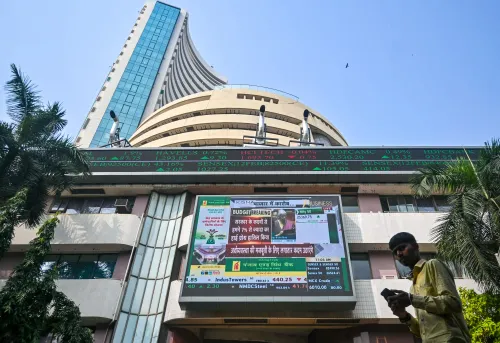
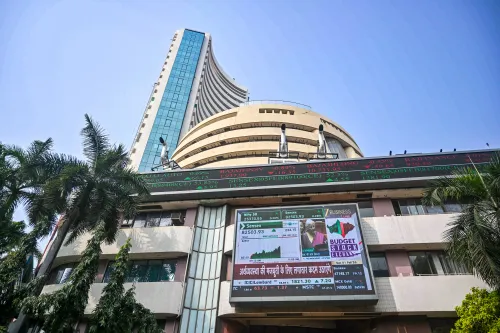
Mumbai, Feb 12 (NationPress) The Indian equity markets commenced the day on a negative note on Thursday, primarily impacted by declines in IT stocks.
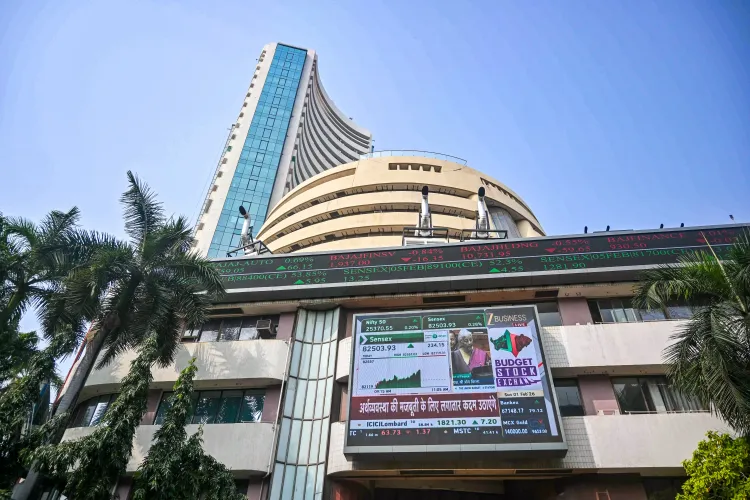
At 9:25 am, the Sensex experienced a drop of 397 points, equivalent to 0.47 percent, landing at 83,836, while the Nifty fell by 111 points, or 0.43 percent, settling at 25,842.
The major broad-cap indices reported more significant losses than the benchmark indices, with the Nifty Midcap 100 decreasing by 0.76 percent and the Nifty Smallcap 100 dipping by 0.88 percent.
All sectoral indices traded in the red, with the exception of FMCG, private banks, and oil and gas. The most significant losers included Nifty IT, which fell by 3.58 percent, along with realty and media sectors declining by 1.11 percent and 1.04 percent, respectively.
Market analysts indicated that immediate support for Nifty is observed in the 25,800-25,850 zone, while resistance is found in the 26,050-26,100 range.
Recent US jobs data showing an addition of 130,000 jobs last month and a decrease in unemployment to 4.3 percent has dampened expectations for imminent rate cuts by the Fed.
In India, analysts believe that the rate-cutting cycle has concluded, as economic growth remains robust, and inflation is anticipated to align with the RBI's long-term target by the conclusion of FY27.
In the Asian markets, China's Shanghai index gained 0.12 percent, and Shenzhen increased by 0.81 percent; Japan's Nikkei rose by 0.1 percent, while Hong Kong's Hang Seng Index fell 0.97 percent. South Korea's Kospi saw an increase of 2.74 percent.
The US markets concluded primarily in the red overnight, with Nasdaq declining by 0.16 percent. The S&P 500 remained largely unchanged, whereas the Dow Jones dipped by 0.13 percent.
On February 11, foreign institutional investors (FIIs) were net buyers of equities worth Rs 944 crore, while domestic institutional investors (DIIs) sold equities worth Rs 125 crore.
Indian equities encountered a correction in January amidst global volatility and FII outflows; however, analysts maintain a constructive medium-term outlook.
Point of View
I emphasize the importance of closely monitoring the fluctuations in the Indian equity markets. While today's dip is concerning, it is crucial to take a broader view. The fundamentals show promise, with strong growth indicators suggesting potential recovery in the medium term.
NationPress
3 Oct 2026
Frequently Asked Questions
What caused the drop in the Indian equity markets today?
The decline was primarily driven by a significant drop in IT stocks, which affected overall market sentiment.
What are the immediate support and resistance levels for Nifty?
Immediate support for Nifty is at the 25,800-25,850 zone, while resistance levels are identified at 26,050-26,100.
How did global markets influence the Indian markets?
Recent US jobs data indicated strong job additions, impacting expectations for rate cuts by the Federal Reserve, which in turn influenced the Indian markets.
What is the outlook for the Indian equity markets?
Despite recent corrections, analysts maintain a constructive medium-term outlook for the Indian equities, as growth remains robust.
What role do foreign institutional investors play in the market?
Foreign institutional investors (FIIs) significantly impact market dynamics, as seen with their net purchases of equities worth Rs 944 crore recently.