UPI MDR charges row: Karnataka Congress protests in Bengaluru, demands Centre roll back proposed fee
Synopsis
Karnataka Congress took to the streets of Bengaluru on 17 September over the Centre's proposed 0.4% MDR on UPI merchant transactions above ₹2,000, due from 15 October. With Deputy CM Parameshwara calling it a step backwards and opposition leaders alleging foreign-pressure-driven policy, the debate cuts to the heart of whether India's zero-cost digital payments promise can survive commercial and geopolitical pressures.
Key Takeaways
Karnataka Congress staged a protest in Bengaluru on 17 September demanding the Centre withdraw the proposed UPI MDR.
The framework, announced on 15 September , proposes a 0.4% MDR on specified person-to-merchant UPI transactions above ₹2,000 , effective 15 October .
The Finance Ministry says customers will not be directly charged, and around 96% of merchant transactions will be unaffected.
Parameshwara called the move 'a step backwards' for India's digital payments journey, warning that merchants could pass costs on to consumers.
Person-to-person UPI transactions remain free under the proposed framework.
Protesters also cited rising prices, unemployment, and alleged foreign-policy pressure as compounding economic concerns.
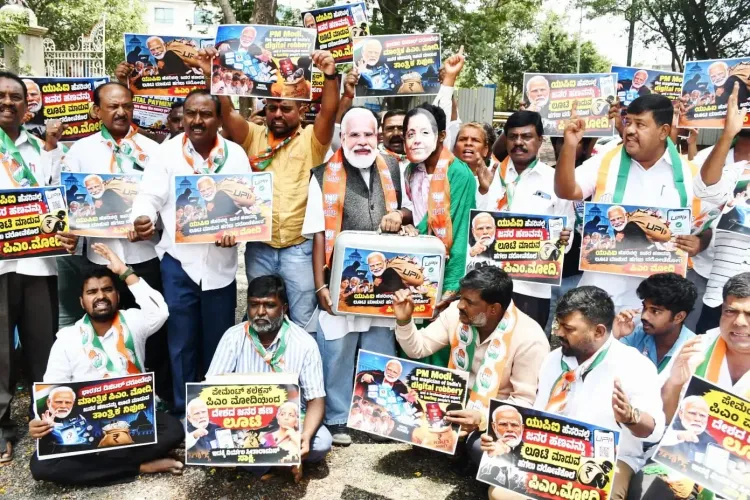
Karnataka's Congress leaders and workers staged a protest in Bengaluru on Thursday, 17 September 2026, demanding that the Centre immediately withdraw the proposed Merchant Discount Rate (MDR) of 0.4 per cent on specified person-to-merchant UPI transactions above ₹2,000, set to take effect from 15 October. The protesters alleged the move would increase the financial burden on ordinary citizens, small traders, and the middle class.
What the Proposed MDR Framework Entails
Under the framework announced on 15 September, a 0.4 per cent MDR applies to specified person-to-merchant UPI transactions above ₹2,000, while person-to-person transactions remain free of charge. The Finance Ministry has clarified that customers will not directly pay the MDR and that approximately 96 per cent of merchant transactions will remain unaffected. Critics, however, argue that costs borne by merchants could eventually be passed on to consumers through higher prices or ancillary charges.
Congress Leaders Voice Opposition at Protest
The protest saw participation from Karnataka Pradesh Congress Committee (KPCC) general secretary S. Manohar and Congress leaders including A. Anand, G. Prakash, Lakshminarayan, Umesh, Puttaraju, Chandrashekhar, Kushal Haravegowda, Ranjit Kumar Madhavanhunur, and Praveen Rao. Protesters called on Prime Minister Narendra Modi and Union Finance Minister Nirmala Sitharaman to reconsider the decision, arguing that UPI had become an indispensable part of daily life and that any additional charge would hurt small businesses and household budgets.
The demonstrators also raised wider economic grievances, alleging that rising prices of essential commodities — covering food, transport, fuel, and household requirements — had already stretched ordinary family budgets. They further alleged that unemployment had increased under the NDA government and accused the Centre of imposing additional burdens through new charges and taxes.
Deputy CM Parameshwara Calls It a Step Backwards
Karnataka Deputy Chief Minister G. Parameshwara separately opposed the proposed MDR, describing it as 'a step backwards for India's digital payments journey.' He argued that UPI's success was built on being simple, accessible, and free, enabling millions of citizens and small businesses to shift from cash to digital transactions. While acknowledging the government's assurance that consumers would not be directly charged, Parameshwara contended that higher costs imposed on merchants could ultimately be transferred to end-users.
Citing Congress MP and Leader of the Opposition in the Lok Sabha Rahul Gandhi, he alleged that the Modi government was yielding to American pressure and opening India's digital payments ecosystem to foreign corporate interests. Parameshwara also raised concerns over the expanding role of large banks, fintech companies, and global technology firms within the UPI ecosystem, and urged the Centre to protect affordable digital payments.
Broader Political and Policy Context
The proposed MDR framework marks a notable policy shift for UPI, which has operated on a zero-charge model since the government scrapped MDR on RuPay cards and UPI transactions in 2020. India currently processes hundreds of crores of UPI transactions monthly, making it one of the world's largest real-time payments networks. Notably, any move to introduce merchant charges — even indirectly — risks disrupting the adoption curve among micro and small merchants who were nudged away from cash specifically by the promise of fee-free digital infrastructure.
With the 15 October implementation date approaching, industry bodies, trader associations, and opposition parties are expected to keep the pressure on the Centre for a formal review or rollback.
Point of View
000 is a policy U-turn that contradicts the government's own zero-charge mandate of 2020 — and the timing, just months before state budget cycles, gives the opposition a ready-made street issue. The Finance Ministry's assurance that 96% of merchant transactions are unaffected sounds reassuring until one examines the other 4%: high-value micro-merchant payments that sit precisely at the margin of digital adoption. If merchants in that bracket revert to cash, the last-mile gains of UPI expansion could quietly unravel. Deputy CM Parameshwara's invocation of foreign corporate interests reflects a politically resonant anxiety about whether India's homegrown payments stack will remain sovereign infrastructure or become a fee-generating layer for global fintech.
NationPress
17 Sept 2026
Frequently Asked Questions
What is the proposed UPI MDR that Congress is protesting against?
The proposed Merchant Discount Rate (MDR) is a 0.4% charge on specified person-to-merchant UPI transactions above ₹2,000, announced on 15 September and set to take effect from 15 October. Person-to-person UPI transactions remain free, and the Finance Ministry has clarified that end-consumers will not be directly charged.
Will ordinary UPI users have to pay the new MDR charge?
According to the Finance Ministry, customers will not directly pay the MDR; it applies to merchants receiving payments. However, critics including Karnataka Deputy CM G. Parameshwara argue that merchants could pass the cost on to consumers through higher prices or other charges.
Why has Congress opposed the proposed UPI fee?
Congress argues that the MDR will increase financial burdens on small traders and ordinary citizens who rely on UPI for daily transactions. Party leaders also allege the move reflects foreign-policy pressure to open India's digital payments ecosystem to global corporate interests.
How many UPI transactions will be affected by the proposed MDR?
The Finance Ministry has stated that approximately 96% of merchant UPI transactions will remain unaffected. Only specified person-to-merchant transactions above ₹2,000 fall within the MDR framework.
What is the background to the UPI zero-charge policy?
The Indian government scrapped MDR on RuPay cards and UPI transactions in 2020 to accelerate digital adoption among small businesses and consumers. The current proposal marks the first significant move toward reintroducing merchant charges on UPI since that decision, making it a politically and commercially sensitive reversal.