US Military Chiefs Set for Congressional Hearings Over Iran Conflict
Synopsis
Next week, top US military officials will testify before Congress regarding the implications of the ongoing US-Israeli conflict with Iran, raising important questions about its impact on US strategic focus on China and North Korea. Stay informed on these critical developments.
Key Takeaways
Top US commanders to testify before Congress on military readiness.
Concerns arise over the impact of the Iran conflict on US focus on China and North Korea.
Recent redeployment of military assets highlights the flexibility of US defense capabilities.
The US Navy has engaged in maritime operations to enforce blockades against Iranian vessels.
Ten vessels have been turned around as part of the US blockade in the Strait of Hormuz.
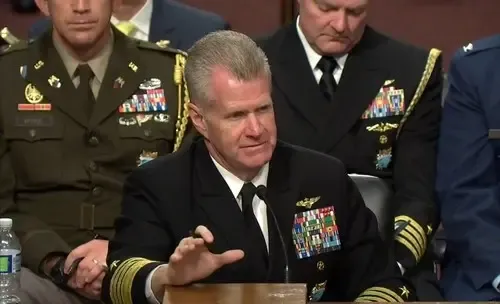
Washington, April 16 (NationPress) Senior US military leaders stationed in the Indo-Pacific are set to participate in hearings held by the Senate and House committees at the Capitol next week, as indicated by Congress's official website. This comes in light of rising concerns that the conflict involving the US and Israel against Iran may divert America's attention from confronting threats posed by China and North Korea.
Adm. Samuel Paparo, who leads the US Indo-Pacific Command, alongside Gen. Xavier Brunson, the commander of US Forces Korea, will present their testimonies before the Senate and House Armed Services Committees on Tuesday and Wednesday respectively, focusing on the military's readiness and the security challenges faced in the region, as reported by the Yonhap news agency.
The hearings are expected to follow reports that the US has relocated segments of its THAAD missile defense system from South Korea to the Middle East and has sent thousands of US Marines from the 31st Marine Expeditionary Unit stationed in Japan to the increasingly unstable area.
These developments arise amid ongoing worries that the conflict in the Middle East could undermine the US military's capacity to adequately address the 'pacing challenge' presented by a more assertive China and the growing nuclear and missile threats from North Korea.
Last month, Michael Duffey, the undersecretary of defense for acquisition and sustainment, emphasized that the ability to redeploy military resources to meet urgent global needs is a significant strength of the US defense system, particularly regarding the movement of THAAD components from South Korea.
In related news, the US Central Command announced on Wednesday that a US Navy guided-missile destroyer successfully intercepted and redirected an Iranian-flagged cargo ship in the Strait of Hormuz.
According to the command, "Yesterday, an Iranian-flagged cargo vessel attempted to avoid the US blockade after departing Bandar Abbas, exiting the Strait of Hormuz, and navigating along the Iranian coastline." The guided-missile destroyer USS Spruance (DDG 111) effectively redirected the vessel back toward Iran.
To date, ten vessels have been turned away, with no ships breaching the strait since the initiation of the US blockade on Monday, as noted by the command.
Brad Cooper, chief of US Central Command, indicated on Tuesday night that US forces have entirely halted maritime economic trade into and out of Iran.
Point of View
It's crucial to highlight the implications of the upcoming congressional hearings involving top US military commanders. The intersection of the Iran conflict with US strategic priorities in the Indo-Pacific raises vital questions about resource allocation and national security amidst rising global tensions.
NationPress
19 Sept 2026
Frequently Asked Questions
What is the purpose of the upcoming congressional hearings?
The hearings aim to address the US military's readiness and security challenges, particularly in the context of the ongoing conflict involving Iran and its potential effects on US strategic focuses in Asia.
Who are the key military figures testifying?
Adm. Samuel Paparo, commander of US Indo-Pacific Command, and Gen. Xavier Brunson, commander of US Forces Korea, are the key figures who will provide testimonies.
Why are the hearings significant?
These hearings are significant as they will examine how the US-Israeli conflict with Iran may impact America's capacity to address threats from China and North Korea.
What actions has the US taken regarding its military presence in the Middle East?
The US has relocated parts of its THAAD missile defense system to the Middle East and deployed thousands of Marines from Japan to the region amid the ongoing conflict.
What recent actions have US forces taken in the Strait of Hormuz?
US Navy forces, specifically the USS Spruance, have intercepted and redirected an Iranian-flagged cargo vessel attempting to evade a US blockade in the Strait of Hormuz.