Is the US Position on Greenland Igniting Security Concerns?
Synopsis
The recent comments by the Trump administration regarding Greenland have sparked a significant political debate centered on national security, diplomacy, and the US's Arctic strategy. As tensions rise, lawmakers from both parties are weighing in on the implications for international relations and cooperation in the region.
Key Takeaways
Trump administration comments on Greenland have sparked political debate.
Lawmakers warn against aggressive rhetoric that could harm alliances.
Greenland is strategically important for US military operations.
Diplomacy remains the preferred approach for resolving security concerns.
Greenland's autonomy within Denmark plays a crucial role in discussions.
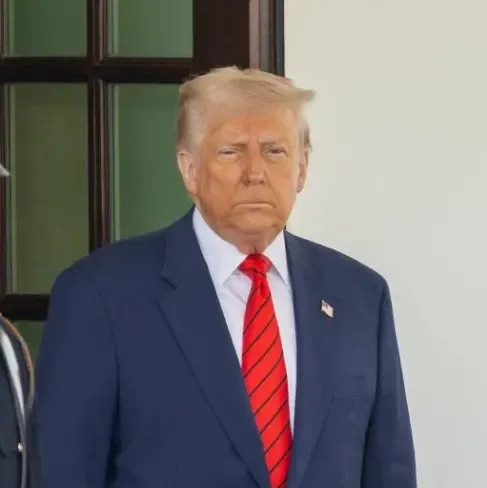
Washington, Jan 8 (NationPress) The statements made by the Trump administration regarding Greenland, characterized by officials as a matter of national security, have ignited a political discourse in Washington concerning diplomacy, NATO alliances, and the US strategy in the Arctic.
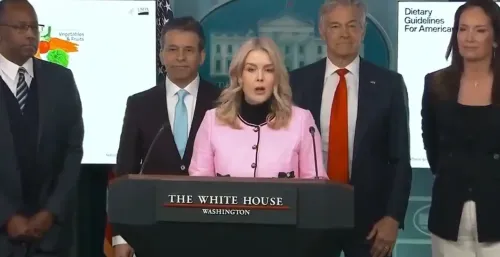
During a White House briefing on Wednesday (local time), Press Secretary Karoline Leavitt mentioned that the potential acquisition of Greenland by the United States was "something that's currently being actively discussed by the president and his national security team."
She emphasized that the matter was linked to US national security interests and the imperative to deter Russian and Chinese aggression in the Arctic region. Additionally, she highlighted that "the president's first option has always been diplomacy."
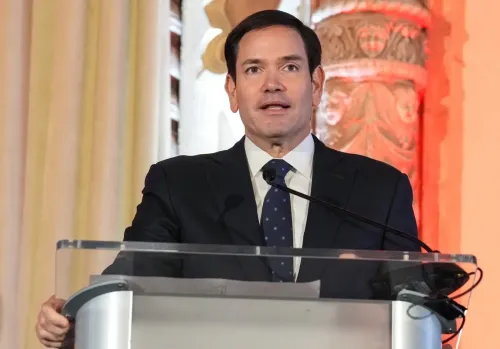
Secretary of State Marco Rubio, speaking separately to reporters, noted that President Donald Trump had referenced Greenland since his first term and that the concept was "not new."
Rubio stated that Trump was not the first US president to consider ways the United States might acquire Greenland, adding that "every president… always retains the option" to address threats to US national security.
As a diplomat, Rubio remarked that the United States "always prefer(s) to settle it in different ways," suggesting that military action was not the favored approach.
The administration's comments swiftly drew reactions from lawmakers on Capitol Hill, including senior Republicans and Democrats, many of whom cautioned that aggressive rhetoric could jeopardize longstanding alliances in the Arctic.
Senators Lisa Murkowski of Alaska and Angus King of Maine, co-chairs of the Senate Arctic Caucus, issued a joint statement urging caution against any notion of force.
Murkowski expressed hope that the administration's rhetoric was "nothing more than posturing for a new era of cooperation," warning that any attempt to claim or seize Greenland by force would "undermine both our national security and our international relationships."
King asserted, "There is absolutely no national security reason for us to own, occupy, or control Greenland."
Democrats condemned the administration's stance. Representative Pete Aguilar of California remarked that discussions of military action against Greenland amounted to "threatening a NATO ally," labeling such rhetoric as "completely unhinged."
Representative Ted Lieu stated there was "absolutely no legal justification whatsoever to use military force against a NATO ally, against Greenland," adding that any such action without congressional authorization would be illegal.
Republican leaders sought to clarify the administration's stance while emphasizing diplomacy. House Speaker Mike Johnson stated there was "no intent of being at war with Greenland," describing the discussions as focusing on Greenland's "geopolitical and strategic importance."
Johnson noted that Congress had not been asked to authorize any military action and that such action was not under consideration.
Many lawmakers underscored existing cooperation with Danish and Greenlandic officials.
Congressman Mike Flood expressed confidence that Rubio could "navigate a diplomatic win-win solution," highlighting their willingness to explore measures that would enhance US security while respecting Danish sovereignty.
He referenced Trump's earlier comments supporting "the incredible people of Greenland" and their "right to determine your own future."
Senate Republican Leader Mitch McConnell cautioned that "threats and intimidation by US officials over American ownership of Greenland are as unseemly as they are counterproductive."
McConnell argued that using force to seize the territory of "one of America's most loyal and capable allies" would be an act of "strategic self-harm" that could tarnish US global influence.
Lawmakers from both parties reiterated that close cooperation with Denmark and Greenland has historically provided the United States with strategic access in the High North without necessitating ownership.
Greenland is an autonomous territory within the Kingdom of Denmark. It holds a critical location between North America and Europe and is situated near emerging Arctic shipping routes.
The United States has sustained a military presence on the island for decades, including at the Pituffik Space Base, formerly known as Thule Air Base, which plays a vital role in missile warning and space surveillance.
Point of View
The United States must navigate its relationships with allies carefully. The dialogue around Greenland serves as a reminder of the delicate balance between national security interests and maintaining fruitful diplomatic ties. At NationPress, we advocate for a balanced approach that respects international relationships while addressing security concerns.
NationPress
18 Oct 2026
Frequently Asked Questions
What prompted the Trump administration's comments on Greenland?
The Trump administration's remarks were framed as a national security issue, emphasizing the need to deter Russian and Chinese aggression in the Arctic region.
How have lawmakers responded to the administration's position?
Lawmakers from both parties have expressed concern that aggressive rhetoric could undermine long-standing alliances, with some arguing for a focus on diplomacy instead of military action.
What is Greenland's status in relation to the US?
Greenland is an autonomous territory within the Kingdom of Denmark, strategically located between North America and Europe, and has been a site of US military presence for decades.
What are the implications of the US acquiring Greenland?
Acquiring Greenland could have significant geopolitical implications, impacting US relations with Denmark and other NATO allies, and raising concerns over military aggression.
What role does Greenland play in US national security?
Greenland's strategic location is vital for the US military, particularly for missile warning and space surveillance operations conducted from the Pituffik Space Base.