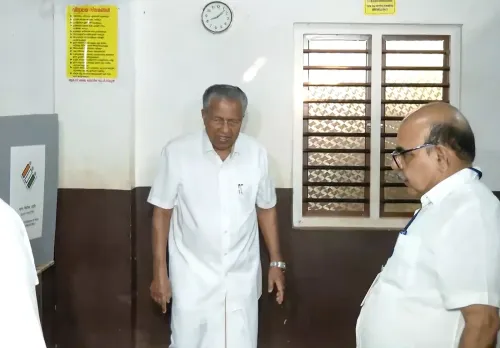
Pinarayi Vijayan becomes first CPI-M Politburo member summoned by ED
Synopsis
Pinarayi Vijayan — the man who spent years demanding accountability from others — is now the first CPI-M Politburo member ever summoned by the Enforcement Directorate. The CMRL-Exalogic case implicates his daughter and son-in-law, and forces the party to apply, or abandon, the very standard it set for its opponents.
Key Takeaways
Pinarayi Vijayan has become the first CPI-M Politburo member to be summoned by the Enforcement Directorate (ED) .
He is asked to appear before ED officials on Friday, 17 October 2026 , in the Masappadi (CMRL-Exalogic) case .
The case involves alleged payments by Cochin Minerals and Rutile Ltd (CMRL) to Exalogic Solutions , linked to his daughter T.
Veena , who is the second accused in two registered cases.
Vijayan's son-in-law and CPI-M legislator P.A.
Mohammed Riyas is the first accused in a related hawala case.
Vijayan served as Kerala Chief Minister for two consecutive full terms (2016–2026) — a first in Kerala's political history.
The CPI-M has stated Vijayan need not resign as Leader of the Opposition , despite having demanded resignations from rivals in comparable situations.
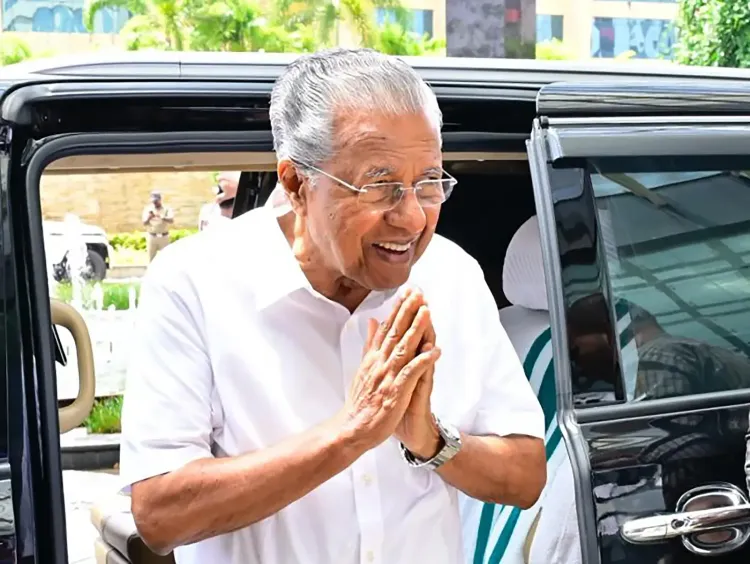
Former Kerala Chief Minister and Communist Party of India (Marxist) veteran Pinarayi Vijayan has become the first CPI-M Politburo member to receive a summons from the Enforcement Directorate (ED), which has asked him to appear before its officials on Friday, 17 October 2026, in connection with the Masappadi (CMRL-Exalogic) case. The development adds a distinctly unwelcome entry to a political career already defined by record-setting milestones.
A Career Built on Records
Vijayan's political résumé is formidable by any measure. He served as CPI-M Kerala State Secretary from 1998 to 2015 before becoming Chief Minister — a post he held for two consecutive full terms from 2016 to 2026, a feat no other Kerala Chief Minister has achieved. The ED summons now stands as a record of a very different kind: no member of the party's supreme decision-making body, the Politburo, has previously been called in by the federal financial crimes agency.
What the Case Is About
The Masappadi case centres on alleged payments made by Cochin Minerals and Rutile Ltd (CMRL) to Exalogic Solutions, a company reportedly associated with Vijayan's daughter, T. Veena. Two separate cases have been registered in connection with these transactions. Veena is named as the second accused in both. Her husband and sitting CPI-M legislator P.A. Mohammed Riyas is the first accused in a related hawala case. Vijayan himself has not been formally charged; the ED summons is at the investigation stage.
The Irony the CPI-M Cannot Escape
The political irony is difficult to overlook. The CPI-M has long fashioned its public identity around anti-corruption campaigning and demanding accountability from those in power. In 2015, the party led an aggressive campaign against then Finance Minister K.M. Mani over bar bribery allegations, eventually contributing to his resignation after adverse remarks by a High Court judge. Vijayan himself was among the loudest voices against then Chief Minister Oommen Chandy during the Solar scam controversy of the 2011–16 period, repeatedly demanding Chandy's resignation. Chandy was subsequently exonerated.
The Party's Response and Its Double Standard
The CPI-M's official position is that the ED is being deployed as a political instrument against opposition leaders — a charge routinely levelled by multiple parties across India. That argument, critics note, does not address the substance of the allegations. Notably, the party has made clear that Vijayan need not resign as Leader of the Opposition, a position it is unlikely to have adopted had a rival party leader faced identical circumstances. Political observers have pointed out that the CPI-M's own template — demanding resignation on the mere appearance of impropriety — is now being set aside for its own senior-most figure.
What Happens Next
Vijayan is expected to either appear before the ED on Friday or challenge the summons legally. The outcome of the ED's questioning could determine whether the agency proceeds to further action. For Kerala's political landscape, the episode represents a stress test for the principle that accountability applies equally regardless of ideology. As former Chief Minister Oommen Chandy once observed, Kerala politics often turns less on what is done than on who does it — a remark that has found fresh resonance this week.
Point of View
And may even be partially valid, but it bypasses the question of conduct entirely. The deeper damage is reputational: if the CPI-M's anti-corruption identity was always conditional on which party's leader stood accused, that identity was never about accountability — it was about advantage.
NationPress
16 Oct 2026
Frequently Asked Questions
Why has the ED summoned Pinarayi Vijayan?
The Enforcement Directorate has summoned Vijayan in connection with the Masappadi (CMRL-Exalogic) case, which involves alleged payments by Cochin Minerals and Rutile Ltd (CMRL) to Exalogic Solutions, a company reportedly linked to his daughter T. Veena. Vijayan has been asked to appear before ED officials on Friday, 17 October 2026.
What is the CMRL-Exalogic case?
The CMRL-Exalogic case, also referred to as the Masappadi case, involves alleged financial transactions between Cochin Minerals and Rutile Ltd and Exalogic Solutions. Two cases have been registered; T. Veena, Vijayan's daughter, is the second accused in both, and her husband, CPI-M legislator P.A. Mohammed Riyas, is the first accused in a related hawala case.
What records has Pinarayi Vijayan set in Kerala politics?
Vijayan served as CPI-M Kerala State Secretary from 1998 to 2015 and then as Chief Minister for two consecutive full terms from 2016 to 2026 — the only Kerala Chief Minister to have completed back-to-back full terms. He is now also the first CPI-M Politburo member to be summoned by the Enforcement Directorate.
What is the CPI-M's position on the ED summons?
The CPI-M has maintained that the ED is being used as a political instrument against opposition leaders, a standard party line deployed by multiple parties across India. The party has also stated that Vijayan need not resign as Leader of the Opposition despite the summons.
How does this compare to the CPI-M's past stance on similar cases?
The CPI-M previously demanded the resignation of Finance Minister K.M. Mani over bar bribery allegations in 2015, and Vijayan personally led aggressive campaigns for the resignation of then Chief Minister Oommen Chandy during the Solar scam controversy. Chandy was eventually exonerated. Critics argue the party is now applying a different standard to its own senior leader.