Affordable AI Development is Key: Insights from Energy Bureau Official
Synopsis
Ravi Shankar Prajapati, Joint Director of the Bureau of Energy Efficiency, emphasizes the importance of affordability and accessibility in India's AI roadmap during a recent policy roundtable, addressing sustainability in technology.
Key Takeaways
AI should be affordable and accessible .
Infrastructure is essential for large-scale AI applications.
Data centers must be recognized as strategic infrastructure.
Challenges like water stress and climate risks impact AI growth.
A holistic approach is necessary to bridge AI ambitions with resource constraints.
New Delhi, April 16 (NationPress) India's journey in artificial intelligence (AI) must prioritize affordability and accessibility, emphasized Ravi Shankar Prajapati, the Joint Director at the Bureau of Energy Efficiency, during a keynote address on Thursday.
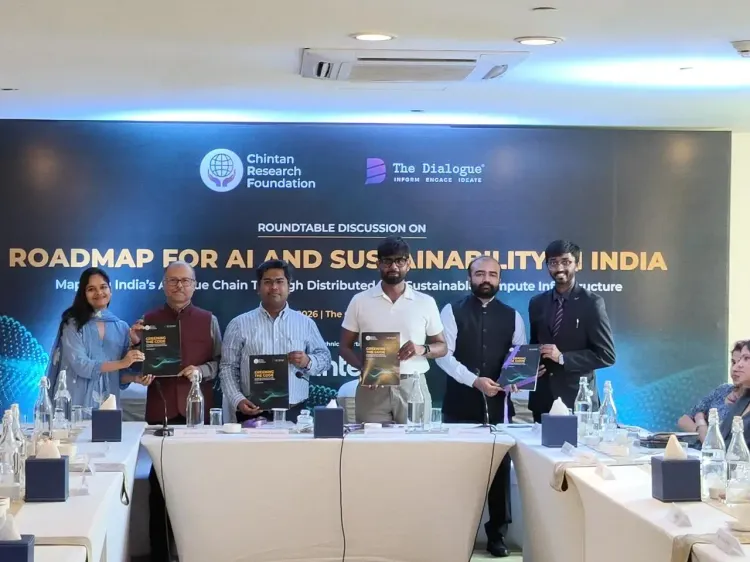
He spoke at a policy roundtable entitled “Roadmap for AI and Sustainability in India,” hosted by the Chintan Research Foundation in collaboration with The Dialogue.
Prajapati indicated that India's aspirations in AI are at a pivotal juncture, uniquely benefiting from its extensive data generation capabilities.
However, he pointed out that AI's future in India will depend not only on algorithms and applications but also on the infrastructure that enables large-scale computations, including its design, location, and sustainability.
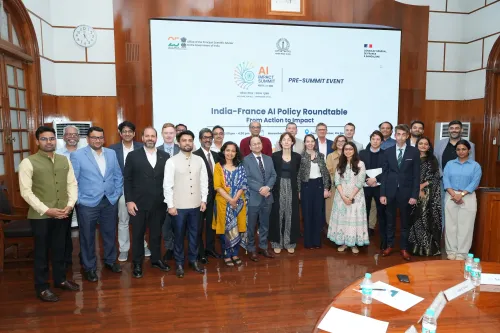
The roundtable convened policymakers, experts, and industry representatives to discuss how AI development can align with sustainability objectives. Dr. Debajit Palit, the Centre Head at the Centre for Climate Change and Energy Transition at CRF, opened the discussion by reiterating the importance of balancing energy demands with AI.
"India needs to develop a 'virtuous cycle' where AI enhances energy efficiency, and in return, energy systems sustainably facilitate the growth of AI," he commented.
Shreeppriya Gopalakrishnan, DGM Policy at IndiaAI under the Ministry of Electronics and IT, added that AI infrastructure should be regarded as an integrated ecosystem.
She highlighted that this ecosystem encompasses hardware, software, data, energy, and institutional frameworks, making it crucial to adopt a comprehensive strategy that aligns AI ambitions with real-world resource limitations.
Participants concurred that data centers and AI-capable computing resources should be recognized as strategic infrastructure rather than mere digital assets.
They underscored that such infrastructure has significant implications for energy systems, regional development, digital sovereignty, and sustained economic growth.
Simultaneously, experts identified various structural challenges that could influence India's AI trajectory, including the concentration of data centers in a limited number of metropolitan areas, restricted grid capacity, water scarcity, climate risks, and increasing energy demands. Addressing these challenges is essential for the sustainable scaling of AI throughout the nation.
Point of View
The roundtable provides a framework that could shape sustainable AI growth, vital for the nation's future.
NationPress
19 Sept 2026
Frequently Asked Questions
What is the main focus of India's AI roadmap?
The roadmap should prioritize affordability and accessibility while ensuring sustainable development.
Who organized the policy roundtable on AI and sustainability?
The roundtable was organized by the Chintan Research Foundation in collaboration with The Dialogue.
What are some challenges facing AI development in India?
Challenges include the concentration of data centers, limited grid capacity, water stress, climate risks, and rising energy demand.
Why is infrastructure important for AI in India?
Infrastructure is crucial as it supports large-scale computation, which is necessary for the effective implementation of AI technologies.
What did Dr. Debajit Palit emphasize during the roundtable?
He emphasized the need for a balance between energy demands and AI development, advocating for a 'virtuous cycle' between the two.