Anand Mahindra Calls Mumbai a Pulse, Not a Place
Synopsis
Mahindra Group chairman Anand Mahindra distilled Mumbai's identity into seven words on 25 September 2026, calling the city 'a pulse, not a place' — echoing Suketu Mehta's celebrated 'Maximum City' epithet and reframing India's financial capital as a living, circulatory force.
Key Takeaways
Mahindra Group chairman Anand Mahindra posted on 25 September 2026 : 'Maximum City Mumbai isn't a place.
It's a pulse.' The phrase 'Maximum City' was popularised by author Suketu Mehta in his 2004 book Maximum City: Bombay Lost and Found .
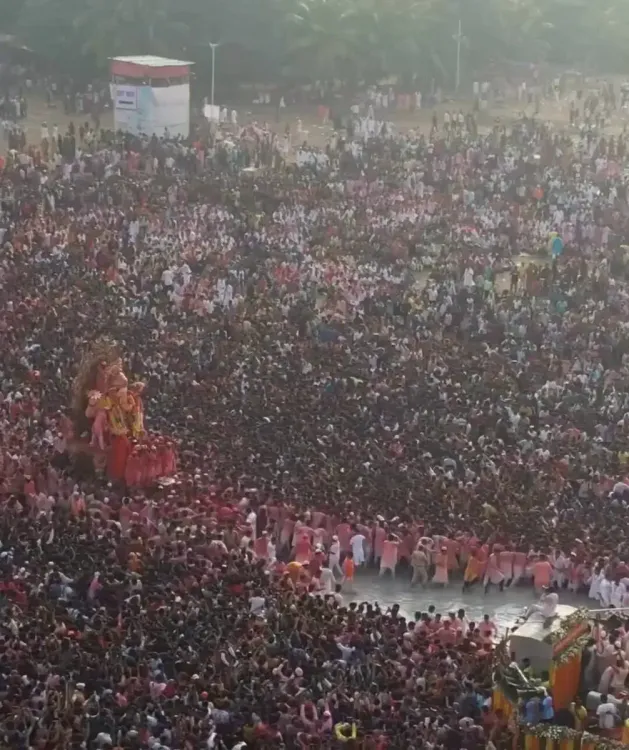
The post was accompanied by a video, extending the visual dimension of Mahindra's tribute to the city.
Mahindra's corporate base spans Maharashtra , with major Mahindra Group operations in Mumbai and Pune .
The metaphor repositions Mumbai from geography to a living, economic, and cultural force contributing roughly 6 percent of India's GDP .
It takes just seven words to capture the soul of India's most relentless city — and Mahindra Group chairman Anand Mahindra delivered them on Friday, 25 September 2026: 'Maximum City Mumbai isn't a place. It's a pulse.'
The line is a deliberate echo of Suketu Mehta's seminal 2004 nonfiction work, Maximum City: Bombay Lost and Found, which cemented the 'Maximum City' epithet in global literary consciousness. Mehta's portrait of Mumbai — its ambition, its cruelty, its impossible coexistence of wealth and squalor — gave the city a mythology to match its skyline. Mahindra's post lifts that mythology and sharpens it into a single heartbeat metaphor.
Why 'Pulse' lands harder than 'Place'
A place can be mapped, bordered, governed. A pulse cannot. By swapping one noun for the other, Mahindra reframes Mumbai not as geography but as a living, circulatory force — one that keeps India's financial engine, its film industry, its port economy, and its street-level hustle all beating in sync. The city processes roughly 6 percent of India's GDP, hosts the country's premier stock exchange, and absorbs migration from every corner of the subcontinent. That is not a place. That is, genuinely, a pulse.Mahindra, Mumbai, and the habit of urban storytelling
The Mahindra Group's own corporate roots run deep in Maharashtra, with major operations spread across Mumbai and Pune. Mahindra has long used his social media presence to narrate urban energy and cultural identity, often bypassing policy specifics in favour of the kind of sharp, image-driven observation that travels fast online. This post — paired with a video — fits that pattern precisely: short, resonant, and designed to spark a feeling rather than a debate. For a city that never quite stops arguing about its identity — Bombay versus Mumbai, cosmopolitan versus parochial, reclamation project versus heritage precinct — a seven-word post from one of its most prominent industrialists lands as both a compliment and a provocation. The pulse, after all, can race. It can falter. It never simply rests.Point of View
The chairman of a Maharashtra-rooted conglomerate reinforces the Mahindra Group's own identity as a company built on that same restless ambition. Business leaders who narrate cities well earn cultural capital that no advertising budget can replicate. The 'pulse' framing also subtly positions Mumbai — and by extension its corporate ecosystem — as a dynamic organism rather than a static market, a useful signal at a time when global investors are mapping India's urban growth story. Short posts with literary resonance generate disproportionate engagement, and Mahindra's track record on social media suggests this is strategy as much as sentiment.
NationPress
26 Sept 2026
Frequently Asked Questions
What did Anand Mahindra post about Mumbai?
On 25 September 2026, Anand Mahindra posted: 'Maximum City Mumbai isn't a place. It's a pulse.' — a seven-word tribute to the city, accompanied by a video.
What does 'Maximum City' mean for Mumbai?
'Maximum City' is a literary epithet for Mumbai popularised by author Suketu Mehta in his 2004 book Maximum City: Bombay Lost and Found , capturing the city's extreme scale, ambition, and contradictions.
Who wrote the book Maximum City about Mumbai?
Author Suketu Mehta wrote Maximum City: Bombay Lost and Found , published in 2004 , a celebrated nonfiction portrait of Mumbai that brought the phrase into global usage.
Why does Anand Mahindra post about Mumbai?
Mahindra Group's corporate roots are in Maharashtra , with significant operations in Mumbai and Pune. Mahindra frequently uses social media to highlight urban culture and national identity, and Mumbai features prominently in that narrative.
Is Mumbai really India's financial capital?
Yes. Mumbai is widely recognised as India's financial capital, home to the Bombay Stock Exchange, the Reserve Bank of India headquarters, and a concentration of corporate and banking activity that accounts for a substantial share of the national economy.