Why Did the CCPA Fine 27 Restaurants for Mandatory Service Charges?

Synopsis
In a significant move, the CCPA has penalized 27 restaurants across India for enforcing mandatory service charges, violating consumer rights. This decision emphasizes the authority's commitment to fair trade practices and consumer protection, reinforcing the need for transparency in the food service industry.
Key Takeaways
CCPA fines 27 restaurants for unfair trade practices.
Mandatory service charges are prohibited under the Consumer Protection Act.
Consumers must be informed that paying service charges is voluntary .
Restaurants are required to stop automatic additions of service charges.
CCPA emphasizes consumer rights and transparency.
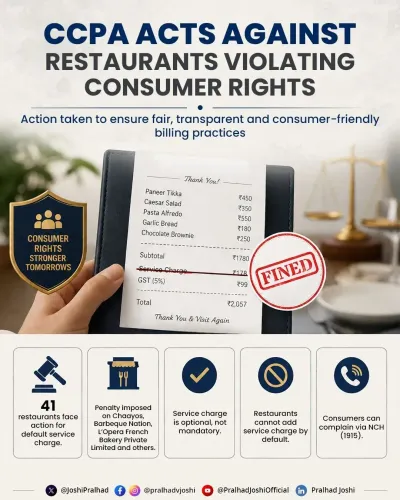
New Delhi, Jan 10 (NationPress) The Central Consumer Protection Authority (CCPA) has taken decisive action against 27 restaurants across India for infringing upon consumer rights by mandatorily enforcing service charges on food bills, as announced by the government on Saturday.
Investigations revealed that numerous restaurants were automatically adding a 10 percent service charge without consent.
This includes establishments like Cafe Blue Bottle in Patna and China Gate Restaurant Private Limited, which operates Bora Bora in Mumbai.
The authority highlighted that these actions were in direct violation of the law and the CCPA's guidelines, constituting unfair trade practices under the Consumer Protection Act, 2019.
In the case of Cafe Blue Bottle, the CCPA mandated the restaurant to refund the entire service charge to customers, cease the practice immediately, and pay a fine of Rs 30,000.
For China Gate Restaurant Private Limited in Mumbai, the restaurant refunded the service charge during the hearing. Nevertheless, the CCPA imposed a fine of Rs 50,000 and ordered the restaurant to modify its billing system to prevent automatic additions of service charges. Additionally, the restaurant was instructed to maintain an active official email ID for consumer grievance resolution, as required by law, according to an official statement.
This enforcement follows a recent ruling by the Delhi High Court on March 28, 2025, which upheld the CCPA's guidelines concerning service charges.
The court explicitly stated that restaurants are prohibited from compulsorily collecting service charges and must adhere strictly to the guidelines set forth by the consumer watchdog. It also confirmed the CCPA's full authority to enforce these regulations.
As per the CCPA guidelines issued in July 2022, restaurants are not allowed to add a service charge to the bill automatically, cannot collect it under any alternative name, and cannot coerce customers into paying it.
Consumers must be informed that paying a service charge is entirely voluntary. Restaurants are also prohibited from denying service or restricting entry if a customer opts not to pay the charge. Furthermore, service charges cannot be included in the bill and subsequently taxed with GST.
This action was instigated by complaints received on the National Consumer Helpline, backed by evidence of automatic service charge additions in bills. The CCPA confirmed that such practices are classified as unfair trade practices.
Point of View
I believe that the CCPA's actions reflect a crucial step towards safeguarding consumer rights in India. By enforcing guidelines against mandatory service charges, the authority not only protects consumers but also promotes fair trade practices within the food service sector. It is imperative that restaurants adhere to these guidelines to maintain trust and transparency with their customers.
NationPress
19 Sept 2026
Frequently Asked Questions
What prompted the CCPA to take action against these restaurants?
The CCPA acted upon complaints received on the National Consumer Helpline regarding the mandatory imposition of service charges on food bills, which is against the Consumer Protection Act.
What are the penalties imposed on the restaurants?
The penalties include fines of up to Rs 50,000, along with directives to stop the practice of automatically adding service charges and refunding customers.
Are service charges mandatory in restaurants?
According to CCPA guidelines, service charges cannot be made mandatory. Consumers must be informed that payment of such charges is voluntary.