Hyundai Motor to add 1.27 mn units capacity, launch 100+ models by 2030
Synopsis
Hyundai Motor has put a precise number on its ambitions: 1.27 million additional units of capacity, 100-plus models, and a 60% electrified sales mix — all by 2030. With 320,000 units earmarked for India and hybrids crowned the 'biggest opportunity' in the US, this is the most granular public commitment Hyundai has made in years, and a direct counter-punch to surging Chinese rivals.
Key Takeaways
Hyundai Motor plans to add 1.27 million units of global production capacity by 2030 , up from a current base of approximately 5 million vehicles .
More than 100 new and updated models are planned, including 18 all-new models .
Capacity additions include 500,000 units in North America, 320,000 in India, 200,000 in South Korea, and 250,000 via CKD production.
The company targets 60% electrified vehicle share of global sales and 50% hybrid share in North America by 2030 .
2030 operating margin target raised to above 9% ; 2026 guidance held at 6.3–7.3% .
CEO Jose Munoz called hybrids 'the biggest opportunity' in the US, with 10 new HEV models planned for North America by 2030 .
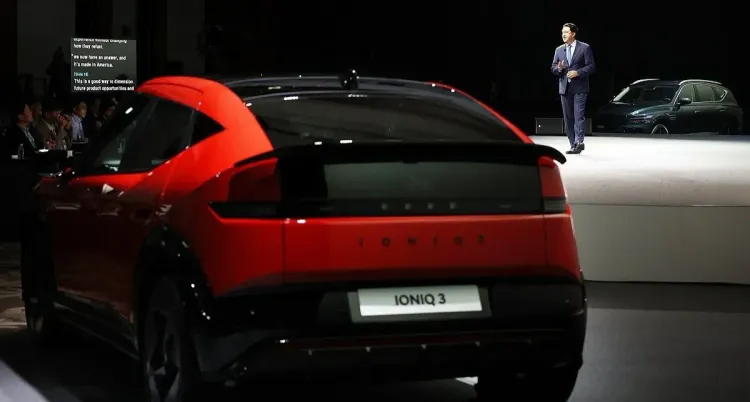
Hyundai Motor announced on Wednesday, 26 August that it plans to expand its global production capacity by 1.27 million units by 2030 and roll out more than 100 new and updated models to deepen its foothold in an increasingly competitive global automotive market. The announcement was made at the company's CEO Investor Day event in Seoul.
Capacity Expansion Targets
Hyundai Motor CEO Jose Munoz outlined a region-wise capacity build-out that takes the company's current base of approximately 5 million vehicles significantly higher. The breakdown includes 500,000 units in North America, 320,000 units in India, 200,000 units in South Korea, and 250,000 units through completely knocked-down (CKD) production. The India allocation is particularly notable, signalling Hyundai's intent to treat the subcontinent as a major manufacturing hub rather than just a growth market.
Model Lineup and Key Launches
Of the more than 100 models planned — encompassing facelifts, partial redesigns, and new variants — 18 are all-new models. Near-term launches include the Genesis GV80 hybrid, slated for South Korea and the United States later in 2025, and an extended-range electric vehicle (EREV) set for the first half of 2027. The Tucson SUV and its hybrid variants are also scheduled for release in the second half of this year.
Electrification and Hybrid Strategy
Munoz identified hybrids as 'the biggest opportunity' in the US market. Hyundai plans to launch 10 new hybrid electric vehicle (HEV) models in North America by 2030, with hybrids targeted to account for 50 percent of regional sales. Across all markets, the company aims to raise electrified vehicles to 60 percent of total global sales by 2030. To sharpen cost competitiveness, Hyundai is targeting a 20 percent reduction in raw material costs for hybrid vehicles by the same year.
Financial Targets and Margin Guidance
Hyundai maintained its global sales target of 5.55 million vehicles by 2030 and raised its operating margin target for that year to above 9 percent, up from the earlier projected range of 8–9 percent. For 2026, the company held its margin guidance at 6.3–7.3 percent, even as it flagged headwinds including US tariffs, Middle East geopolitical tensions, and intensifying competition from Chinese automakers.
Competitive Context
The investor day presentation comes as South Korean automakers face mounting pressure from aggressively priced Chinese electric vehicles in key export markets. Hyundai's strategy of doubling down on hybrids — while keeping its EV roadmap intact — reflects a pragmatic hedge: capture near-term demand where pure-EV infrastructure remains thin, while building toward a majority-electrified portfolio by decade's end. This is the most detailed public capacity roadmap Hyundai has released in several years, and it sets a clear accountability benchmark for investors tracking execution.
Point of View
000-unit India capacity target is the headline that deserves closer scrutiny: it implies Hyundai sees India not just as a volume market but as an export base, which has significant implications for domestic supply chains and employment. The raised 9% margin target for 2030, against a 6.3–7.3% guidance for 2026, also embeds a steep recovery curve that will require tariff headwinds to ease — something no automaker can fully control.
NationPress
26 Aug 2026
Frequently Asked Questions
What is Hyundai Motor's production capacity expansion plan for 2030?
Hyundai Motor plans to expand its global production capacity by 1.27 million units by 2030, taking its total base well above the current approximately 5 million vehicles. The additions span North America (500,000 units), India (320,000), South Korea (200,000), and CKD production (250,000).
How many new models will Hyundai launch by 2030?
Hyundai plans to introduce more than 100 new and updated models by 2030, including facelifts, partial redesigns, and new variants. Of these, 18 are entirely new models.
What is Hyundai's electrification target by 2030?
Hyundai aims to raise electrified vehicles — including hybrids and battery electric vehicles — to 60 percent of its total global sales by 2030. In North America specifically, the company targets hybrids at 50 percent of regional sales, backed by 10 new HEV models.
Why is Hyundai focusing heavily on hybrids?
CEO Jose Munoz identified hybrids as 'the biggest opportunity' in the US market, reflecting slower-than-expected pure-EV adoption in key regions. Hyundai also aims to cut raw material costs for hybrid vehicles by 20 percent by 2030 to sharpen price competitiveness against Chinese rivals.
What are Hyundai's financial targets for 2030?
Hyundai has raised its 2030 operating margin target to above 9 percent, up from the earlier projected range of 8–9 percent, while maintaining its global sales target of 5.55 million vehicles. For 2026, the company held its margin guidance at 6.3–7.3 percent despite headwinds from US tariffs and geopolitical tensions.