How the IBC is Reshaping Business Failure Management in India: Insights from PHDCCI

Synopsis
Discover how the Insolvency and Bankruptcy Code (IBC) is revolutionizing business failure management in India, enhancing asset recovery, and fostering investor confidence. Sanjay Singhania of PHDCCI shares insights from a recent conference discussing critical amendments and the evolving insolvency landscape.
Key Takeaways
IBC revolutionizes business failure management .
Focus on timely resolution and asset recovery .
2026 amendments introduce significant changes .
AI could enhance efficiency in insolvency processes .
Importance of Information Utilities for MSMEs .
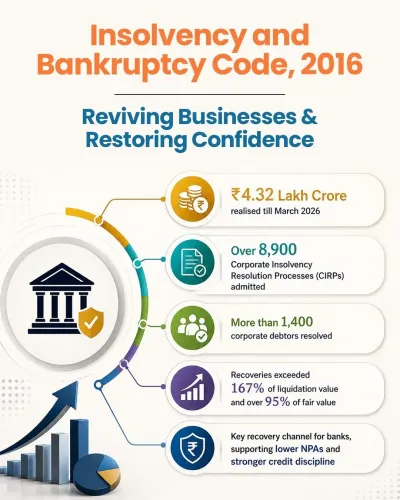
New Delhi, April 19 (NationPress) The Insolvency and Bankruptcy Code (IBC) has significantly revolutionized the management of business failures in India, facilitating prompt resolutions and enhancing asset value recovery, stated Sanjay Singhania, Vice President of the PHD Chamber of Commerce and Industry (PHDCCI), during an event on Sunday.
At the seminar titled “IBC Pulse: Trends, Transitions & Trajectories,” held at PHD House, Singhania commented on the previous delays in addressing business failures, which often resulted in a considerable decline in value.
“The IBC has redirected attention towards expeditious resolutions, fostering improved credit discipline and boosting investor trust,” he remarked.
Nonetheless, he emphasized the necessity for increased speed, adaptability, and a stronger focus on value preservation and business revival.
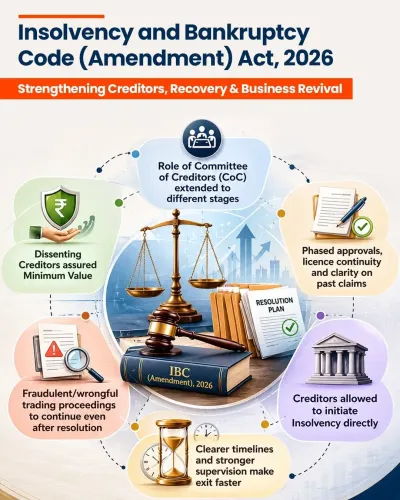
The event highlighted the newly enacted Insolvency and Bankruptcy Code (IBC) Amendment Act, 2026, gathering policymakers, legal experts, and industry leaders to discuss the evolving insolvency landscape in India.
Justice Rakesh Kumar Jain, former Judicial Member of the National Company Law Appellate Tribunal (NCLAT), outlined the progression of insolvency legislation in India, underscoring the shift from a fragmented approach to a cohesive, creditor-oriented system under the IBC.
“The 2026 amendment is designed to minimize delays and bolster creditor confidence, introducing features like group insolvency and cross-border frameworks,” he added.
Ashok Kumar Bhardwaj, Judicial Member at the National Company Law Tribunal (NCLT), highlighted that insolvency laws must continually adapt to reflect the changing economic landscape.
He reiterated that the primary goal of the IBC should be resolution and value maximization, not merely collection.
Furthermore, Chetan Sharma underscored the vital role of time in insolvency cases, warning that delays unavoidably diminish asset values.
He proposed the integration of AI-driven pre-litigation mediation techniques to expedite processes and enhance operational efficiency.
RJR Kasibhatla detailed key aspects of the 2026 amendments, including provisions for reasoned orders, cross-border insolvency, group insolvency, and penalties for frivolous litigation.
He portrayed the IBC as a contemporary legal framework that aligns with the demands of a globalized economy.
Meanwhile, Debajyoti Ray Chaudhuri, Managing Director and CEO of National E-Governance Services Limited (NeSL), emphasized the significance of Information Utilities in enhancing transparency and minimizing delays by providing authenticated records of defaults, which is particularly advantageous for MSMEs.
Point of View
Reflecting a proactive approach to address economic challenges.
NationPress
18 Sept 2026
Frequently Asked Questions
What is the Insolvency and Bankruptcy Code (IBC)?
The IBC is a legal framework in India that provides a structured process for resolving insolvency and bankruptcy issues, aimed at timely resolution and maximizing asset value.
What are the key features of the IBC Amendment Act, 2026?
The 2026 amendment introduces provisions for group insolvency, cross-border frameworks, and aims to reduce delays while enhancing creditor confidence.
Why is the IBC important for businesses?
The IBC facilitates faster resolutions of business failures, helping preserve asset value and restore investor confidence, which is crucial for economic stability.
How can AI improve insolvency proceedings?
AI can streamline pre-litigation mediation processes, reducing delays and improving efficiency in handling insolvency cases.
What role do Information Utilities play in insolvency?
Information Utilities enhance transparency by providing authenticated records of defaults, which can significantly benefit small and medium enterprises (MSMEs).