India's airport capacity tops 580 mn passengers annually: Parliament

Synopsis
India's airports can now handle 580 million passengers a year — but only 420 million actually flew in 2025-26. With 25 greenfield projects approved, 14 already operational, and airlines sitting on orders for 2,056 aircraft, the infrastructure build-out is running ahead of demand. The real question is whether that gap closes fast enough to justify the capital deployed.
Key Takeaways
India's total airport passenger handling capacity has crossed 580 million per year , as disclosed in Parliament on 3 August .
Actual passenger traffic in 2025-26 stood at approximately 420 million , leaving a buffer of around 160 million .
The country has 166 operational airports ; in-principle approval has been granted for 25 greenfield projects , of which 14 are already operational .
Indian airlines currently operate 860 aircraft and have placed orders for 2,056 more , with 427 already delivered .
11 scheduled and scheduled commuter airlines are presently operating in India, according to Civil Aviation Minister K Rammohan Naidu .
India's airport passenger handling capacity has crossed 580 million passengers per year, the government disclosed in Parliament on Monday, 3 August, marking a significant milestone in the country's civil aviation infrastructure push. The figure was shared by Minister of State for Civil Aviation Murlidhar Mohol in a written reply to the Rajya Sabha.
Capacity Outpaces Current Traffic
According to Mohol, airports across India can now collectively handle more than 580 million passengers annually, against actual passenger traffic of approximately 420 million recorded during the 2025-26 financial year. The surplus capacity — roughly 160 million passengers — is designed to absorb projected growth in both domestic and international air travel and ease congestion at high-traffic hubs.
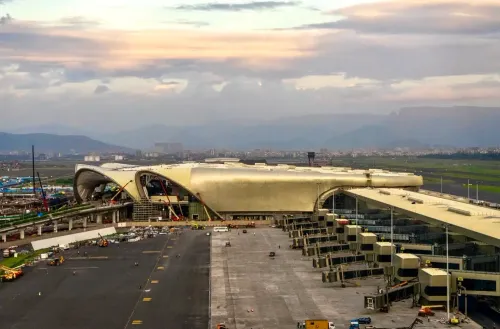
The minister attributed the capacity expansion to continuous modernisation and upgradation efforts by the Airports Authority of India (AAI) and private airport operators. Projects were greenlit based on traffic growth projections, airline demand, operational requirements, financial viability, and techno-economic assessments.
Greenfield Airports and Regional Connectivity
India currently operates 166 airports across the country. To further deepen aviation reach, the Centre has granted in-principle approval for 25 greenfield airport projects. Of these, 14 have already become operational, reflecting a deliberate policy focus on regional connectivity and last-mile air access.
This is part of a broader infrastructure drive that has seen airport numbers grow substantially over the past decade, particularly in Tier-2 and Tier-3 cities that were previously underserved by commercial aviation.
Fleet Expansion and Airline Landscape
In a separate written reply to the Upper House, Civil Aviation Minister K Rammohan Naidu confirmed that 11 scheduled and scheduled commuter airlines are currently operating in India. He reaffirmed the government's commitment to fostering a competitive environment that supports both the scaling of existing carriers and the entry of new players.
Indian airlines presently operate a combined fleet of 860 aircraft. Carriers have placed firm orders for 2,056 additional aircraft, of which 427 have already been delivered. The remaining jets are expected to be inducted in phases, subject to fleet expansion strategies, market conditions, supply chain constraints, and aircraft availability.
What This Means for Indian Aviation
The capacity buffer is notable: with 580 million in handling capacity against 420 million in actual traffic, India has headroom to absorb near-term demand surges without the bottlenecks that have historically plagued major hubs like Mumbai and Delhi. Notably, the pending induction of 1,629 aircraft from existing orders signals that airlines are betting on sustained demand growth — a trajectory that will test whether infrastructure keeps pace with fleet expansion over the next decade.
Point of View
It suggests India has learned from the congestion crises of the 2010s and is building ahead of the curve. On the other, greenfield airports in smaller cities have historically struggled with viability — several AAI-operated regional airports run at a fraction of capacity while requiring operating subsidies. The more telling number may be the 1,629 undelivered aircraft still on order: if supply-chain delays persist and demand softens, airlines could face a capacity overhang that squeezes yields. Parliament was told what was built; what it was not told is how many of those 14 greenfield airports are commercially self-sustaining.
NationPress
17 Sept 2026
Frequently Asked Questions
What is India's current airport passenger handling capacity?
India's airports can collectively handle more than 580 million passengers annually, according to a written reply submitted to the Rajya Sabha on 3 August. This compares to actual passenger traffic of around 420 million in the 2025-26 financial year.
How many airports does India currently have?
India has 166 operational airports as of the government's latest disclosure to Parliament. Additionally, in-principle approval has been granted for 25 greenfield airport projects, of which 14 have already become operational.
How many aircraft are Indian airlines ordering?
Indian airlines have placed orders for 2,056 aircraft in total, of which 427 have already been delivered. The remaining aircraft will be inducted in phases depending on market conditions, fleet strategies, and supply chain factors.
Which body oversees airport expansion in India?
The Airports Authority of India (AAI), along with private airport operators, is responsible for expanding and modernising airport infrastructure. Projects are approved based on traffic growth, airline demand, financial viability, and techno-economic assessments.
How many airlines operate in India currently?
Eleven scheduled and scheduled commuter airlines are currently operating in India, Civil Aviation Minister K Rammohan Naidu told the Rajya Sabha. The government has stated its commitment to enabling both existing carrier growth and new entrants into the sector.