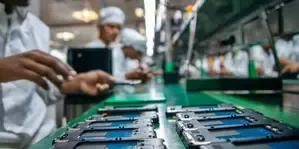
India set to hit 20% of global smartphone output within 2 years: Report

Synopsis
India has quietly captured 18% of global smartphone production — and analysts say it could hit one-fifth within two years. The China-plus-one strategy, accelerated by pandemic disruptions and geopolitical pressure, is redrawing the world's electronics map, with India and Vietnam emerging as the clearest winners.
Key Takeaways
India accounted for approximately 18 per cent of global smartphone production as of 2025 , up from a marginal share a decade ago.
Analysts expect India's share to reach 20 per cent — one-fifth of global output — within the next one to two years , per the One World Outlook report.
China retained the largest share at an estimated 63 per cent of global smartphone production.
China, India, and Vietnam together accounted for more than 90 per cent of global smartphone output by 2025.
The shift is driven by the 'China-plus-one' strategy, accelerated by pandemic supply-chain disruptions, tariffs, and geopolitical tensions.
India's rise marks a structural pivot from its traditional identity as a services and IT economy toward high-value electronics manufacturing.
India is on course to account for nearly one-fifth of the world's smartphone production within the next one to two years, according to the One World Outlook report released on 21 August. The projection underscores India's rapid transformation from a services-dominated economy into a serious contender in global electronics manufacturing.
The China-Plus-One Shift
For over a decade, China was the undisputed centre of global smartphone manufacturing, at its peak producing more than two-thirds of the world's handsets. That dominance was underpinned by a dense supplier ecosystem, mature port and power infrastructure, and a large skilled workforce.
The Covid-19 pandemic, however, exposed the risks of concentrating production in a single geography. Factory shutdowns and port disruptions cascaded across global supply chains, prompting manufacturers to reassess their strategies. Subsequent tariff measures and export controls on critical technologies accelerated that rethink, giving rise to the widely adopted 'China-plus-one' approach — diversifying production into additional Asian economies to reduce single-country dependency.
Where Production Has Moved
As companies began executing the China-plus-one strategy, India and Vietnam emerged as the primary beneficiaries. By 2025, the three markets — China, India, and Vietnam — together accounted for more than 90 per cent of global smartphone production, according to the report, reflecting a high concentration of manufacturing within a narrow geography even as diversification accelerated.
China retained the largest share at an estimated 63 per cent, but India's share climbed to approximately 18 per cent. Analysts cited in the report expect India's share to rise further, potentially crossing the 20 per cent threshold within the next year or two.
India's Manufacturing Pivot
The trajectory marks a structural shift in India's economic identity. Traditionally recognised for its strengths in information technology, software services, and business process outsourcing, India has increasingly repositioned itself as a destination for high-value electronics and smartphone assembly. Government incentive frameworks — including production-linked schemes — have played a role in attracting global original equipment manufacturers to expand or establish facilities in the country.
Notably, India's rise in smartphone manufacturing comes at a moment when geopolitical tensions between the United States and China continue to reshape global trade flows, making supply-chain diversification a strategic imperative rather than a purely commercial one for many multinationals.
What Comes Next
Reaching and sustaining a 20 per cent global share will require India to deepen its domestic components ecosystem — currently, a significant portion of inputs is still imported. Infrastructure gaps in logistics and power reliability remain areas flagged by industry observers. The pace at which India can localise component supply will likely determine whether its smartphone manufacturing share continues to climb or plateaus in the medium term.
Point of View
Meaning the value addition remains shallow compared to China's vertically integrated ecosystem. The China-plus-one narrative has been good for India's assembly lines; it has not yet been transformative for India's components industry. Crossing 20 per cent is achievable. Building the supplier depth to defend and grow that share beyond the next geopolitical cycle is the real test — and one that current policy frameworks have only partially addressed.
NationPress
21 Aug 2026
Frequently Asked Questions
What share of global smartphone production does India currently hold?
India held approximately 18 per cent of global smartphone production as of 2025, according to the One World Outlook report. Analysts expect this to rise to around 20 per cent — one-fifth of global output — within the next one to two years.
What is the 'China-plus-one' strategy and how has it benefited India?
The China-plus-one strategy refers to the practice of global manufacturers diversifying production into at least one country beyond China to reduce supply-chain risk. India has been a primary beneficiary, with its smartphone production share growing significantly as companies sought alternatives following pandemic disruptions, rising tariffs, and geopolitical tensions.
How much of global smartphone production does China still control?
China retained an estimated 63 per cent share of global smartphone production as of 2025, making it still the dominant player. However, its share has declined from a peak of more than two-thirds as production diversified to India and Vietnam.
Which countries dominate global smartphone manufacturing?
China, India, and Vietnam together accounted for more than 90 per cent of global smartphone production by 2025, according to the One World Outlook report. China leads with 63 per cent, followed by India at around 18 per cent.
What challenges does India face in growing its smartphone manufacturing share further?
India's primary challenge is deepening its domestic components ecosystem, as a significant share of manufacturing inputs is still imported. Logistics infrastructure and power reliability have also been flagged as areas requiring improvement before India can sustainably defend or grow its global production share.