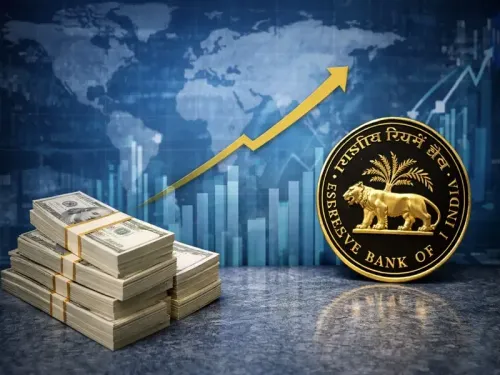
India's forex reserves at $780.78 billion as of September 11, RBI data shows
Synopsis
India's forex reserves touched a record $785.71 billion on 4 September before easing slightly to $780.78 billion the following week. The near-$95 billion build-up since end-March signals strong capital inflows and gives the RBI substantial firepower to defend the rupee against global headwinds — a critical buffer as the Fed's rate path keeps dollar volatility elevated.
Key Takeaways
India's foreign exchange reserves stood at $780.78 billion in the week ended 11 September 2026 , per RBI data.
Reserves had hit a record $785.71 billion in the week ended 4 September , driven by a single-week surge of $44.90 billion .
Foreign currency assets (FCA) , the largest component, stood at $648.17 billion as of 4 September .
Gold reserves were valued at $113.816 billion — $23.517 billion above year-ago levels.
Overall reserves have risen by $94.599 billion since end- March 2026 and are $87.438 billion above year-ago levels.
India's foreign exchange reserves stood at $780.78 billion in the week ended 11 September 2026, according to data released by the Reserve Bank of India (RBI) on Friday. The figure marks a slight retreat from the record high of $785.71 billion logged in the previous week ended 4 September, which had been driven by a sharp single-week surge of $44.90 billion.
Record High and Recent Trajectory
The 4 September peak of $785.71 billion represented India's highest-ever forex reserves. Before that milestone, reserves had climbed by $11.47 billion in the week ended 28 August to reach $740.80 billion. Overall, reserves have risen by $94.599 billion since the end of March 2026 and stand $87.438 billion above year-ago levels, reflecting sustained capital inflows and RBI intervention activity.
Breakdown of Reserve Components
Foreign currency assets (FCA) — the largest component of India's reserves — stood at $648.17 billion as of 4 September. FCA had surged by $47.498 billion in that week alone, and were $95.886 billion higher than at end-March and $63.692 billion above the year-ago level. Gold reserves were valued at $113.816 billion as of 4 September — $23.517 billion above their level a year earlier, though still $1.580 billion below end-March levels, reflecting gold price movements during the period.
India's Special Drawing Rights (SDRs) with the International Monetary Fund (IMF) stood at $18.806 billion as of 4 September, up $184 million from end-March and $64 million above year-ago levels. The country's reserve position with the IMF came in at $4.916 billion, having risen marginally during the same week — $108 million above end-March and $168 million above year-ago levels.
Why the Reserves Buffer Matters
A robust reserve position gives the RBI firepower to intervene in currency markets and cushion the Indian rupee against sharp swings triggered by global risk-off episodes. At $780.78 billion, India's reserves comfortably cover more than 10 months of projected import requirements — a metric watched closely by rating agencies and sovereign debt investors. This comes amid renewed volatility in global financial markets driven by US dollar strength, fluctuating crude oil prices, and shifting expectations around Federal Reserve rate policy.
Context and Outlook
The near-$95 billion rise in reserves since end-March 2026 signals that India has been on the receiving end of strong portfolio and foreign direct investment inflows this financial year. Notably, the RBI has also been an active buyer of gold, with holdings remaining significantly elevated year-on-year despite the marginal dip from end-March. Analysts will watch whether the slight pullback in the week ended 11 September continues or whether reserves resume their upward trajectory in the coming weeks, particularly as global central banks navigate a shifting rate environment.
Point of View
But the more telling number is the $94.6 billion build since end-March — that pace of accumulation suggests the RBI has been actively mopping up dollar inflows to keep the rupee from appreciating too sharply, even as it signals balance-of-payments comfort. The slight pullback from the $785.71 billion record in a single week is worth watching: if global risk-off resumes and FII equity flows reverse, the RBI may shift from accumulation to defence mode quickly. India's gold holding strategy also deserves scrutiny — at $113.8 billion, gold now represents a meaningful share of total reserves, and any sharp correction in bullion prices would dent the headline number without any underlying change in the external position.
NationPress
18 Sept 2026
Frequently Asked Questions
What are India's current foreign exchange reserves?
India's foreign exchange reserves stood at $780.78 billion in the week ended 11 September 2026, according to RBI data released on Friday. This is slightly below the record high of $785.71 billion reached in the previous week ended 4 September.
Why did India's forex reserves hit a record in early September 2026?
Reserves surged to a record $785.71 billion in the week ended 4 September 2026, driven by a sharp single-week increase of $44.90 billion, largely reflecting strong foreign currency asset inflows. The build-up of $94.599 billion since end-March points to sustained capital inflows and RBI accumulation activity.
What are the main components of India's forex reserves?
India's forex reserves comprise foreign currency assets (FCA), gold reserves, Special Drawing Rights (SDRs) with the IMF, and the country's reserve position with the IMF. As of 4 September, FCA stood at $648.17 billion, gold at $113.816 billion, SDRs at $18.806 billion, and the IMF reserve position at $4.916 billion.
Why do large forex reserves matter for India?
A large reserve buffer allows the RBI to intervene in currency markets and stabilise the rupee during periods of global volatility. At over $780 billion, India's reserves cover more than 10 months of projected imports — a level that strengthens sovereign credit standing and reduces vulnerability to external shocks.
How much have India's forex reserves grown since March 2026?
India's forex reserves have risen by $94.599 billion since end-March 2026 and are $87.438 billion higher than a year earlier, as of 4 September 2026, reflecting strong inflows and central bank accumulation through the financial year.