India Needs 8% Growth for 2 Decades: World Bank Expert
Synopsis
A World Bank expert warned at Washington's New India Conference that India must grow at 8% annually for 20 years to hit its economic targets — but skilling gaps, low female workforce participation, and uneven state-level governance remain the real barriers standing between ambition and reality.
Key Takeaways
India must sustain a minimum 8% annual GDP growth rate for two decades to become the world's third-largest economy by 2030 , per World Bank expert Hemang Jani .
Skills gaps, underemployment, and low female workforce participation were identified as the most critical binding constraints on India's long-term growth potential.
US-India bilateral trade has surged from $50 billion to $212 billion without a formal trade agreement, reflecting strong organic economic momentum.
Global supply chain shifts away from China are creating a strategic window for India, but experts warn the opportunity is time-sensitive and depends on reform pace.
Ashok Malik of The Asia Group noted India's trade strategy has been recalibrated after earlier agreements exposed vulnerabilities to cheap imports via China-linked supply chains.
State-level governance — particularly on power, labour flexibility, and land access — will be the decisive factor in converting India's growth narrative into actual investment, per CSIS analyst Richard Rossow .
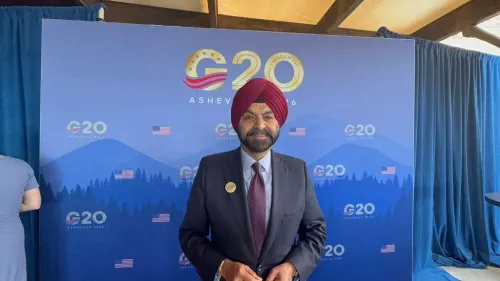
Washington, April 23 — India must sustain a minimum 8 percent economic growth rate for at least two decades and urgently bridge its skills and workforce gaps to realise its ambition of becoming the world's third-largest economy by 2030, a senior World Bank policy expert warned at the New India Conference in Washington, D.C. The assessment, delivered on April 23, underscores that while India holds a structurally advantageous global position, its long-term trajectory depends heavily on human capital investment and regulatory predictability.
World Bank Expert Flags Skilling Crisis as Core Challenge
Hemang Jani, Public Policy and Governance Expert at the World Bank and former Officer on Special Duty (OSD) to the Prime Minister's Office, said India remains the world's fastest-growing major economy but faces binding structural constraints that could limit its potential if left unaddressed.
"India's potential is immense, but so are the challenges," Jani said, pointing to unemployment, underemployment, and skilling gaps as the most critical bottlenecks. He emphasised that workforce participation — particularly among women — remains a significant drag on productivity and growth potential.
He called for "very definitive investments in human capital" alongside improvements in "regulatory predictability," arguing that without these, even a favourable demographic dividend could become a demographic liability. India's labour force participation rate for women remains among the lowest in Asia, hovering around 25-30 percent according to World Bank data — a stark contrast to peer economies like Bangladesh and Vietnam.
US-India Trade: From $50 Billion to $212 Billion — And Counting
Nisha Biswal, Partner at The Asia Group and former US Assistant Secretary of State for South and Central Asian Affairs, highlighted the dramatic expansion of bilateral economic ties, noting that two-way trade has surged from $50 billion to approximately $212 billion — achieved without a formal trade agreement between the two nations.
"This is India's moment on the economic space," Biswal said, describing how shifting global supply chains and strategic concerns over over-dependence on China are accelerating corporate interest in India. Businesses worldwide are now actively evaluating "what does a de-risking from China look like," she noted, with India's large domestic market and deep talent pool emerging as decisive advantages.
On the prospects of a formal US-India trade agreement, Biswal suggested it is likely to materialise in phases rather than as a sweeping comprehensive pact — a realistic assessment given the complexity of aligning two of the world's most politically sensitive trade ecosystems.
India's Trade Recalibration: Protecting Domestic Manufacturing
Ashok Malik, Partner and Chair of India Practice at The Asia Group, provided critical context on why New Delhi has grown cautious about broad-based free trade agreements. He noted that earlier trade deals exposed Indian industries to an influx of cheap consumer goods linked to China-connected supply chains, prompting a strategic rethink.
"That did cause a recalibration of approach to trade," Malik said, explaining that India is now pursuing agreements that simultaneously support domestic manufacturing and protect sensitive sectors — a dual mandate that has complicated negotiations with Washington. "The search for a maximalist trade agreement is coming in the way of a very workable arrangement," he cautioned, suggesting both sides need to lower their ambitions to unlock near-term gains.
This tension is not new. India's withdrawal from the Regional Comprehensive Economic Partnership (RCEP) in 2019 was driven by similar concerns about Chinese goods flooding Indian markets through backdoor routes — a decision that drew both praise and criticism but set the template for India's current trade posture.
State-Level Reforms: The Make-or-Break Factor for Investment
Richard Rossow, Senior Adviser and Chair on India and Emerging Asia Economics at CSIS (Center for Strategic and International Studies), shifted the lens to subnational governance, arguing that Indian states — not the central government alone — will ultimately determine whether foreign and domestic investment flows translate into sustained growth.
"States run the country," Rossow said bluntly, noting that corporate investment decisions hinge on access to reliable power, labour flexibility, land, and water. These practical factors, he said, form the "first 20 slides" in any serious corporate site-selection process — a reminder that macro-level policy announcements mean little without consistent execution at the state level.
This is a critical insight often buried in national-level economic discourse. States like Tamil Nadu, Karnataka, Gujarat, and Maharashtra have historically attracted disproportionate shares of foreign direct investment precisely because of superior infrastructure and governance predictability — while several large northern and eastern states continue to lag despite significant central government transfers.
The Bigger Picture: India's Structural Moment and Its Risks
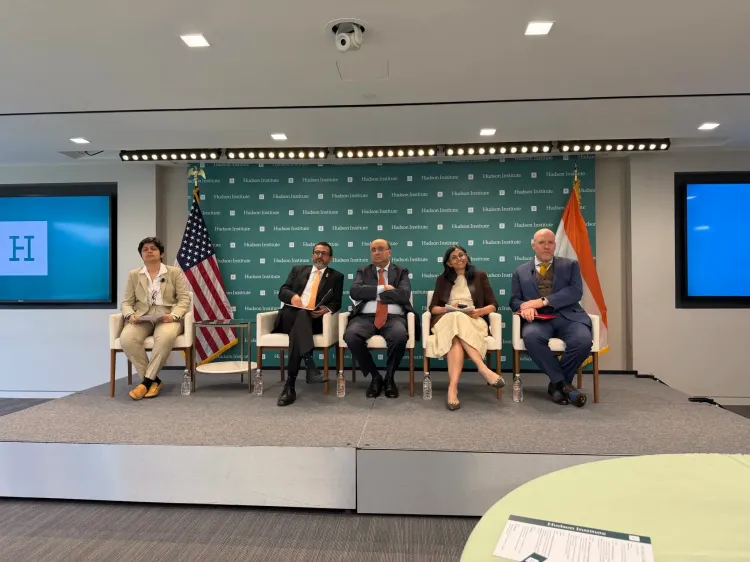
The New India Conference, moderated by Aparna Pande, Senior Fellow at Hudson Institute, brought together policymakers and analysts to assess India's economic trajectory amid a volatile global environment marked by supply chain realignments, geopolitical tensions, and US-China strategic competition.
India has made measurable strides — expanding physical infrastructure, scaling digital public infrastructure through platforms like UPI and Aadhaar, and growing manufacturing capacity under initiatives like Production Linked Incentive (PLI) schemes. Yet the experts' consensus was clear: structural reforms in skilling, labour markets, and state-level governance remain the unfinished agenda that will define whether India's 2030 and 2047 ambitions are realised or remain aspirational.
As India navigates its next phase of economic ascent, the coming months will be pivotal — with ongoing US-India trade framework negotiations, the Union Budget cycle, and state-level investment summits all serving as near-term tests of whether reform rhetoric translates into measurable outcomes on the ground.
Point of View
Yet its most critical constraints are entirely self-inflicted — poor skilling infrastructure, chronically low female labour force participation, and wildly uneven state-level governance. The irony is sharp: India doesn't need the world to change for it to succeed, it needs its own states to deliver reliable power and predictable policy. Until New Delhi stops measuring success by announcements and starts measuring it by outcomes in districts and factory floors, the gap between India's potential and its performance will remain the defining story of this decade.
NationPress
15 Sept 2026
Frequently Asked Questions
Why does India need 8% GDP growth for two decades?
India needs sustained 8% annual GDP growth for at least 20 years to achieve its goal of becoming the world's third-largest economy by 2030 and a developed nation by 2047. According to World Bank expert Hemang Jani, anything below this threshold risks leaving India's economic ambitions unfulfilled given its large population and development needs.
What are the biggest challenges to India's long-term economic growth?
Experts at the New India Conference in Washington identified skills gaps, unemployment, underemployment, and low female workforce participation as the primary binding constraints on India's growth. Regulatory unpredictability and inconsistent state-level governance were also flagged as major deterrents to investment.
How much has US-India trade grown in recent years?
US-India two-way trade has grown from approximately $50 billion to around $212 billion, according to Nisha Biswal of The Asia Group. This growth has occurred without a formal bilateral trade agreement, highlighting the strength of organic economic ties between the two nations.
Will the US and India sign a trade agreement soon?
A comprehensive US-India trade agreement is unlikely in the near term, according to experts. Analysts suggest it may emerge as a phased or partial arrangement first, given differences over scope and India's strategic priority of protecting domestic manufacturing sectors.
Why are Indian states important for attracting foreign investment?
Indian states control critical factors that businesses prioritise — including reliable power supply, labour law flexibility, and access to land and water — making state-level governance a decisive variable in investment decisions. CSIS expert Richard Rossow noted these factors dominate corporate site-selection processes above all else.