India's Strategic Energy Expansion Focuses on Innovation and Collaboration

Synopsis
As India gears up for a major shift in its energy landscape, Union Minister Dr. Jitendra Singh reveals ambitious plans for clean energy. With investments nearing $100 billion and advancements in green hydrogen and nuclear energy, the country is set to become a global leader in sustainable solutions.
Key Takeaways
India's energy strategy focuses on innovation and collaboration.
Aim for nearly $100 billion in oil and gas investments.
Expansion of nuclear energy to reach 100 GW by 2047.
Significant advancements in green hydrogen production.
Development of Small Modular Reactors for flexible energy solutions.
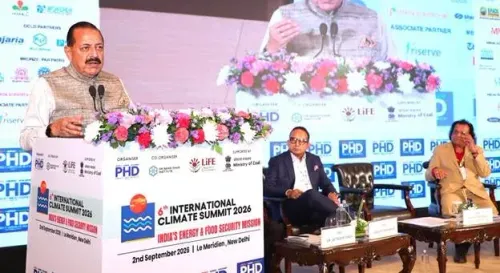
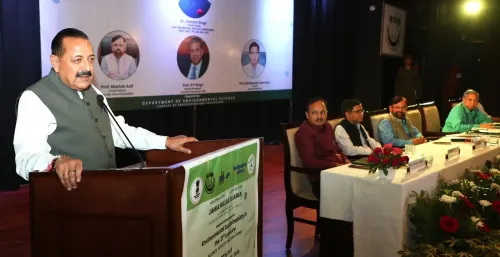
New Delhi, April 16 (NationPress) India is progressively establishing itself as a significant contender in the global clean energy sector, leveraging a well-balanced combination of policy support, technological advancement, and industry collaboration, stated Union Minister of State Dr. Jitendra Singh on Thursday.
The minister emphasized that the nation is advancing in green hydrogen production, enhancing its nuclear energy capabilities, and bolstering renewable energy sources, while simultaneously fostering domestic expertise in critical technologies such as electrolysers.
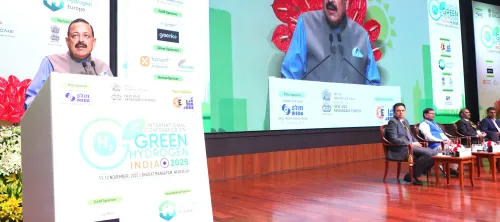
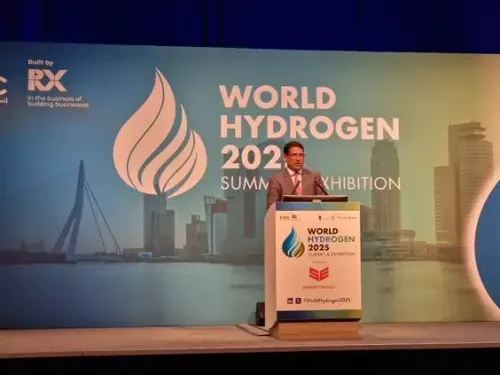
While addressing the World Hydrogen Energy Summit and the World Petrocoal Congress, Dr. Singh articulated that India's strategy is centered around developing a resilient and self-sufficient ecosystem, underpinned by increased research funding and innovation-driven growth.
The country is adopting a comprehensive strategy that merges energy security with sustainability.
According to Dr. Singh, India aims to attract nearly $100 billion in investments in the oil and gas sector, expand exploration areas to 1 million square kilometers, and elevate the share of natural gas in its energy portfolio to 15 percent.
India's refining capacity is on the rise, positioning it among the leading nations worldwide.
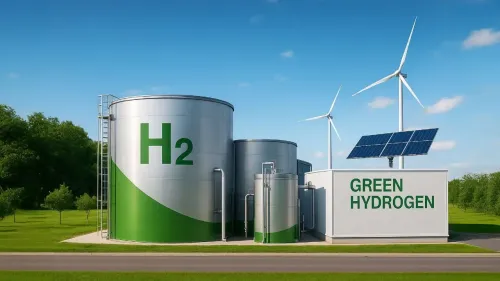
On the topic of the clean energy transition, Dr. Singh noted that the National Green Hydrogen Mission, with a budget allocation of Rs 19,744 crore, has catapulted India to the forefront of developing alternative fuel ecosystems.
He remarked that green hydrogen is set to be pivotal in decarbonizing hard-to-abate sectors like steel and cement, while initiatives are being undertaken to lower production costs through local manufacturing and innovation.
Dr. Singh also reported advancements in India's nuclear energy initiative, highlighting the recently launched Nuclear Energy Mission, which aspires to achieve 100 GW of nuclear power capacity by 2047.
He mentioned that India is entering a new phase of its nuclear program, showcasing indigenous technological innovations, which places it among a select group of nations.
India is planning to construct five Small Modular/Small Reactors by 2033, with work already in progress on three of them. This includes a Bharat Small Modular Reactor (SMR), a Bharat Small Reactor (BSR) based on established heavy water technology, and a small-scale hydrogen-linked reactor with a few megawatts of capacity. These reactors aim to provide flexible, scalable, and decentralized clean energy solutions while also supporting emerging hydrogen applications.
Point of View
India's proactive approach to expanding its energy capabilities through innovation and collaboration demonstrates a strong commitment to sustainability and energy security. This multifaceted strategy not only addresses current energy needs but also positions the country favorably in the global clean energy arena.
NationPress
19 Sept 2026
Frequently Asked Questions
What is the National Green Hydrogen Mission?
The National Green Hydrogen Mission aims to develop alternative fuel ecosystems in India, with a significant budget allocation of Rs 19,744 crore.
How much investment is India targeting in the oil and gas sector?
India is targeting nearly $100 billion in investments within the oil and gas sector.
What is the goal for India's nuclear power capacity by 2047?
India aims to achieve 100 GW of nuclear power capacity by the year 2047.
What are Small Modular Reactors?
Small Modular Reactors are advanced nuclear reactors designed for flexibility and scalability, contributing to decentralized clean energy solutions.
What role does green hydrogen play in India's energy strategy?
Green hydrogen is crucial for decarbonizing hard-to-abate sectors like steel and cement and is a key component of India's clean energy transition.