India's female workforce participation hits 40% on Labour Day 2025, social cover at 64%

Synopsis
India's female labour force participation has nearly doubled in seven years — from 23.3% in 2017–18 to 40% in 2025 — with rural India leading the charge. Social protection coverage has jumped from 19% to 64% in a decade. The numbers signal a structural shift, but the quality and durability of these jobs remain the key unanswered question.
Key Takeaways
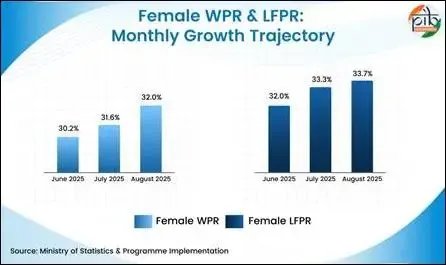
Female labour force participation rose from 23.3% in 2017–18 to 40% in 2025, according to the Periodic Labour Force Survey .
Social protection coverage expanded from 19% in 2015 to over 64% in 2025.
Over 10 crore women households have been mobilised into self-help groups under DAY-NRLM .
The Lakhpati Didi programme targets women entrepreneurs earning over ₹1 lakh annually through credit and skills access.
India's startup ecosystem has over 2.2 lakh recognised startups with more than 1 lakh having at least one woman director.
A new ESIC hospital in Budgam, J&K will serve over 50,000 workers and their families.
India's female labour force participation rate has climbed to 40 per cent in 2025, up sharply from 23.3 per cent in 2017–18, while social protection coverage has expanded from roughly 19 per cent in 2015 to over 64 per cent in 2025, the government announced on Friday, 1 May 2025, on the occasion of International Labour Day. The figures, drawn from the Periodic Labour Force Survey (PLFS), mark what officials describe as a broad-based structural shift in how Indian women engage with formal economic activity.
Key Labour Market Gains for Women
According to the government statement, women are increasingly engaged in income-generating activities, local enterprises, and leadership roles. Rural India has been the primary driver of this change, with officials noting that women are now participating "not just as occasional contributors, but as consistent economic participants."
The rise in female participation, the statement said, reflects a broader expansion of employment opportunities and a steady movement towards formalisation in the labour market — a trend that has been building since the mid-2010s but appears to have accelerated in the post-pandemic period.
Social Protection and Worker Healthcare
The government's expanded social protection push is also reflected in the strengthening of healthcare infrastructure under the Employees' State Insurance (ESI) Scheme. A recently inaugurated ESIC hospital in Budgam, Jammu and Kashmir, is expected to serve over 50,000 workers and their families, improving access to medical care in a region that has historically had limited formal worker welfare infrastructure.
Expanded access to provident fund, insurance, and healthcare has been especially significant for women, who are disproportionately represented in informal employment. Officials noted that bringing women into the formal social security net has been a stated policy priority across recent budget cycles.
Rural Entrepreneurship and Self-Help Groups
Across rural India, women are reportedly moving beyond traditional roles into entrepreneurship at an unprecedented scale. Under the Deendayal Antyodaya Yojana–National Rural Livelihoods Mission (DAY-NRLM), over 10 crore women households have been mobilised into self-help groups (SHGs).
What began as a financial inclusion pathway has evolved into a network of micro-enterprises, according to the government, "where women are producing, managing, and selling, often becoming primary earners within their households." The Lakhpati Didi programme has sought to enable crores of women entrepreneurs to earn over ₹1 lakh annually, with expanded access to credit, skills, and market linkages.
Startups and Women in Leadership
India's startup ecosystem now comprises over 2.2 lakh recognised startups that have collectively created more than 23.3 lakh jobs. Notably, over 1 lakh startups have at least one woman director — a figure the government cited as evidence of growing female presence in high-growth economic sectors.
This comes amid broader global conversations about gender parity in the workforce, where India's trajectory — particularly the rural-led surge — stands out as a data point worth scrutiny and, if sustained, replication.
What Comes Next
With social protection coverage now exceeding 64 per cent, the government's stated focus is on deepening quality of coverage rather than just expanding headcount. Analysts and labour economists will be watching whether the female LFPR gains are sustained beyond agriculture-linked seasonal employment and translate into durable, higher-wage formal jobs — a distinction the current data does not yet fully resolve.
Point of View
But the composition of female labour force participation matters as much as the rate. A significant portion of the rural surge is tied to agriculture and SHG-linked activity — both of which can be seasonal and low-wage. The jump from 23.3% to 40% is real, but whether it represents a durable shift into formal, higher-productivity employment or a statistical widening of how 'work' is counted deserves sharper scrutiny. The social protection coverage leap from 19% to 64% is equally striking — and equally in need of a quality audit. Coverage on paper and meaningful access to benefits are not the same thing, especially for women in informal roles.
NationPress
19 Sept 2026
Frequently Asked Questions
What is India's female labour force participation rate in 2025?
India's female labour force participation rate stood at 40 per cent in 2025, up from 23.3 per cent in 2017–18, according to the Periodic Labour Force Survey. Rural India has been the primary driver of this increase.
How much has India's social protection coverage expanded?
India's social protection coverage has grown from approximately 19 per cent in 2015 to over 64 per cent in 2025, according to the government's International Labour Day statement. The expansion has been particularly significant for women in informal employment.
What is the Lakhpati Didi programme?
The Lakhpati Didi programme is a government initiative aimed at enabling women entrepreneurs to earn over ₹1 lakh annually through expanded access to credit, skills training, and market linkages. It builds on the self-help group network established under DAY-NRLM.
How many women have been mobilised under DAY-NRLM self-help groups?
Over 10 crore women households have been mobilised into self-help groups under the Deendayal Antyodaya Yojana–National Rural Livelihoods Mission (DAY-NRLM). The programme has evolved from a financial inclusion scheme into a network of women-led micro-enterprises.
What is the significance of the new ESIC hospital in Budgam?
The newly inaugurated ESIC hospital in Budgam, Jammu and Kashmir, will serve over 50,000 workers and their families, extending formal healthcare access under the Employees' State Insurance Scheme to a region with historically limited worker welfare infrastructure.