India's National Geospatial Policy: Building open ecosystem for governance

Synopsis
India's National Geospatial Policy is no longer just a technical document — it's being positioned as a governance backbone. From drone-based land surveys under SVAMITVA to UN-GGIM alignment, the government is betting that interoperable spatial data can transform how India plans cities, manages disasters, and administers land at scale.
Key Takeaways
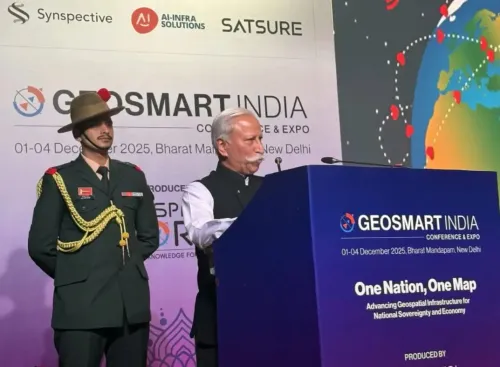
Narendra Bhooshan , Secretary, Department of Land Resources , addressed a technical expert forum in New Delhi on 28 April 2025 .
India's National Geospatial Policy aims to build an open, interoperable, and innovation-driven geospatial ecosystem.
Key programmes — DILRMP , SVAMITVA , and NAKSHA — use drones, aerial surveys, and GIS platforms to modernise land records.
India reaffirmed its commitment to the UN-GGIM framework for global geospatial norms and cooperation.
Asia-Pacific delegates called for stronger regional cooperation on climate adaptation, disaster resilience, and urban expansion.
India is advancing an interoperable national geospatial ecosystem to strengthen governance, disaster response, and sustainable development, a senior government official said on Tuesday, 28 April 2025, at a technical expert forum in New Delhi. The event brought together policymakers, technical experts, and international delegates from the Asia-Pacific region to discuss the expanding role of geospatial systems in public service delivery.
What the Policy Represents
"India's National Geospatial Policy marks an important milestone in building an open, interoperable, and innovation-driven geospatial ecosystem aligned with international best practices," said Narendra Bhooshan, Secretary, Department of Land Resources. He emphasised that geospatial information has evolved from a technical support tool into a central pillar of modern governance. Accurate, reliable geospatial data systems, he noted, enable proactive decision-making across sectors including agriculture, engineering, climate resilience, transport, and land administration.
Key Government Initiatives Highlighted
Several flagship programmes were cited as practical examples of India's geospatial push. The Digital India Land Records Modernization Programme (DILRMP), SVAMITVA, and NAKSHA were highlighted for deploying drones, aerial surveys, digital mapping, and GIS platforms to improve land records and property ownership documentation in both rural and urban areas. These initiatives collectively represent India's effort to translate geospatial policy into on-ground administrative reform.
India's Role in Global Geospatial Frameworks
Bhooshan underscored India's commitment to the United Nations Committee of Experts on Global Geospatial Information Management (UN-GGIM), describing it as a key body in shaping global norms, frameworks, and international cooperation. The UN-GGIM framework, he said, provides countries with practical roadmaps to strengthen national geospatial ecosystems, improve institutional coordination, and integrate data systems across sectors.
Asia-Pacific Priorities and Regional Cooperation
Delegates from across the Asia-Pacific region stressed the need for deeper cooperation on climate adaptation, disaster resilience, coastal vulnerability, urban expansion, agricultural sustainability, and modernisation of land administration systems. The forum underscored that geospatial data is increasingly indispensable for resilient infrastructure, environmental management, and urban planning at both national and regional levels.
What This Means Going Forward
India's push for an open, interoperable geospatial ecosystem signals a broader shift in how the government intends to use spatial data as a governance backbone. With the Asia-Pacific region facing mounting pressures from climate change and rapid urbanisation, the alignment of India's national policy with UN-GGIM frameworks positions the country as a potential standard-setter in regional geospatial cooperation.
Point of View
But the real test lies in interoperability — whether DILRMP, SVAMITVA, and NAKSHA data actually talk to each other across ministries and states. Historically, India's data silos have been a structural governance failure, and a policy framework alone cannot dissolve them. The UN-GGIM alignment is a credibility signal, but without a binding national data-sharing mandate, the ecosystem risks remaining a collection of parallel platforms rather than a unified spatial intelligence layer.
NationPress
19 Sept 2026
Frequently Asked Questions
What is India's National Geospatial Policy?
India's National Geospatial Policy is a framework aimed at building an open, interoperable, and innovation-driven geospatial data ecosystem aligned with international best practices. It seeks to make geospatial information a central tool for governance across sectors such as agriculture, land administration, climate resilience, and urban planning.
What are DILRMP, SVAMITVA, and NAKSHA?
These are flagship government programmes that use drones, aerial surveys, digital mapping, and GIS platforms to modernise land records and property ownership documentation. DILRMP focuses on digital land records, SVAMITVA maps rural property rights using drones, and NAKSHA supports urban and rural planning through digital mapping.
What is UN-GGIM and why does India value it?
The United Nations Committee of Experts on Global Geospatial Information Management (UN-GGIM) shapes global norms, frameworks, and cooperation for geospatial data systems. India values it for providing practical roadmaps to strengthen national ecosystems, improve institutional coordination, and integrate data systems across countries.
Who attended the geospatial expert forum on 28 April 2025?
The forum in New Delhi brought together policymakers, technical experts, and international delegates from the Asia-Pacific region to discuss geospatial systems in governance, sustainable development, and public service delivery.
Why does geospatial data matter for governance?
Geospatial data enables accurate, proactive decision-making across sectors including disaster response, land administration, climate resilience, transport, and urban planning. According to officials, it has moved beyond a technical support role to become central to how modern governments plan and deliver services.