MeitY Honors Cyber Security Grand Challenge 2.0 Winners with ₹6.85 Crore Prize Pool
Synopsis
In a landmark event, MeitY recognized the winners of the Cyber Security Grand Challenge 2.0, awarding a total of ₹6.85 crore to enhance the nation’s digital security capabilities. This initiative not only rewards innovation but also empowers start-ups to retain their intellectual property.
Key Takeaways
MeitY awarded ₹6.85 crore to Cyber Security Grand Challenge winners.
Intellectual Property Rights belong to the start-ups.
The challenge targeted six critical cyber security domains.
Start-ups received mentorship to enhance their solutions.
Indigenization in cyber security is a national priority.
New Delhi, February 26 (NationPress) - The Ministry of Electronics & Information Technology (MeitY) celebrated the triumph of the participants in the 'Cyber Security Grand Challenge 2.0' on Thursday, as per an official announcement. This significant initiative boasts a total prize pool of Rs 6.85 crore.
In collaboration with the Data Security Council of India (DSCI), MeitY's flagship program awarded Rs 1 crore to the winner, while the first and second runners-up received Rs 50 lakh and Rs 25 lakh respectively.
This initiative is designed to bolster the nation’s cyber security capabilities and enhance expertise in vital technological domains, thereby fostering a secure and resilient digital environment, as noted in the ministry's statement.
A noteworthy aspect of this initiative is that the Intellectual Property Rights (IPR) for the developed solutions are retained by the respective start-ups, according to the ministry.
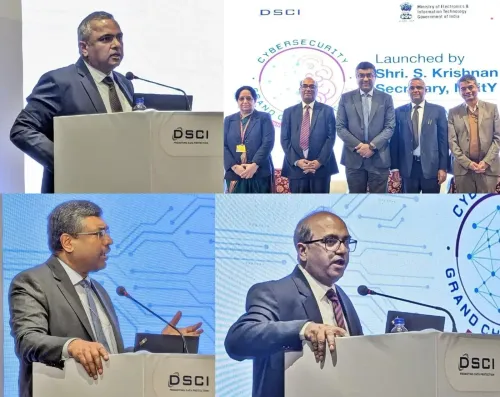
S. Krishnan, the Secretary of the Ministry of Electronics & IT, presented awards to the challenge's victors. The challenge, which began in January 2025 on the MyGov Platform, focused on six critical areas, including API Security, Data Security, Wearable Device Security and Privacy, Clone and Fake App Mitigation, AI for Threat Detection and Incident Response, and Securing Next-Generation Biometric Systems.
Conducted in four structured phases, the Challenge included progressive evaluations and financial support at each level. During the Idea Stage, 36 start-ups each received Rs 5 lakh to develop their solutions. In the Minimum Viable Product stage, these start-ups were provided structured technical and business mentorship, leading to 18 start-ups—three from each problem statement—advancing to the Final Product Stage, where they were awarded Rs 10 lakh each.
In later phases, selected start-ups received Rs 25 lakh each and were assessed based on commercial readiness, scalability, and market potential, resulting in three start-ups being named Grand Winners.
Throughout the Challenge, participating start-ups benefited from ongoing technical and business mentorship to enhance product maturity, deployability, and market readiness, as mentioned by the ministry.
“Cyber security is a domain where domestic capabilities are critically important. The indigenization of cyber security solutions is essential, as the security challenges we face are both real and continuously evolving,” stated Krishnan.
The challenge experienced a rigorous evaluation process, attracting extensive participation from various groups, including student-led teams, start-ups, and women-led enterprises. He emphasized that the ministry is dedicated to promoting indigenization in cyber security and strengthening institutional and ecosystem capacity through sustained collaboration.
Point of View
It's crucial to acknowledge the significance of the Cyber Security Grand Challenge 2.0. This initiative not only incentivizes innovation but also enhances India's cyber resilience. The commitment to domestic capability in cyber security is a proactive approach in addressing evolving threats, showcasing MeitY's dedication to fostering a robust digital ecosystem.
NationPress
19 Sept 2026
Frequently Asked Questions
What is the Cyber Security Grand Challenge 2.0?
The Cyber Security Grand Challenge 2.0 is an initiative by MeitY aimed at enhancing India's cyber security capabilities through innovation and start-up participation.
How much total prize money was awarded?
A total of ₹6.85 crore was awarded to the winners of the challenge.
Who were the partners in this initiative?
The initiative was implemented in collaboration with the Data Security Council of India (DSCI).
What are the critical domains targeted in the challenge?
The challenge focused on API Security, Data Security, Wearable Device Security, Clone and Fake App Mitigation, AI for Threat Detection, and Securing Biometric Systems.
What support did start-ups receive during the challenge?
Participating start-ups received continuous technical and business mentorship throughout the challenge.