Is Over 1,825 MW Capacity Rooftop Solar Installed on 91,574 Government Buildings?
Click to start listening
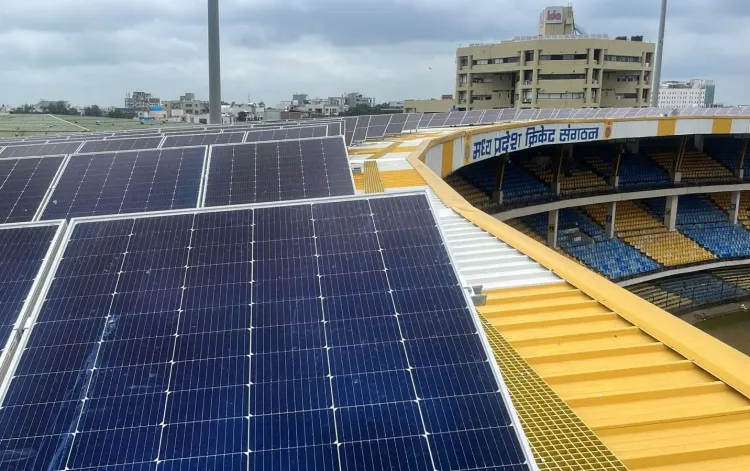
Synopsis
In a significant move towards renewable energy, India has successfully installed over 1,825 MW capacity rooftop solar systems on 91,574 government buildings. This initiative is part of the PM Surya Ghar Muft Bijli Yojana, aimed at utilizing vacant rooftops and promoting sustainable energy solutions for the nation.
Key Takeaways
- 1,825.62 MW capacity rooftop solar systems installed.
- 91,574 government buildings involved in the initiative.
- No Central Financial Assistance required for installations on government properties.
- Individual households can benefit from significant subsidies.
- Special provisions for certain states enhance financial support.
New Delhi, Dec 2 (NationPress) A total of 1,825.62 MW capacity rooftop solar systems have been deployed on 91,574 government buildings across various Central ministries, departments, and states/UTs as reported to Parliament on Tuesday (as of November 4). The Ministry of New and Renewable Energy has urged all states/UTs to issue directives to departments and institutions to utilize unused rooftops for solar panel installations. Additionally, all Central Government Ministries and Departments have been asked to facilitate rooftop solar plant installations on their properties.
Minister of State for Power, Shripad Yesso Naik, noted in Rajya Sabha, “The extensive installation of rooftop solar on government buildings is a key aspect of the PM Surya Ghar Muft Bijli Yojana.”
He explained that No Central Financial Assistance (CFA) is required for government buildings, as their rooftop solar installations are financially sustainable without it.
Under the PM Surya Ghar Muft Bijli Yojana, individual households can receive a CFA of Rs 30,000 per kWp for the first 2 kWp and Rs 18,000 for any additional capacity, with a maximum subsidy applicable for up to 3 kWp system capacity.
For Group Housing Societies and Residential Welfare Associations, the CFA stands at Rs 18,000 per kWp, with a cap of 500 kWp on rooftop solar plant capacity.
Special category states/UTs, including Uttarakhand, Himachal Pradesh, J&K, Ladakh, northeastern states, Andaman and Nicobar Islands, and Lakshadweep, are entitled to a 10% higher CFA.
“Currently, there is no plan to increase CFA further under the scheme,” the minister stated.
India is making strides in energy justice and empowerment through transformative programs such as PM-KUSUM, PM Surya Ghar Muft Bijli Yojana, PM-JANMAN, and 'One Sun, One World, One Grid', strengthening South-South cooperation.
Point of View
It is crucial to recognize India's proactive approach towards renewable energy through initiatives like the PM Surya Ghar Muft Bijli Yojana. This not only addresses the urgent need for sustainable energy solutions but also promotes energy equity among its citizens. The government's commitment to harnessing solar power on a massive scale reflects a forward-thinking strategy that aligns with global trends in environmental responsibility.
NationPress
02/12/2025
Frequently Asked Questions
What is the total capacity of rooftop solar installed on government buildings?
The total capacity of rooftop solar installed on government buildings is 1,825.62 MW.
What financial assistance is available for rooftop solar installations?
Currently, there is no Central Financial Assistance for government buildings, as their installations are viable without it.
What is the subsidy for individual households under the PM Surya Ghar Muft Bijli Yojana?
Individual households can receive a subsidy of Rs 30,000 per kWp for the first 2 kWp and Rs 18,000 for additional capacity.
Are there any special provisions for certain states under the scheme?
Yes, special category states/UTs are entitled to a 10% higher Central Financial Assistance.
What other initiatives are promoting renewable energy in India?
Other initiatives include PM-KUSUM, PM-JANMAN, and 'One Sun, One World, One Grid'.