How Did RBI Transform UPI into a Public Good? Insights from NR Narayana Murthy
Synopsis
Discover how the Reserve Bank of India has revolutionized digital payments by making UPI accessible and affordable, as shared by Infosys founder NR Narayana Murthy. His insights on leadership, values, and compassionate capitalism provide a roadmap for future innovators in India.
Key Takeaways
RBI's role in making UPI accessible and affordable.
Importance of leadership with high aspirations.
Value of institutional memory in organizational growth.
Need for publicly available code to prevent monopolies.
Encouragement for future leaders to embrace compassionate capitalism.
New Delhi, Jan 24 (NationPress) The Reserve Bank of India (RBI) has played a pivotal role as a benevolent and wise facilitator, allowing UPI to become a public asset by reducing costs for users and enhancing accessibility, thereby gaining the trust of the general populace, as stated by NR Narayana Murthy, the Founder of Infosys.
“When leaders possess lofty aspirations and genuine intentions, they can bring about national transformation,” he emphasized during an event in Bengaluru.
Murthy pointed out that to create an organization grounded in strong values and to uphold the dignity of every employee, “leaders must embody their words through actions. Values will not stem from mere speeches, but from tangible deeds. Discipline, strong leadership, and compassionate capitalism are essential for societal and national advancement.”
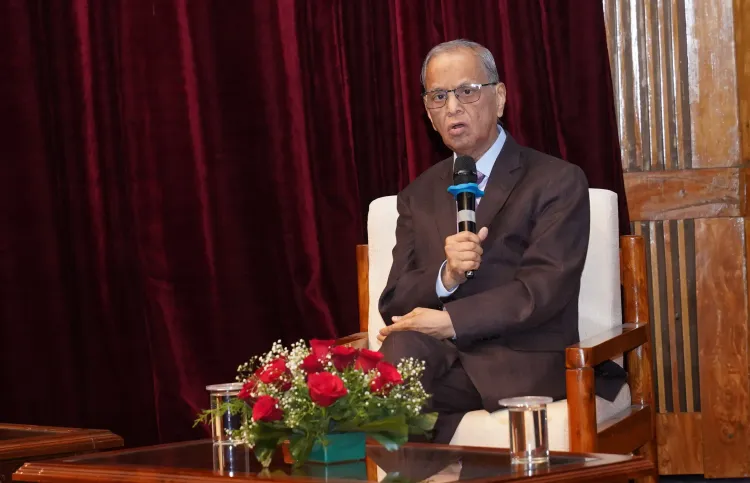
In a fireside discussion with Dr. Balakrishnan Mahadevan, a Post Doctoral Fellow at IIM Bangalore, at the Center for Digital Public Goods, Murthy shared his insights on the values and governance principles that have been crucial in India's digital payment evolution.
He remarked that technology is a transient asset.
“India has predominantly adhered to an oral tradition rather than a written one regarding the documentation of organizational advancements. However, understanding how institutions are developed, the sacrifices and hurdles faced, the quirks of leadership, the intricacies of teamwork, and the societal contributions made are invaluable,” he observed.
All of this will contribute to the repository of institutional memory, and the future of India’s progress will rely on such critical knowledge and insights provided by contemporary authors, Murthy noted.
He asserted that the core lesson is to make the code publicly available at minimal cost.
“This approach will deter monopolies and foster a platform for innovation. Merging innovation with a robust foundation requires exceptional leaders,” he stated.
Encouraging leaders to live simply without ostentatious displays of wealth, he advised students, “You, as the future leaders, are the advocates of compassionate capitalism, who will propel society and the nation forward. This will also promote entrepreneurship.”
Point of View
It's clear that the RBI's efforts in making UPI a public good have not only enhanced digital payment accessibility but have also set a precedent for future innovations. This shift towards affordable technology is a crucial step in fostering trust and inclusivity in our financial systems.
NationPress
24 Sept 2026
Frequently Asked Questions
What role did RBI play in UPI's success?
The RBI made UPI a public good by reducing costs and enhancing accessibility for users.
Who is NR Narayana Murthy?
He is the founder of Infosys and a prominent advocate for strong leadership and compassionate capitalism.
What is compassionate capitalism?
It refers to a business approach that combines profit-making with social responsibility.