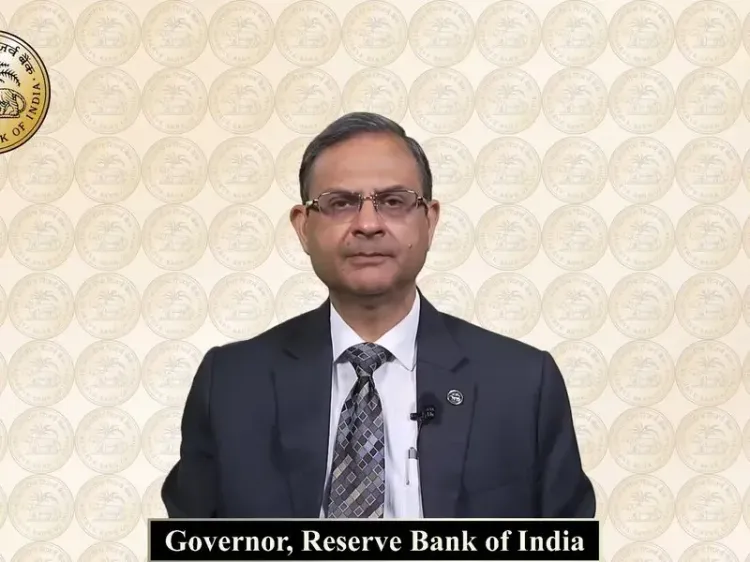
RBI Governor Sanjay Malhotra: Fintech puts India at digital innovation forefront
Synopsis
At the Global Fintech Fest 2026, RBI Governor Sanjay Malhotra did more than celebrate India's digital progress — he laid out a regulatory philosophy: open to new players, committed to self-regulation, and anchored in trust. With PM Modi attending for the third straight year and 1,00,000 delegates in the room, India is staking its claim as the world's fintech capital — and the RBI wants to be seen as the regulator that made it possible.
Key Takeaways
RBI Governor Sanjay Malhotra addressed the Global Fintech Fest (GFF) 2026 in Mumbai on 8 September 2026 .
Malhotra credited fintech with reducing account-opening times, cutting transaction costs, and strengthening fraud detection via AI-driven analytics .
He highlighted fintech's role in expanding credit access to MSMEs through cash flow-based lending, account aggregators, and the Unified Lending Interface .
The RBI has promoted self-regulation and supported digital public infrastructure as pillars of its fintech strategy.
Prime Minister Narendra Modi attended GFF for the third consecutive year , reinforcing the government's commitment to fintech-led financial inclusion.
GFF 2026 is expected to host over 1,00,000 delegates , 8,000 institutions , 1,200 speakers , and 500 investors .
Reserve Bank of India (RBI) Governor Sanjay Malhotra on Tuesday, 8 September 2026 credited fintech with positioning India at the global forefront of digital innovation, saying the sector has connected the country's vast population to formal finance faster and more affordably than any previous mechanism. His remarks came at the Global Fintech Fest (GFF) 2026 in Mumbai, one of the world's largest gatherings of financial technology stakeholders.
Key Developments at GFF 2026
Malhotra outlined the sweeping transformation fintech has delivered across India's financial ecosystem. He pointed to measurable gains: sharply reduced account-opening and payment-settlement times, lower transaction costs, and enhanced fraud detection powered by AI-driven analytics. He also highlighted the emergence of real-time supervision tools that allow regulators to monitor the system with unprecedented granularity.
'This has been made possible by fintech, which bridges and connects our vast, diverse population to formal finance faster and more affordably,' Malhotra said. He added that fintech had been 'equally significant' in improving customer experience and strengthening the underlying financial infrastructure.
Impact on MSMEs and Credit Delivery
The RBI Governor singled out credit delivery to micro, small and medium enterprises (MSMEs) as an area where fintech's impact has been especially visible. He cited cash flow-based lending, the account aggregator framework, and the Unified Lending Interface as instruments that have materially expanded credit access for businesses that were previously underserved by traditional banking channels.
This comes amid a broader policy push to deepen formal credit penetration in India, where MSMEs account for roughly 30% of GDP but have historically faced a significant credit gap. The RBI's embrace of data-driven lending models signals a structural shift in how the central bank views technology's role in monetary transmission.
RBI's Regulatory Approach to Fintech
Malhotra elaborated on the central bank's philosophy of balancing innovation with stability. He said the RBI has encouraged self-regulation within the fintech industry and actively supported the development of digital public infrastructure on which companies can build new products and services.
'We have been open to new ideas and new players. We have promoted responsible innovation while safeguarding trust, which is the very foundation of finance,' he said. Notably, the RBI's regulatory sandbox framework — launched in earlier years — has been a key vehicle for this approach, allowing startups to test products under controlled conditions before full deployment.
PM Modi's Presence and Political Signal
Malhotra also welcomed Prime Minister Narendra Modi's attendance at the festival, noting that it marked his third consecutive year at GFF — a signal, the Governor said, of the Prime Minister's sustained commitment to technology-led financial inclusion. Modi's repeated presence at the event has reinforced the government's positioning of fintech as a pillar of India's economic identity on the global stage.
Scale of GFF 2026
Kris Gopalakrishnan, Chair of GFF 2026, co-founder of Infosys, and Chairman of Axilor Ventures, said the festival is expected to draw more than 1,00,000 delegates, over 8,000 participating institutions, more than 1,200 speakers, and over 500 investors. The scale underscores India's growing centrality in the global fintech conversation.
As regulatory frameworks mature and digital public infrastructure deepens, the RBI's next challenge will be ensuring that the innovation dividend reaches the last mile — rural households, informal workers, and the smallest enterprises — without compromising systemic stability.
Point of View
Not just a gatekeeper, of fintech growth. Yet the self-regulation emphasis carries risk: India's fintech sector has seen its share of consumer-harm episodes, from predatory digital lending to data-privacy lapses, that self-regulatory bodies have been slow to address. The MSME credit narrative is compelling, but the credit gap remains large and the Unified Lending Interface is still nascent in reach. Modi's third consecutive GFF appearance is a political statement as much as a policy one — fintech is now a brand asset for the government, which raises the stakes if systemic risks materialise on the RBI's watch.
NationPress
24 Oct 2026
Frequently Asked Questions
What did RBI Governor Sanjay Malhotra say at the Global Fintech Fest 2026?
RBI Governor Sanjay Malhotra said fintech has placed India at the forefront of global digital innovation by connecting its diverse population to formal finance faster and more affordably. He highlighted gains in payment efficiency, fraud detection through AI, and expanded MSME credit access as key outcomes.
What is the Global Fintech Fest 2026 and how big is it?
The Global Fintech Fest (GFF) 2026 is one of the world's largest fintech conferences, held in Mumbai. According to GFF Chair Kris Gopalakrishnan, it is expected to attract over 1,00,000 delegates, 8,000 participating institutions, 1,200 speakers, and 500 investors.
How has fintech improved credit access for MSMEs in India?
According to RBI Governor Malhotra, fintech has improved MSME credit delivery through cash flow-based lending models, the account aggregator framework, and the Unified Lending Interface. These tools allow lenders to assess creditworthiness using real-time financial data rather than traditional collateral requirements.
What is the RBI's regulatory approach to fintech?
The RBI has encouraged self-regulation within the fintech industry and supported the development of digital public infrastructure on which companies can build new products. Governor Malhotra described the approach as being 'open to new ideas and new players' while prioritising trust and responsible innovation.
Why did PM Modi attend the Global Fintech Fest 2026?
Prime Minister Narendra Modi attended GFF 2026 for the third consecutive year, a fact noted by Governor Malhotra as reflecting Modi's sustained commitment to technology and innovation in the financial sector. His repeated presence has reinforced fintech as a central pillar of India's economic positioning globally.