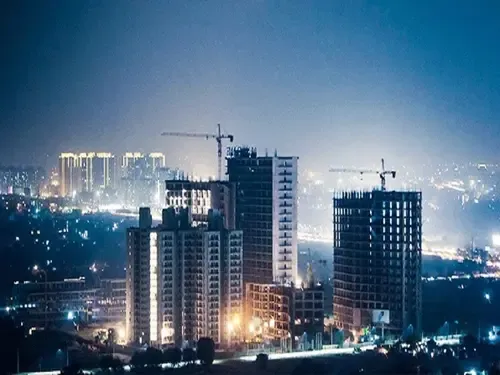
Will Residential Realty Demand Decline in FY26 While Commercial Demand Grows by 5%?

Synopsis
A recent report reveals that residential demand in India's largest cities is projected to decline by 2–4% this fiscal year due to a high base effect. However, commercial real estate is expected to see a 5–7% growth, driven by leasing in key sectors. Discover how these trends will shape the future of the Indian real estate market.
Key Takeaways
Residential demand in top cities expected to decline.
Commercial real estate projected to grow significantly.
Moderate capital value increases anticipated.
Premiumisation trend continues in the market.
Long-term outlook remains optimistic.
New Delhi, Dec 24 (NationPress) The residential demand in India’s leading seven cities is anticipated to decline by 2–4 percent this fiscal year, primarily due to a significant base effect, according to a report released on Wednesday.
The analysis from Crisil Intelligence indicates that the demand for commercial real estate is expected to grow between 5–7 percent this fiscal year, with supply increasing by 9–11 percent. This growth is driven by leasing activities from global capability centers, flexible workspace providers, and sectors such as IT/ITeS and BFSI.
The report attributes the moderation in residential demand to substantial growth observed between FY22 and FY24, influenced by a high base effect, notable capital value increases, and city-specific elements like elevated stamp duty and registration fees.
Despite the slowdown, the trend of premiumisation persists, highlighted by significant capital value increases and larger average carpet areas in new residential units, as noted in the report.
The firm projects a moderate rise in capital values of about 5–7 percent this fiscal year, a decrease from the previous two fiscals where growth was at 13–14 percent.
Crisil pointed out that the commercial momentum may slow in the forthcoming fiscal year due to the high base established over the last four to five years.
Looking ahead, the research firm is optimistic about fiscal 2027, predicting that demand recovery will be fueled by rising incomes, reduced interest rates, and ongoing infrastructure enhancements.
Overall, the long-term outlook for the Indian real estate sector remains positive, with anticipated growth and stability returning in the medium term, according to Aniket Dani, Director of Crisil Intelligence.
Another recent report highlighted that conventional office absorption reached 58.5 million sq ft in 2025, marking a 7 percent increase, while flexible workspace uptake amounted to 13 million sq ft, representing approximately 18 percent of total leasing.
Office space demand remained diverse in 2025, with around 25 million sq ft of conventional space—40 percent of total uptake—contributed by BFSI, engineering & manufacturing, and consulting sectors.
New supply across major cities rose by 5 percent to 56.5 million sq ft, with Bengaluru, Hyderabad, and Pune collectively accounting for nearly 70 percent of completions.
Point of View
I observe that the fluctuations in the real estate market, particularly the anticipated decline in residential demand, reflect broader economic dynamics. While challenges exist, the ongoing growth in commercial real estate signifies resilience in specific sectors. The overall outlook remains cautiously optimistic.
NationPress
25 Sept 2026
Frequently Asked Questions
What is the projected change in residential demand for FY26?
Residential demand in India’s top seven cities is expected to ease by 2–4% this fiscal year.
What factors are contributing to the decline in residential demand?
The decline is attributed to a high base effect, significant capital value appreciation, and increased stamp duty and registration charges.
How is commercial real estate expected to perform?
Commercial real estate demand is projected to grow by 5–7% this fiscal year, driven by leasing from various sectors.
What is premiumisation in the real estate market?
Premiumisation refers to the trend of increased capital value appreciation and larger average carpet areas in new apartments.
What is the long-term outlook for the Indian real estate market?
The long-term outlook remains positive, with expectations of growth and stability returning in the medium term.