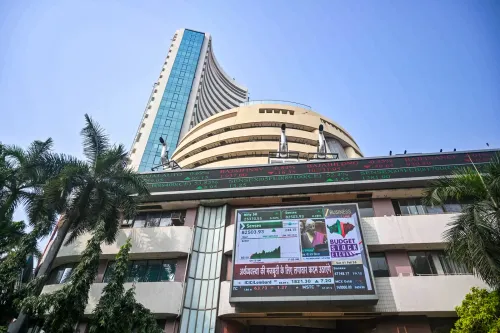
Sensex, Nifty slide at open as FII selling hits auto, cement stocks

Synopsis
Indian benchmarks slipped at Thursday's open as FIIs extended their selling streak to a fifth straight session, dumping over ₹10,148 crore on Wednesday alone. With ₹45,536 crore exiting through exchanges in September, rising US yields and crude oil above $98 are keeping markets in a sideways-to-bearish grip — and the Nifty's next move hinges on whether the 22,500 support holds.
Key Takeaways
Sensex opened down 287.39 points at 72,192.89 on 1 October ; Nifty50 fell 76.75 points to 22,543.70 .
FIIs were net sellers for the fifth consecutive session , offloading equities worth over ₹10,148 crore on Wednesday.
FII outflows in September totalled ₹45,536 crore through exchanges; DIIs bought ₹11,271 crore in a single session to cushion the fall.
Nifty Auto and Nifty Cement led sectoral losses, plunging up to 2.76 per cent ; Nifty IT rose more than 1 per cent .
Analysts place immediate Nifty support at 22,500–22,550 and resistance at 22,800–22,900 .
A drop in Brent crude below $98 a barrel is seen as a potential market relief trigger.
The BSE Sensex opened 287.39 points lower at 72,192.89 on Thursday, 1 October, while the Nifty50 shed 76.75 points to begin the session at 22,543.70, as sustained foreign institutional investor outflows and broad sectoral weakness weighed on domestic equities at the open.
Sectoral Snapshot
Nifty Auto and Nifty Cement were among the steepest fallers in early trade, with select sectoral indices plunging up to 2.76 per cent. Nifty Realty, Nifty Media, and Nifty Healthcare also featured among the top laggards. Energy, metal, and pharma indices traded sharply lower as well, declining between 0.86 per cent and 0.95 per cent in early deals.
Not all segments were in the red, however. Nifty IT bucked the trend with a gain of more than 1 per cent, while Nifty Private Bank edged up 0.60 per cent, providing pockets of support to the broader market.
FII Selling Streak Enters Fifth Session
The pressure on benchmarks tracked a relentless exit by foreign funds. On Wednesday, foreign institutional investors (FIIs) were net sellers for the fifth consecutive session, offloading equities worth more than ₹10,148 crore, according to provisional data. Over the full month of September, FIIs sold equities worth ₹45,536 crore through exchanges, partially offset by ₹9,676 crore invested via the primary market.
Countering the outflow, domestic institutional investors (DIIs) continued to absorb the selling pressure, purchasing equities worth ₹11,271 crore on Wednesday alone — providing a floor that has kept declines from accelerating into a sharper correction.
What Analysts Are Watching
Market analysts note that sustained FII selling, combined with rising US bond yields, could keep large-cap equities under pressure in the near term. The near-term structure for the Nifty is described as sideways to bearish, with immediate support seen around 22,500–22,550 and resistance in the 22,800–22,900 band.
Experts caution that a sustained move above the resistance zone would be needed to meaningfully improve market sentiment, while a break below the support band could intensify selling. Notably, crude oil prices are also being closely tracked — analysts say a decline in Brent crude below $98 a barrel could offer some relief to the market by easing inflation and current account concerns.
Broader Context
This marks a continuation of a risk-off trend that has gripped domestic markets over recent sessions. Rising US yields have made dollar-denominated assets more attractive relative to emerging-market equities, historically triggering FII rotation away from India. The DII counter-buying, while supportive, has not been sufficient to reverse the directional pressure set by foreign flows. How global macro cues — particularly US Federal Reserve commentary and crude oil trajectory — evolve in the sessions ahead will likely determine whether the current selling phase deepens or stabilises.
Point of View
But institutional counter-buying cannot indefinitely substitute for genuine foreign confidence. The split market — IT and private banks holding while autos, cement, and realty bleed — suggests FIIs are not fleeing India wholesale but rotating within it, favouring rate-insensitive exporters over domestic cyclicals. The real stress test comes if Nifty breaks below 22,500: that level has held on intraday dips, but a closing breach would likely trigger stop-loss selling that DIIs alone cannot absorb.
NationPress
1 Oct 2026
Frequently Asked Questions
Why did Sensex and Nifty fall at open on 1 October 2026?
Sensex opened 287 points lower and Nifty slipped to 22,543 on 1 October due to continued FII selling and broad sectoral weakness. Foreign institutional investors offloaded equities worth over ₹10,148 crore on Wednesday, their fifth consecutive session of net selling, weighing on market sentiment at the open.
Which sectors are falling the most today?
Nifty Auto and Nifty Cement are among the worst performers, with sectoral indices falling up to 2.76 per cent in early trade. Nifty Realty, Nifty Media, and Nifty Healthcare are also trading sharply lower, while energy, metal, and pharma indices have declined between 0.86 per cent and 0.95 per cent.
How much did FIIs sell in September 2026?
FIIs sold equities worth ₹45,536 crore through exchanges in September, according to analysts, while investing ₹9,676 crore via the primary market during the same period. This sustained outflow is a key factor keeping large-cap equities under pressure.
What are the key Nifty support and resistance levels to watch?
Analysts have placed immediate support for the Nifty at 22,500–22,550 and resistance at 22,800–22,900. A sustained move above the resistance band could improve sentiment, while a break below the support zone may intensify selling pressure.
Is there any positive signal in today's market?
Nifty IT rose more than 1 per cent and Nifty Private Bank advanced 0.60 per cent, bucking the broader downtrend. Domestic institutional investors also continued to provide support, buying equities worth ₹11,271 crore on Wednesday to partially cushion FII outflows.