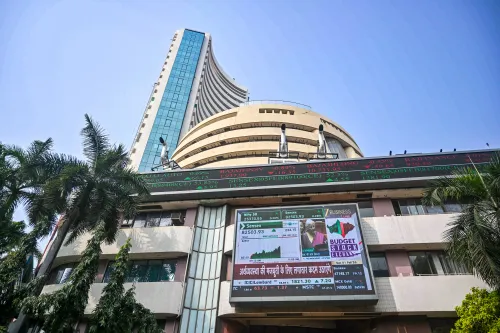
Sensex, Nifty fall for 3rd straight session; metal stocks drag
Synopsis
Indian equities logged a third straight session of losses on 13 August, but the damage was contained — Sensex slipped just 113 points and Nifty held above a key 24,325 support zone where the 20-day SMA meets the 38.2% Fibonacci level. Metal stocks bore the brunt while mid- and small-caps quietly outperformed, signalling selective investor appetite beneath the headline weakness.
Key Takeaways
BSE Sensex fell 113.61 points ( 0.15% ) to close at 78,079.96 on 13 August .
NSE Nifty50 shed 40.10 points ( 0.16% ) to settle at 24,395.85 — a third consecutive session of losses.
Hindalco Industries , UltraTech Cement , and Grasim Industries were the top Nifty50 losers.
Nifty Metal index dropped more than 1% ; Nifty Chemical was the top sectoral gainer.
Nifty MidCap rose 0.15% and Nifty SmallCap gained 0.27% , outperforming frontline indices.
Near-term market direction expected to hinge on energy markets , geopolitical risks , and foreign capital inflow trends.
Indian benchmark equity indices extended their losing streak into a third consecutive session on Thursday, 13 August, closing modestly lower after trading within a tight range all day amid subdued investor sentiment. The BSE Sensex declined 113.61 points, or 0.15%, to settle at 78,079.96, while the NSE Nifty50 shed 40.10 points, or 0.16%, to close at 24,395.85.
Technical Outlook for Nifty
Analysts noted that the Nifty50 is approaching a critical support zone around 24,325, where the 20-day Simple Moving Average (SMA) converges with the 38.2% Fibonacci retracement level. 'As long as the 24,325 support remains intact, the broader uptrend is likely to resume, with the index expected to retest the immediate resistance around 24,775,' an analyst said. A decisive break above that level, experts added, could pave the way for a further advance towards 24,900.
Top Losers and Sectoral Performance
Selling pressure in heavyweight counters weighed on the frontline indices. Hindalco Industries, UltraTech Cement, and Grasim Industries emerged as the top losers on the Nifty50. At the sectoral level, the Nifty Metal index was the worst performer, falling more than 1% as weakness in metal stocks persisted. In contrast, the Nifty Chemical index outperformed peers to end as the top sectoral gainer of the session.
Broader Markets Show Resilience
Despite the drag on frontline indices, broader markets held up relatively well. The Nifty MidCap index closed 0.15% higher, while the Nifty SmallCap index gained 0.27%. This divergence suggests that investor interest in select mid- and small-cap stocks remained intact even as large-cap sentiment turned cautious — a pattern seen in earlier consolidation phases this year.
Rupee and Near-Term Market Drivers
The Indian rupee faced steady depreciation pressure during the session, driven by strong dollar demand from importers. Analysts pegged near-term spot USD/INR support at 95.10 and resistance at 95.60. On the broader market outlook, experts flagged that near-term direction will likely be shaped by developments in energy markets, geopolitical risks, and the sustainability of foreign capital inflows. With no major domestic triggers in sight, global cues are expected to set the tone in the sessions ahead.
Point of View
But the actual point-fall tells a different story — 113 on Sensex and 40 on Nifty is consolidation, not capitulation. The more telling signal is the mid- and small-cap resilience: when broader markets outperform frontline indices during a down session, it usually reflects rotation rather than broad-based selling. The real test is the 24,325 Nifty support; a clean break there would change the narrative entirely. Until then, this looks like a market waiting for a global cue rather than one pricing in domestic distress.
NationPress
27 Sept 2026
Frequently Asked Questions
Why did the Sensex and Nifty fall for a third straight session on 13 August?
The Sensex fell 113.61 points to 78,079.96 and the Nifty shed 40.10 points to 24,395.85 on 13 August, weighed by selling in heavyweight stocks — particularly in the metals sector — amid subdued investor sentiment and caution over global geopolitical and energy market developments.
What is the key technical support level for Nifty right now?
Analysts have identified 24,325 as a critical support zone for the Nifty50, where the 20-day Simple Moving Average coincides with the 38.2% Fibonacci retracement level. A hold above this level is seen as necessary for the broader uptrend to resume.
Which stocks and sectors led the losses on 13 August?
Hindalco Industries, UltraTech Cement, and Grasim Industries were the top losers on the Nifty50. At the sectoral level, the Nifty Metal index was the worst performer, falling more than 1% during the session.
Did broader markets also fall on 13 August?
No — broader markets showed resilience despite frontline weakness. The Nifty MidCap index rose 0.15% and the Nifty SmallCap index gained 0.27%, bucking the trend seen in large-cap benchmarks.
What factors will drive Indian markets in the near term?
Analysts expect near-term market direction to be shaped by developments in global energy markets, geopolitical risks, and the sustainability of foreign capital inflows into Indian equities. The Indian rupee's trajectory — currently under depreciation pressure with USD/INR resistance at 95.60 — is also being closely watched.