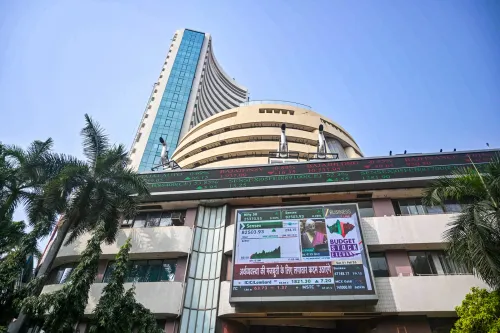
Sensex rises 462 points, Nifty at 23,581 as pharma and banking stocks surge

Synopsis
Indian markets pushed higher on 14 May despite crude above $106 and FPI outflows, with pharma and banking leading a broad rally. But the real story is underneath: IT is cracking, the rupee is sliding, and analysts see no clear catalyst for reversal until either crude eases or the AI-driven global tech trade cools.
Key Takeaways
Sensex surged up to 462 points to an intraday high of 75,071 on 14 May ; Nifty50 traded around 23,581 , up 170 points .
Pharma, healthcare, metals, banking, energy, cement, and FMCG indices each gained over 1% .
Nifty IT was the top laggard; HCLTech, Infosys, TCS, and Tech Mahindra fell up to 1% .
India VIX rose more than 3% to nearly 19 , signalling elevated market anxiety.
Brent crude traded at $106.18 per barrel , adding macro pressure on India as a major oil importer.
FPI outflows are expected to persist as long as markets like the US, Japan, and South Korea outperform India, according to analysts.
Sensex surged as much as 462 points or 0.61% to touch an intraday high of 75,071 on Thursday, 14 May, while the Nifty50 climbed approximately 170 points or 0.72% to trade around 23,581 in early trade. The rally came despite elevated crude oil prices and persisting geopolitical tensions, driven by broad-based buying in pharma, banking, and several other heavyweight sectors.
Sectors Leading the Gains
Buying interest spread across multiple segments, with indices tracking pharma and healthcare, metals, chemicals, banking, energy, cement, and FMCG each gaining over 1%. The breadth of the rally suggests domestic institutional interest rather than a narrow sectoral move.
Notably, Nifty IT bucked the trend, emerging as a top laggard. HCLTech, Infosys, Tata Consultancy Services (TCS), and Tech Mahindra declined up to 1% each, continuing the pressure on technology counters that has persisted through recent sessions.
Volatility and FPI Concerns
The volatility gauge India VIX rose more than 3% to nearly 19, signalling that despite the day's gains, underlying market anxiety remains elevated. According to a market expert, capital is rotating toward markets such as the US, Japan, South Korea, and Taiwan, all of which are currently outperforming.
'As long as the outperformance of these markets and the underperformance of India continue, foreign portfolio investors (FPIs) will continue to sell, which, in turn, will further drag the rupee down,' the expert said.
The analyst flagged that a turnaround would require either the Strait of Hormuz reopening — which would ease crude prices — or a reversal of the AI-driven FPI flow into global tech leaders. 'There is no clarity on when this will happen,' the expert added.
Rupee Depreciation and Its Market Impact
Sustained rupee weakness carries layered consequences for corporate India, the analyst cautioned. Imported inflation is expected to rise, squeezing margins for companies reliant on petroleum-based inputs. Exporters, by contrast, stand to benefit. Pharmaceuticals are seen as a relative safe haven — demand for medicines is relatively inelastic, and the sector gains from a weaker rupee. Textiles are also expected to benefit.
The IT sector, despite being a structural beneficiary of rupee depreciation through dollar-denominated revenues, is reportedly facing additional headwinds from what the analyst described as the 'Anthropic shock' — a reference to competitive disruption in the AI space — keeping the sector under continued pressure.
Global Cues: Crude, Asia, and Wall Street
On the commodities front, international benchmark Brent crude rose 0.52% to $106.18 per barrel, while US West Texas Intermediate (WTI) gained 0.71% to $101.74. Elevated crude remains a key macro risk for India, a major oil importer.
Asian markets showed a mixed picture: Japan's Nikkei traded flat, while Hong Kong's Hang Seng and South Korea's KOSPI edged higher. Indonesia's Jakarta Composite and China's Shanghai Composite declined up to 2%. Overnight on Wall Street, the S&P 500 gained 0.59% and the Nasdaq closed 1.2% higher, providing a supportive global backdrop for Thursday's session.
With crude above $100 per barrel and FPI outflows unresolved, the durability of Thursday's rally will depend on how quickly domestic fundamentals can offset global headwinds.
Point of View
But with FPIs structurally rotating toward AI-driven markets and crude stubbornly above $100, the foundation is fragile. The IT sector's dual trouble — US demand softness and AI disruption — is more structural than cyclical, and the rupee's slide compounds it. A market that rises on pharma and FMCG while IT bleeds is not a confident market; it is a defensive one.
NationPress
22 Sept 2026
Frequently Asked Questions
Why did Sensex and Nifty rise on 14 May despite global headwinds?
Sensex and Nifty rose on 14 May due to broad-based buying in pharma, banking, metals, and FMCG stocks, which offset pressure from elevated crude prices and geopolitical tensions. Domestic institutional buying appeared to support the rally even as FPIs continued selling.
Which sectors led the market rally on 14 May?
Pharma and healthcare, metals, chemicals, banking, energy, cement, and FMCG indices each gained over 1%. IT was the notable exception, with HCLTech, Infosys, TCS, and Tech Mahindra declining up to 1%.
Why is the IT sector underperforming despite a broader market rally?
IT stocks faced dual pressure: continued FPI rotation toward global AI leaders and what analysts described as the 'Anthropic shock' — competitive disruption in the AI space. Although IT companies benefit from rupee depreciation through dollar revenues, these headwinds are reportedly outweighing that advantage.
What is the impact of rising crude oil prices on Indian markets?
Brent crude trading above $106 per barrel raises imported inflation risks for India, squeezing margins for companies with petroleum-based inputs. It also pressures the rupee, which analysts warn will continue to slide as long as FPIs prefer stronger-performing global markets.
What would reverse the FPI selling trend in Indian markets?
According to market analysts, FPI outflows would ease only if crude oil prices fall — potentially linked to the Strait of Hormuz situation — or if the AI-driven capital flow into global tech leaders reverses. Analysts noted there is currently no clarity on a timeline for either development.