Seoul Stocks Surge Amid Renewed US-Iran Tensions
Synopsis
Seoul's stock market saw a substantial rise on Monday, despite fears surrounding the US-Iran conflict. The KOSPI index climbed by 1.32%, with significant gains from major tech firms. Outgoing BOK Governor Rhee Chang-yong highlighted the challenges faced in achieving economic stability.
Key Takeaways
Seoul's stock market shows strong performance despite international tensions.
KOSPI index increased by 1.32%, driven by tech sector gains.
Major players like Samsung Electronics and SK Hynix reported positive movements.
Outgoing BOK Governor highlighted economic challenges.
Investor sentiment remains cautious amid geopolitical issues.
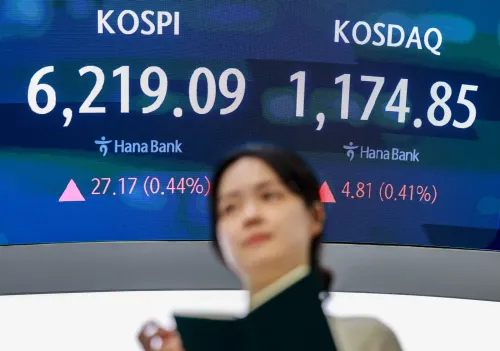
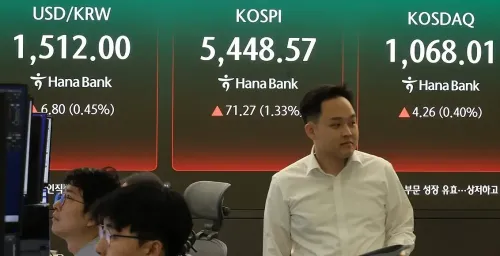
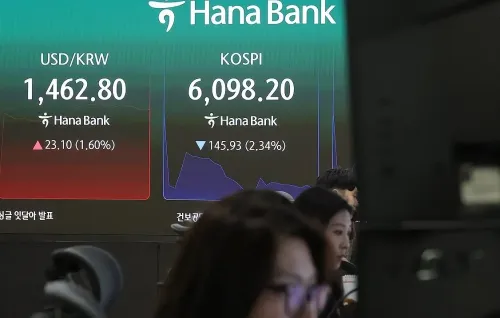
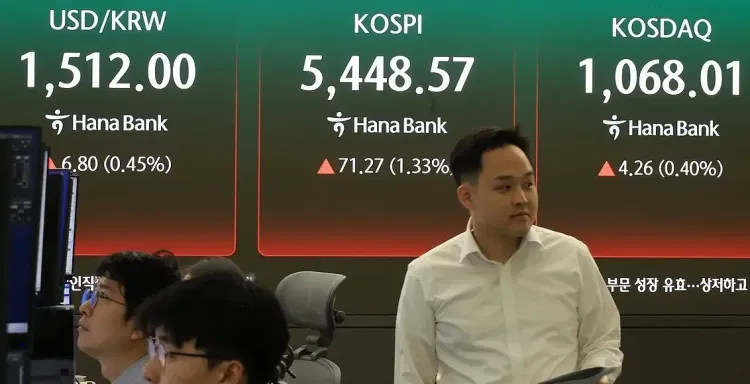
Seoul, April 20 (NationPress) In a surprising turn of events, Seoul's stock market experienced a significant increase on Monday morning, despite ongoing apprehensions regarding escalating tensions between the United States and Iran in the Middle East. By 11:20 am (local time), the benchmark Korea Composite Stock Price Index (KOSPI) surged by 81.79 points, equivalent to a 1.32 percent rise, reaching a total of 6,273.71, according to reports from Yonhap News Agency.
U.S. President Donald Trump announced the seizure of an Iranian-flagged commercial ship in the Gulf, a move perceived by Iran as a breach of the ceasefire agreement.
Market participants are closely monitoring the potential for renewed peace negotiations between the U.S. and Iran, especially in light of reports from Iranian state media indicating that Tehran currently has no intention of participating.
In the Seoul market, most major stocks demonstrated upward movement. Notably, Samsung Electronics and SK Hynix, the leading chip manufacturers, recorded gains of 0.93 percent and 3.72 percent, respectively, with SK Hynix slated to announce its first-quarter earnings this week.
Meanwhile, Hanwha Aerospace, a defense industry heavyweight, added 0.35 percent, financial giant KB Financial rose by 0.12 percent, while the automotive leader Hyundai Motor saw a slight decrease of 0.37 percent.
The local currency was valued at 1,474.1 won against the U.S. dollar, reflecting an increase of 9 won from the previous trading session.
In related news, outgoing Bank of Korea (BOK) Governor Rhee Chang-yong addressed the challenges of achieving economic stability and growth through monetary and fiscal policies alone, emphasizing the need for a more expansive role for the central bank in tackling long-term structural issues.
During his farewell ceremony in Seoul, Rhee noted, "Despite the diminishing impact of monetary and fiscal strategies on stability and growth amid significant economic changes, public expectations from policymakers remain elevated, creating a disparity between reality and perception."
He added, "While recent conditions in the economy and foreign exchange markets have shown relative stability, largely due to the semiconductor boom, this should not be viewed entirely positively, as it underscores deeper structural issues such as over-dependence on specific industries and resulting economic polarization."
Point of View
I find it noteworthy that Seoul's stock market remains resilient despite geopolitical tensions. The performance of major corporations, particularly in the tech sector, indicates a complex economic landscape that warrants close observation.
NationPress
16 Sept 2026
Frequently Asked Questions
What caused the increase in Seoul's stock market?
The increase in Seoul's stock market can be attributed to strong performances from major tech companies like Samsung and SK Hynix, despite concerns over geopolitical tensions between the United States and Iran.
How did the KOSPI index perform?
The KOSPI index rose by 81.79 points, or 1.32 percent, reaching 6,273.71 as of late Monday morning.
What are the implications of the US-Iran tensions?
The tensions may affect investor sentiment and market stability, as uncertainties in international relations can lead to fluctuations in stock prices.
What did the outgoing BOK Governor say?
Outgoing BOK Governor Rhee Chang-yong emphasized the difficulties in achieving economic stability through traditional monetary and fiscal policies alone, calling for a broader approach to address structural challenges.
What is the current exchange rate for the Korean won?
As of the latest update, the Korean won is quoted at 1,474.1 won against the US dollar.