Analysts Assess WTO Ruling on International Subsidies and Highlight Policy Issues
Synopsis
In a panel discussion in New Delhi, experts scrutinized the WTO's verdict on cross-border subsidies, revealing significant legal and policy challenges that could reshape global trade dynamics.
Key Takeaways
WTO Panel Report: Addresses international subsidies under the SCM Agreement.
EU's Approach: Examines the attribution of foreign financial contributions to the Indonesian government.
Legal Interpretations: Highlights the closed definition of 'financial contributions.' Public Body Concept: Stresses the need for substantive evaluations over formal classifications.
Global Trade Implications: Discusses challenges posed by rising cross-border state support mechanisms.
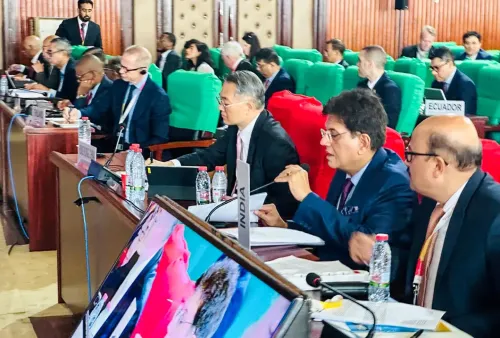
New Delhi, April 19 (NationPress) The legal ramifications and policy challenges stemming from the WTO Panel Report regarding international subsidies were critically analyzed during a recent panel discussion in the capital on Sunday. Experts assessed the implications for global trade regulations and developing industrial policies.
This insightful event was organized by the Centre for Trade and Investment Law (CTIL) at the Indian Institute of Foreign Trade, in partnership with the South Asian International Economic Law Network and the Indian Society of International Law (ISIL).
The panel focused on the WTO dispute concerning the European Union's countervailing and anti-dumping duties on stainless steel cold-rolled flat products imported from Indonesia.
Experts examined the EU's method of linking financial contributions from foreign parties, including those associated with state entities, to the Indonesian government and categorizing these as countervailable subsidies.
The conversation emphasized that such interpretations pose significant questions regarding the breadth and enforcement of international trade law in today's increasingly interconnected global marketplace.
The panel also discussed pivotal conclusions from the WTO Panel, which affirmed that the term "financial contribution" as defined in Article 1.1(a)(1) of the SCM Agreement constitutes a closed list.
This interpretation essentially rules out government-to-government inducements from being classified as subsidies within the existing framework.
Participants further deliberated on the definition of a "public body," stressing the necessity for a thorough assessment of an entity's operations and its connection to the state, as opposed to merely depending on formal classifications.
Beyond legal frameworks, the session investigated the wider consequences of the ruling for governing transnational subsidies and its potential effects on the intersection of trade law and industrial strategy.
Speakers highlighted that the rising prevalence of cross-border state support mechanisms introduces new hurdles for the current WTO structure.
Opening remarks were provided by Manoj Kumar Sinha, President of ISIL and Vice Chancellor of Dharmashastra National Law University, who pointed out the growing intricacies of global trade regulations amid increased economic collaboration and evolving industrial approaches.
Point of View
It emphasizes the need for careful consideration of international trade laws amidst evolving global economic landscapes.
NationPress
19 Sept 2026
Frequently Asked Questions
What is the WTO Panel Report about?
The WTO Panel Report addresses international subsidies, particularly under the Agreement on Subsidies and Countervailing Measures, focusing on the implications for global trade rules.
What were the main topics discussed at the panel?
The panel discussed the EU's approach to financial contributions from foreign entities and the implications for international trade law and industrial policy.
Who organized the panel discussion?
The discussion was organized by the Centre for Trade and Investment Law at the Indian Institute of Foreign Trade, in collaboration with various law networks.
What are countervailable subsidies?
Countervailable subsidies are financial contributions provided by governments that can distort international trade, leading to countervailing duties imposed by importing countries.
Why is this WTO ruling significant?
The ruling clarifies definitions related to subsidies and poses challenges for the existing WTO framework, impacting future international trade practices.