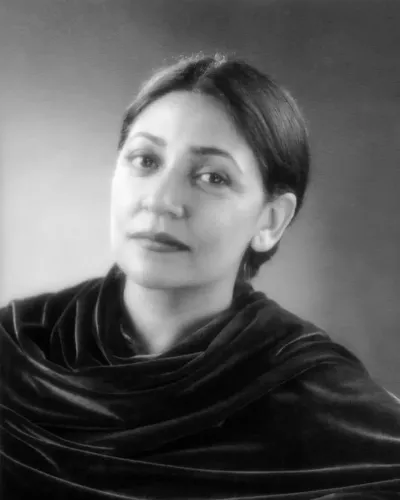
Deepti Naval revisits directorial debut 'Do Paise Ki Dhoop, Chaar Aane Ki Baarish'

Synopsis
Deepti Naval has resurfaced memories of her directorial film 'Do Paise Ki Dhoop, Chaar Aane Ki Baarish' — a story about a homeless songwriter, an ageing sex worker, and her wheelchair-bound son forming an unlikely family. The Instagram post is a rare public reflection from an actress-turned-director on a film that quietly tackled marginalisation long before it became a mainstream cinematic conversation.
Key Takeaways
Deepti Naval shared the poster of her directorial 'Do Paise Ki Dhoop, Chaar Aane Ki Baarish' on Instagram on 27 July .
The film centres on three marginalised characters — a struggling songwriter, an ageing sex worker, and her twelve-year-old wheelchair-bound son.
Naval described the film as an exploration of 'the complexity of relationships in today's society.' The post marks a rare public revisit by Naval to her work as a director, a role less known than her acting career.
The film's themes of chosen family and human dignity are drawing renewed attention following the Instagram post.
Actress Deepti Naval has revisited memories of her directorial venture 'Do Paise Ki Dhoop, Chaar Aane Ki Baarish', sharing the film's poster on Instagram on Monday, 27 July alongside a heartfelt note that laid out the story's emotional core. The post offered a rare, personal window into the making of a film Naval has described as an exploration of human bonds in contemporary society.
The Story at the Film's Heart
In her caption, Naval outlined the central premise: Debu, a struggling songwriter abandoned by his lover and left homeless, crosses paths on a rainy night with Juhi, an ageing sex worker who struggles to find clients. Juhi's twelve-year-old son Kaku, confined to a wheelchair, yearns for affection he rarely receives.
Debu strikes a deal — he will babysit Kaku in exchange for shelter. The arrangement shifts the emotional landscape of all three characters. As Debu and Kaku grow close, Juhi finds herself on the outside of a bond she could never build with her own child — a quiet, devastating irony that drives much of the film's dramatic tension.
Themes Naval Wanted to Explore
Naval's note framed the film around a specific idea of love: 'Love is not about finding someone who can make you feel complete, but being with someone with whom you can share your incompleteness.' That philosophy threads through the narrative as Debu attempts to encourage Juhi to leave her profession and reclaim dignity, while Juhi begins to see him differently — as a potential partner, perhaps even as the missing piece of a makeshift family.
'Can the three of them be a family?' Naval asked in her caption. The film, she wrote, 'explores the complexity of relationships in today's society, where, above all, the human bond survives.'
Naval's Place Behind the Camera
Better known to audiences as an actress across decades of Hindi cinema, Deepti Naval stepped into the director's chair for this project — a relatively uncommon transition for performers of her generation. The film stands as a testament to her interest in stories that sit at the margins: characters who are economically vulnerable, socially invisible, yet emotionally searching.
Notably, the Instagram post drew attention to a film that does not occupy mainstream cultural memory, suggesting Naval may be keen to reintroduce it to a newer audience or simply preserve its story in public record.
Why the Post Resonates Now
Naval's reflection arrives at a moment when conversations around representation of marginalised communities — sex workers, disabled children, struggling artists — are gaining renewed urgency in Indian cinema. The film's premise, centred on three people society has largely discarded, carries a quiet political weight that feels relevant beyond its original release period.
Whether the post signals a re-release, a retrospective, or simply a personal act of remembrance remains to be seen — but it has reignited interest in a directorial effort that many had not encountered before.
Point of View
A disabled child, and a drifter forming a family unit would be considered bold even today; that Naval directed it at all is a footnote that deserves a larger frame. The post raises a legitimate question: how many such films — made by actors stepping behind the camera, centred on lives at the economic margin — have simply been allowed to fade? Naval's act of remembrance is also, implicitly, a critique of how selective the industry's memory tends to be.
NationPress
26 Oct 2026
Frequently Asked Questions
What is 'Do Paise Ki Dhoop, Chaar Aane Ki Baarish'?
It is a Hindi film directed by actress Deepti Naval, centred on three marginalised characters — a homeless songwriter named Debu, an ageing sex worker named Juhi, and her twelve-year-old disabled son Kaku — who form an unlikely emotional bond. The film explores themes of love, dignity, and chosen family.
Why did Deepti Naval post about the film now?
Naval shared the film's poster on Instagram on 27 July alongside a detailed caption describing its plot and themes. The specific reason — whether a re-release, retrospective, or personal reflection — was not stated in her post.
What are the central themes of the film?
The film explores the complexity of human relationships, particularly among people on society's margins. Naval described it as being about sharing incompleteness rather than seeking completeness — and about whether three broken individuals can build something resembling a family.
Is Deepti Naval known as a director?
Naval is primarily known as an actress in Hindi cinema, making her directorial work on this film a lesser-known aspect of her career. The Instagram post has drawn fresh attention to that side of her creative identity.
Who are the main characters in the film?
The three central characters are Debu, a struggling songwriter dumped by his lover; Juhi, an ageing sex worker; and Kaku, Juhi's twelve-year-old son who uses a wheelchair and longs for love and care.