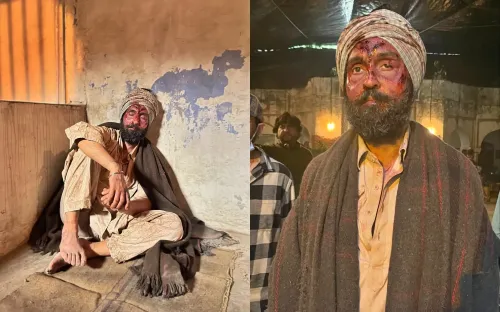
Diljit Dosanjh on Toronto university course: 'I don't know what they'll teach'

Synopsis
Diljit Dosanjh's reaction to a Toronto university course about him was pure self-deprecation — 'I don't know what they'll teach.' But his interview with Jimmy Fallon revealed why academics are paying attention: his journey from a 10th-pass Punjabi artist to selling out 55,000-seat stadiums in the very city where his ancestors were barred entry in 1914 is a narrative of diaspora triumph and cultural reclamation.
Key Takeaways
Diljit Dosanjh reacted to a Toronto university offering a course on him, telling Jimmy Fallon he doesn't know what instructors will teach.
The artist drew a historical parallel: in 1914 , Indian migrants were barred from a Vancouver stadium; now 55,000 people attend his concerts there.
The Komagata Maru incident involved over 300 passengers , mostly Sikhs , denied entry to Canada under discriminatory "continuous journey" regulations in 1914 .
Dosanjh emphasised his message is "love, forgiveness, and respect." The Toronto course reflects growing academic interest in Dosanjh's role in globalising Punjabi culture and diaspora identity.
Punjabi music sensation Diljit Dosanjh has reacted with characteristic humility to news that a Toronto university is offering a course on him, telling The Tonight Show host Jimmy Fallon that he remains unsure what instructors plan to cover, given his own educational background.
In a collaborative segment with Fallon, Dosanjh drew a striking historical parallel between his global success and the discrimination faced by early Indian immigrants to Canada. He recounted how in 1914, when Indian migrants first arrived at a Vancouver stadium, they were barred from entry — a location now just two kilometres from where the Komagata Maru incident unfolded.
The historical context
The Komagata Maru was a Japanese steamship that arrived in Vancouver in 1914 carrying over 300 passengers, predominantly Sikhs alongside Muslims and Hindus from Punjab, British India. Canadian authorities denied them entry under the reported discriminatory "continuous journey" regulations. The passengers were forced to return to India, where many faced violence and imprisonment upon arrival.
From exclusion to 55,000-strong crowds
"So yeah, that's a big thing for us now: 55,000 people in one stadium there," Dosanjh told Fallon. "It's just two kilometres from where you didn't allow us to come, and now we are here, man." The Vancouver concert represents a symbolic reversal — from state-enforced exclusion to global cultural recognition.
On the Toronto university course
When Fallon mentioned that Toronto instructors are teaching a course about Dosanjh, the artist responded with candour: "I don't know, I'm not going to college or university. I'm 10th pass, that's why my English is bad. But I don't know about that… yeah, they started a course at a Toronto university." Asked what curriculum designers might cover, Dosanjh quipped simply: "I don't know, actually."
The artist's message
When pressed on what he would want such a course to convey, Dosanjh distilled his philosophy into three words: "My message is just love, forgiveness, and respect. That's my message." The comment underscores why his music has resonated across borders — a focus on universal values rather than commercial calculation.
The Toronto course reflects a broader academic interest in Dosanjh's role in globalising Punjabi culture and his influence on diaspora identity. His reluctance to speculate on its contents, paired with his historical awareness, suggests an artist comfortable with his impact even as he remains grounded in his roots.
Point of View
But because he amplified them globally. The irony is sharp: the same Canada that barred his ancestors now studies his art. What the Toronto course should teach is not just music history, but how diaspora narratives flip the script on historical exclusion.
NationPress
16 Sept 2026
Frequently Asked Questions
What did Diljit Dosanjh say about the Toronto university course?
Diljit told Jimmy Fallon that he doesn't know what the Toronto university will teach in the course about him, adding that he is a 10th-pass student and hence his English is not fluent. He expressed uncertainty about the curriculum but acknowledged the course exists.
What is the Komagata Maru incident that Diljit referenced?
The Komagata Maru was a Japanese steamship that arrived in Vancouver in 1914 carrying over 300 passengers, predominantly Sikhs along with Muslims and Hindus from Punjab, British India. Canadian authorities denied them entry under discriminatory "continuous journey" regulations, forcing them to return to India where many faced violence and imprisonment.
Why did Diljit mention the 1914 Vancouver stadium incident?
Diljit drew a historical parallel: in 1914, Indian migrants were barred from entering a Vancouver stadium; now, 55,000 people attend his concerts at a stadium just two kilometres away from the Komagata Maru incident site. He described this as "a big thing" symbolising how far the diaspora has come.
What message did Diljit say he wants to convey?
When asked what he would want the Toronto course to teach, Diljit replied: "My message is just love, forgiveness, and respect. That's my message."