Is India-Japan Collaboration Critical for Stability in the Indo-Pacific?
Click to start listening
Synopsis
As the geopolitical landscape shifts, the alliance between India and Japan emerges as a cornerstone for stability in the Indo-Pacific. This partnership not only aims to counterbalance China's influence but also opens new avenues for economic growth and security cooperation, making it essential in today's dynamic international relations.
Key Takeaways
- India-Japan collaboration is vital for Indo-Pacific stability.
- Defense cooperation has paved the way for enhanced relations.
- Both nations are focusing on economic security and innovation.
- Joint initiatives could strengthen maritime security.
- A strong partnership is essential for countering regional threats.
Tokyo, Dec 8 (NationPress) Satoru Nagao, an authority on US-Japan-India security partnerships and a Visiting Fellow at the Hudson Institute, has emphasized that the collaboration between India and Japan is essential for preserving stability and promoting prosperity in the Indo-Pacific region, particularly in the context of countering China.
In a discussion with Politeia Research Foundation (PRF), Nagao highlighted that India, with its expanding economy and strong military, is vital for maintaining a balance in military and economic power within the Indo-Pacific area. He referred to former Japanese Prime Minister Shinzo Abe's statement in the Indian Parliament, where he expressed, "A strong India is in the best interest of Japan, and a strong Japan is in the best interest of India."
Upon being asked about India's significance in the Indo-Pacific, Nagao stated, "For Japan, the primary concern is the threat posed by China. To address this threat, Japan seeks to enhance cooperation with India. While defense collaboration has made significant strides, other sectors have lagged behind. Historically, defense ties have paved the way for broader cooperation, similar to the progress made between the US and Japan, as well as Japan and the UK."
Nagao believes that India’s rapid economic growth and military strength are crucial for maintaining a balance in the region.
"Moreover, the security dynamics between the Himalayan region and the Pacific are interconnected. Hence, the partnership between India and Japan is vital for ensuring stability and fostering growth in the Indo-Pacific. India plays a pivotal role in safeguarding maritime routes in the Indian Ocean, while Japan has been increasing its engagement with African nations, particularly in East Africa. There's potential for India and Japan to collaborate on initiatives like the Indian Ocean Africa Economic Zone Initiative, alongside the operationalization of the India-Middle East-Europe Economic Corridor. Together, they can enhance security and prosperity in the Arabian Sea," he added.
Nagao characterized India as a "rising power" and reiterated Abe's sentiments, stating, "India is on the path to becoming a major global power. The future looks promising. For Japan, a rising India symbolizes renewed hope, just as Abe emphasized in his address to the Indian Parliament.”
Nagao also serves as an Associate Professor at the Institute for International Strategy at Tokyo International University.
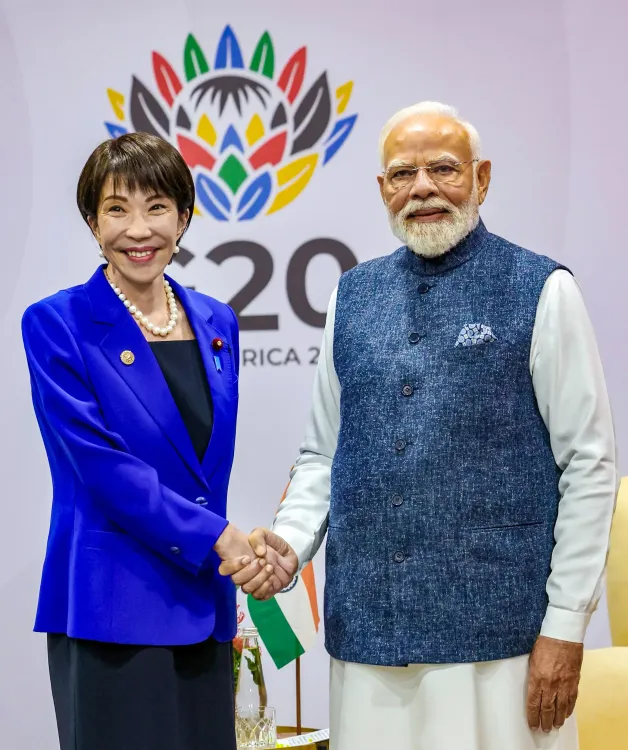
Earlier in November, Prime Minister Narendra Modi and Japanese Prime Minister Sanae Takaichi met on the sidelines of the G20 Summit in Johannesburg to explore avenues for enhancing bilateral cooperation in innovation, defense, and talent mobility. This marked their first discussion since Takaichi's assumption of office.
"I had a fruitful meeting with Prime Minister Sanae Takaichi of Japan. We explored ways to accelerate our bilateral cooperation across various domains such as innovation, defense, and talent mobility. We are also eager to strengthen our trade relations. A robust India-Japan partnership is crucial for a better planet," PM Modi shared on X.
On October 29, Modi had a phone conversation with Takaichi to congratulate her on her new role. The leaders discussed their shared vision for enhancing the India-Japan Special Strategic and Global Partnership, focusing on economic security, defense collaboration, and talent mobility.
"I had a warm discussion with Sanae Takaichi, Japan’s Prime Minister. I congratulated her on her new role and we talked about our common vision for advancing the India-Japan Special Strategic and Global Partnership, emphasizing economic security, defense cooperation, and talent mobility. We agreed that stronger India-Japan ties are essential for global peace, stability, and prosperity," PM Modi noted on X.
During their 25-minute telephonic conversation, Takaichi expressed Japan's commitment to working with India towards achieving a "Free and Open Indo-Pacific," including through the Quad, according to a statement from Japan's Ministry of Foreign Affairs. She conveyed her desire to collaborate with Modi to open a new chapter in the 'Japan-India Special Strategic and Global Partnership.'
Point of View
It is crucial to highlight that the partnership between India and Japan represents a strategic alignment that goes beyond merely countering threats. It symbolizes a collaborative effort towards a stable and prosperous Indo-Pacific, fostering economic growth and security that will benefit not only these nations but the entire region.
NationPress
09/12/2025
Frequently Asked Questions
Why is the India-Japan collaboration important?
The collaboration is vital for maintaining stability in the Indo-Pacific, balancing China's influence and enhancing economic and military cooperation.
What sectors are being focused on in India-Japan relations?
Key sectors include defense, innovation, and talent mobility, alongside enhancing trade ties.
How does this partnership impact regional security?
The partnership is crucial for securing maritime routes and promoting peace and stability in the Indo-Pacific region.
What historical context supports this collaboration?
Historically, defense cooperation has facilitated broader international partnerships, as seen in Japan's ties with the US and UK.
What future initiatives could emerge from this collaboration?
Potential initiatives include the Indian Ocean Africa Economic Zone Initiative and the operationalization of the India-Middle East-Europe Economic Corridor.