Is India Dedicated to Establishing Global Standards Against AI-Driven Terrorism Threats?
Click to start listening
Synopsis
As digitalization continues to reshape our world, India is intensifying efforts to establish global standards aimed at combating the rising threats of AI-driven terrorism. With collaborations alongside the UAE and experts from around the globe, the initiative seeks to enhance security measures and protect against emerging technological risks.
Key Takeaways
- India is committed to establishing global standards against AI-driven terrorism.
- Collaboration with the UAE highlights the importance of international partnerships in security.
- The Delhi Declaration marks significant progress in addressing new technological challenges.
- AI tools are increasingly essential for law enforcement in counter-terrorism.
- Online gaming platforms are vulnerable to misuse by terrorist organizations.
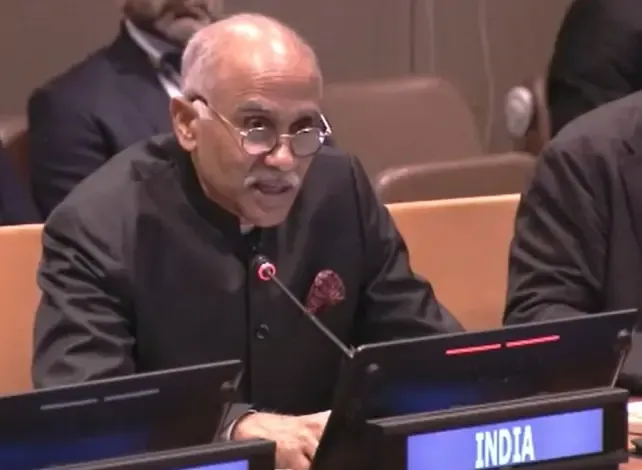
United Nations, Dec 11 (NationPress) As the digital transformation impacts every aspect of life, from personal interactions to essential infrastructures, ensuring their safety from terrorist activities is crucial. India's Permanent Representative, P. Harish, emphasized the nation's dedication to formulating global standards to combat these threats.
During a meeting sponsored by India on 'Building Operational Capacities to Use AI in Counter-Terrorism', he remarked, "The risks associated with deep fakes, cybersecurity breaches, data theft, and the harmful use of high-risk AI technologies are escalating as technology advances."
He underscored that addressing cyber vulnerabilities and thwarting terror threats is now of utmost importance.
Harish highlighted the need to enhance the capabilities of law enforcement and security agencies in leveraging AI tools effectively.
In collaboration with the United Arab Emirates, India co-hosted the meeting with UN counter-terrorism units, where global experts discussed the emerging threats posed by AI, including drones and deep fakes, along with strategies to counter them.
Harish stated that India and the UAE are leading efforts to establish global standards to tackle these dangers.
UAE's Permanent Representative, Mohamed Abushahab, referenced the Delhi Declaration on counter-terrorism, adopted by the Security Council's Counter-Terrorism Committee (CTC) during its visit to India in 2022.
This declaration, promoted by India, signifies a substantial commitment to addressing the challenges posed by new technologies in counter-terrorism.
It called for international collaboration to counter terrorists utilizing new technologies, including drones, information communication technologies, and innovative payment systems.
Abushahab noted that the CTC subsequently adopted the Abu Dhabi Guiding Principles, targeting the misuse of drones by terrorists.
Alexandre Zouev, the acting under-secretary-general for counter-terrorism, shared that law enforcement agencies are increasingly relying on AI to combat terrorism, citing examples where AI-assisted tools enable investigators to process digital evidence at unprecedented speeds.
AI-driven analysis allows agencies to "identify patterns early enough to proactively intervene," and national cybersecurity authorities utilize AI to detect anomalies in real time, thus preventing and mitigating cyber attacks.
Zouev cautioned about terrorist organizations attempting to recruit young individuals with expertise in AI.
"It’s a nightmare scenario where terrorist groups lure the most talented individuals from universities and professional networks," he stated.
He emphasized the need for proactive measures to engage these talents in various counter-terrorism initiatives.
UAE's cybersecurity chief, Mohamed Al Kuwaiti, raised concerns about online gaming platforms being exploited by terrorists to recruit or radicalize young players.
Games like Black Ops, Call of Duty, Red Dead Redemption, and Grand Theft Auto are among those identified as tools for targeting youth.
To combat this, the UAE has entered an agreement with Roblox, a popular gaming platform, to remove games that pose such threats.
(Arul Louis can be reached at arul.l@ians.in)
Point of View
India's proactive approach in addressing the pressing challenges posed by AI in terrorism is commendable. The collaboration with the UAE and the establishment of global standards reflects a commitment to safeguarding national and global security. In a world increasingly reliant on technology, such initiatives are vital for ensuring public safety and maintaining peace.
NationPress
12/12/2025
Frequently Asked Questions
What are the main threats posed by AI in terrorism?
The main threats include deep fakes, cybersecurity vulnerabilities, data theft, and the malicious use of AI technologies.
Who is leading the initiative to establish global standards against AI-driven terrorism?
India, in collaboration with the United Arab Emirates, is at the forefront of these efforts.
What is the Delhi Declaration?
The Delhi Declaration is a commitment adopted by the Security Council's Counter-Terrorism Committee that addresses the challenges posed by new technologies in counter-terrorism.
How is AI being used by law enforcement to combat terrorism?
AI is used to process digital evidence rapidly and to identify patterns that allow for early interventions against potential threats.
What role do online games play in terrorism recruitment?
Terrorists have exploited online games to recruit and radicalize young individuals, making them a target for counter-terrorism efforts.