Nepal's New 'Nepal First' Foreign Policy Under PM Balendra Shah
Synopsis
In a significant shift towards a 'nation-first' approach, Prime Minister Balendra Shah's government in Nepal has introduced a 'Nepal First' foreign policy aimed at prioritizing national interests and fostering regional cooperation amidst evolving global dynamics.
Key Takeaways
'Nepal First' foreign policy prioritizes national interests.
It aims to maintain balanced relations with all countries.
The approach is influenced by the geopolitical landscape between India and China.
Six political parties are involved in shaping this policy.
The goal is to enhance economic development and regional cooperation.
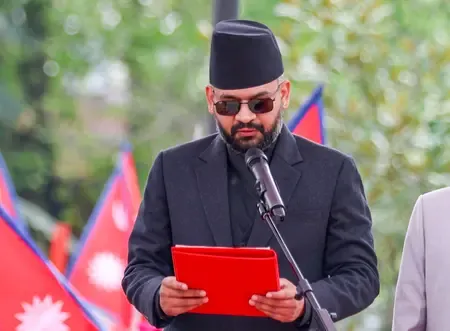
Kathmandu, April 14 (NationPress) In line with a rising global inclination towards "nation-first" foreign policies, the freshly formed Nepali government under Prime Minister Balendra Shah has announced intentions to implement a "Nepal First" foreign policy.
The government highlighted that the principle of 'Nepal First, Nepalis First' will be at the forefront of its diplomatic efforts, as stated in a draft of the National Commitment Paper shared for input among six political parties that gained national recognition following the elections on March 5.
The recognized political entities include the Rastriya Swatantra Party, Nepali Congress, Communist Party of Nepal (Unified Marxist Leninist), Nepali Communist Party, Rastriya Prajatantra Party, and Shram Sanskriti Party.
This draft was formulated as part of the 100-point governance reform strategy introduced by the new Nepali administration shortly after Balendra Shah's inauguration on March 27.
As per the proposed framework, the Himalayan nation aims to maintain an "equal distance and equal proximity" stance with all countries, grounded in the belief that military alliances, arms races, and conflicts impede global harmony.
In practice, Nepal enjoys a complex relationship with India, owing to shared geography, culture, and religion, as both are predominantly Hindu nations.
Nepal's approach will also focus on a "balanced and dynamic diplomacy" that seeks to turn the evolving global geopolitical landscape into developmental opportunities, while prioritizing the country's sovereignty, territorial integrity, and national interests.
The draft National Commitment Paper emphasizes that Nepal will strategically utilize the ascent of neighboring powers and changing global dynamics to boost economic growth, attract investments, and enhance regional collaboration.
With this strategy, Nepal aims to transition from being perceived merely as a "buffer state" to becoming a "vibrant bridge," reaffirming its commitment to sovereignty and national interests.
Situated between the two major powers—India and China—Nepal has historically been viewed as a buffer zone for these geopolitical rivals.
The Nepali government aspires to advance its national interests through trilateral economic cooperatives and regional connectivity while firmly establishing Nepal on the global stage as a sovereign, neutral, and non-aligned entity.
While the proposal does not explicitly name the countries involved in trilateral cooperation, it is typically understood to involve Nepal, India, and China.
Frequently Asked Questions
What is the 'Nepal First' foreign policy?
The 'Nepal First' foreign policy prioritizes national interests and aims to maintain balanced relations with all countries, enhancing economic development while safeguarding sovereignty.
Who is leading the new foreign policy initiative?
The initiative is led by Prime Minister Balendra Shah and his newly formed government.
What does the proposed foreign policy emphasize?
It emphasizes maintaining equal distance with all nations and fostering regional cooperation while focusing on Nepal's sovereignty and national interests.
Which political parties are involved in this initiative?
The initiative involves six parties, including the Rastriya Swatantra Party and Nepali Congress, which gained national recognition after the March 5 elections.
What are the expected benefits of this policy?
The policy aims to boost economic growth, attract investment, and strengthen Nepal's position on the global stage as a neutral and independent country.