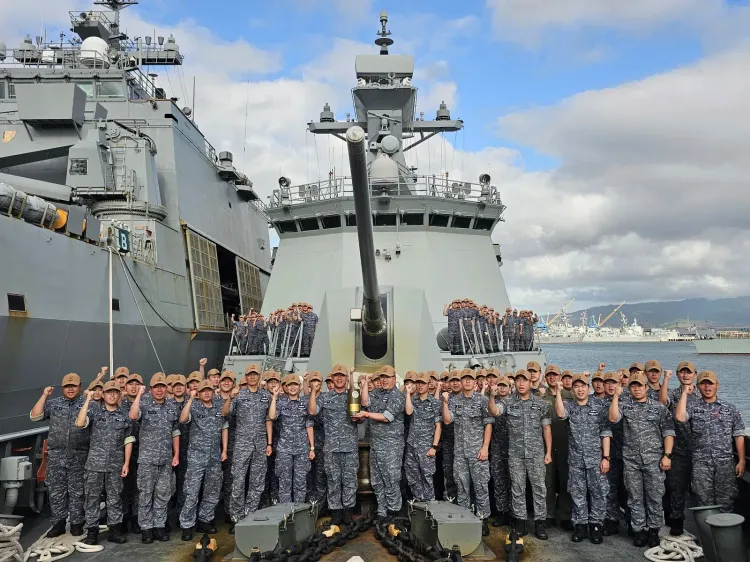
ROKS Daejeon wins RIMPAC gunnery top prize, South Korea's first in 16 years
Synopsis
South Korea's ROKS Daejeon has claimed the top gunnery prize at RIMPAC 2025, ending a 16-year drought since the King Sejong the Great's 2010 win — and doing so in the same exercise where South Korea became the first Asian nation to command the Combined Force Maritime Component. It is a double milestone that signals Seoul's rising weight in Indo-Pacific security.
Key Takeaways
ROKS Daejeon , a 3,100-ton South Korean frigate, won the NSFS Rodeo gunnery competition at RIMPAC 2025 .
It beat 13 warships from 10 countries in the live-fire event held on 12 July 2025 in Hawaii .
South Korea's last RIMPAC gunnery win was in 2010 — a gap of 16 years .
South Korea also served as commander of the Combined Force Maritime Component , the first Asian country and fourth non-US nation to do so.
Vice Admiral Jeffrey Jablon of the US Pacific Fleet called it a 'historic leadership milestone' on 29 July .
The South Korean Navy's 3,100-ton frigate ROKS Daejeon claimed the top honour at the Naval Surface Fire Support (NSFS) Rodeo live-fire gunnery competition during this year's Rim of the Pacific (RIMPAC) exercise, the Navy confirmed on Sunday, 2 August 2025. The victory ends a 16-year wait for South Korea, whose last winner was the destroyer King Sejong the Great in 2010.
Competition Results
The ROKS Daejeon outscored 12 other warships from 10 nations in the NSFS Rodeo held in Hawaii on 12 July 2025, though results were formally announced at the exercise's closing ceremony on Friday. The competition tests warships on precision naval gunfire support — a critical combined-arms capability in modern maritime operations.
South Korea's Historic Command Role
The gunnery triumph came alongside an equally significant command milestone: South Korea served as the commander of the Combined Force Maritime Component during RIMPAC 2025, making it the first Asian country and the fourth non-US participant ever to assume that commanding role. Canada, Chile, and Japan also took on specific leadership positions during the exercise.
Vice Admiral Jeffrey Jablon, deputy commander of the US Pacific Fleet, described South Korea's leadership as a 'historic leadership milestone' during a virtual press briefing on 29 July. 'RIMPAC showcased historic leadership milestones. The Republic of Korea commanded the Combined Force Maritime Component for the first time,' he said, emphasising the exercise's core theme of shared responsibility.
About RIMPAC
Launched in 1971, RIMPAC is a biennial multinational exercise designed to strengthen cooperation among participating nations in securing sea lines of communication and countering maritime security challenges. The 2025 edition ran from 24 June through Friday, operating in and around the Hawaiian Islands.
Why It Matters
South Korea's dual achievement — a gunnery championship and a first-ever combined-force command — signals a deepening of Seoul's role in the Indo-Pacific security architecture. This comes amid heightened regional tensions and growing US emphasis on burden-sharing among allies. Notably, the command role places South Korea alongside established naval powers that have historically led such multinational formations. The ROKS Daejeon's performance reinforces the Republic of Korea Navy's investment in surface warfare capabilities and its readiness to operate alongside allied fleets at the highest level.
Point of View
Not a symbolic one. The question is whether this translates into expanded South Korean defence commitments beyond the peninsula — something that would carry significant geopolitical weight given tensions with both North Korea and China.
NationPress
17 Sept 2026
Frequently Asked Questions
Which South Korean warship won the RIMPAC 2025 gunnery competition?
The ROKS Daejeon, a 3,100-ton frigate of the South Korean Navy, won the Naval Surface Fire Support (NSFS) Rodeo competition at RIMPAC 2025. It scored the highest points among 13 warships from 10 countries in the live-fire event held in Hawaii on 12 July 2025.
When was the last time South Korea won the RIMPAC gunnery competition?
South Korea's previous RIMPAC gunnery win was in 2010, when the destroyer King Sejong the Great claimed the top prize. The ROKS Daejeon's 2025 victory ends a 16-year gap.
What is the NSFS Rodeo competition at RIMPAC?
The Naval Surface Fire Support (NSFS) Rodeo is a live-fire gunnery competition held as part of the RIMPAC exercise, testing warships from participating nations on precision naval gunfire support. In 2025, 13 warships from 10 countries competed.
What was South Korea's command role at RIMPAC 2025?
South Korea served as commander of the Combined Force Maritime Component at RIMPAC 2025, making it the first Asian country and the fourth non-US participant ever to hold that role. The US, Canada, Chile, and Japan also held specific leadership positions in the exercise.
What is RIMPAC and how often does it take place?
RIMPAC — the Rim of the Pacific exercise — is a biennial multinational naval exercise launched in 1971, designed to strengthen cooperation in securing sea lines of communication and addressing maritime security challenges. The 2025 edition ran from 24 June through late July in and around the Hawaiian Islands.