Are South Korea and the US Ready to Launch Working Groups on Summit Agreements?
Click to start listening
Synopsis
Seoul and Washington are gearing up to form working groups to advance negotiations on crucial summit agreements, including South Korea's plans for nuclear submarines and civil uranium enrichment rights. This collaboration marks a significant step in their ongoing alliance and addresses key issues in nuclear energy and security.
Key Takeaways
- Formation of working groups to advance summit agreements.
- Discussions on nuclear-powered submarines and civil uranium enrichment rights.
- Commitments outlined in the joint fact sheet from recent summits.
- U.S. support for South Korea's nuclear ambitions, subject to regulations.
- Collaboration to modernize the U.S.-ROK alliance.
Seoul, Dec 2 (Yonhap) South Korea and the United States have reached an agreement to promptly establish working groups aimed at advancing negotiations on the recent summit agreements, which include Seoul's ambitions to construct nuclear-powered submarines and seek civil uranium enrichment rights, as stated by the foreign ministry on Tuesday.
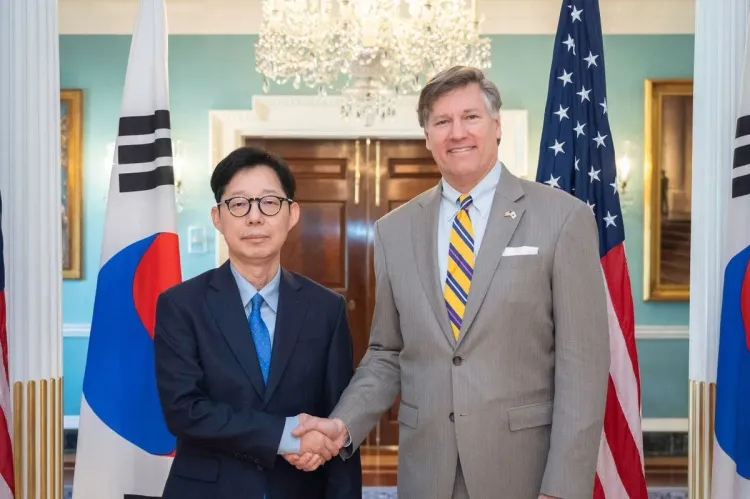
During discussions held on Monday (local time) in Washington, First Vice Foreign Minister Park Yoon-joo emphasized the necessity of these initiatives with U.S. Deputy Secretary of State Christopher Landau, marking the first high-level follow-up dialogue since the issuance of the joint fact sheet on November 14.
The ministry's release noted, "The vice minister and the deputy secretary concurred on the urgency to promptly initiate sectoral working groups to guarantee the swift and comprehensive execution of follow-up measures in pivotal sectors such as nuclear energy, shipbuilding, and nuclear-powered submarines."
Vice Minister Park urged for a rapid commencement of discussions between Seoul and Washington regarding civil uranium enrichment and spent fuel reprocessing capabilities, the ministry added.
Landau reciprocated by stating that the two nations "should maintain close communication on the issue," according to the ministry's summary.
This joint fact sheet outlines the commitments regarding trade, investment, security, and other matters established during the two recent summits between President Lee Jae Myung and U.S. President Donald Trump in August and October.
The document indicates that the U.S. endorses the process leading to South Korea's civil uranium enrichment and spent fuel reprocessing for peaceful purposes, consistent with their existing bilateral nuclear energy agreement and subject to U.S. legal stipulations.
Additionally, the U.S. has approved South Korea's plans to develop nuclear-powered attack submarines and is committed to facilitating the necessary requirements, including fuel sourcing.
Under the bilateral 123 Agreement, South Korea's ability to enrich uranium for civil purposes or reprocess spent fuel is contingent upon obtaining consent from the U.S., following bilateral consultations in accordance with treaties and regulations governing both nations. This agreement is perceived as effectively restricting Seoul from executing these activities.
Attention is now directed towards how the allies will proceed with implementing the commitments outlined in the fact sheet, particularly regarding uranium enrichment and spent fuel reprocessing capabilities.
The two parties have also agreed to collaborate closely to ensure that follow-up discussions on nuclear-powered submarines and shipbuilding cooperation can commence earnestly, as stated by the ministry.
Park further elaborated on Seoul's efforts to fulfill its commitments as per the fact sheet and requested the U.S. to undertake corresponding measures, including reducing U.S. tariffs on South Korean products.
On the topic of the U.S. visa system for South Korean investors, Park highlighted significant progress with the introduction of a dedicated visa desk for Korean companies and urged Landau to maintain focus on facilitating their smooth entry into the U.S.
After the discussions, Park informed reporters that each side would appoint officials responsible for the follow-up negotiations related to the fact sheet among the relevant government agencies.
"The U.S. will appoint its representatives, and we will establish our own task force for coordination," he stated.
While in Washington, Park is also scheduled to engage with officials from the State Department overseeing Korean affairs and the White House National Security Council to deliberate on subsequent steps following the summits and issues concerning North Korea, according to the ministry.
In a separate statement, the U.S. State Department confirmed that both sides discussed the implementation of the joint fact sheet, encompassing commitments to modernize the alliance and enhance shipbuilding cooperation.
"They discussed the execution of the U.S.-ROK Joint Fact Sheet, which encompasses modernizing the U.S.-ROK Alliance — the cornerstone of peace, security, and prosperity on the Korean Peninsula and throughout the Indo-Pacific region for over 70 years," stated Tommy Pigott, principal deputy spokesperson.
Point of View
This development signifies a critical juncture in the U.S.-South Korea alliance. The swift formation of working groups demonstrates a proactive approach to address pressing security and energy issues, reinforcing the partnership's commitment to mutual interests. It is essential for both nations to navigate these negotiations carefully, ensuring that their collaboration strengthens regional stability and aligns with international norms.
NationPress
02/12/2025
Frequently Asked Questions
What are the key agreements between South Korea and the US?
The key agreements include South Korea's plans to develop nuclear-powered submarines and pursue civil uranium enrichment rights.
Who are the main officials involved in these discussions?
The main officials involved are South Korean First Vice Foreign Minister Park Yoon-joo and U.S. Deputy Secretary of State Christopher Landau.
What is the significance of the joint fact sheet?
The joint fact sheet outlines the commitments on trade, investment, and security made during recent summits, serving as a roadmap for future cooperation.
How does the bilateral 123 Agreement affect South Korea's nuclear ambitions?
The bilateral 123 Agreement stipulates that South Korea may enrich uranium or reprocess spent fuel only with U.S. consent, placing restrictions on these activities.
What steps are being taken to facilitate South Korean investment in the US?
Significant progress has been made with the launch of a dedicated visa desk for South Korean businesses to ensure smoother access to the U.S. market.