Senate Showdown: Republicans Call Trump Probe a 'Modern Watergate'
Synopsis
The US Senate witnessed a contentious clash as Republicans denounced federal probes into Donald Trump as a 'modern Watergate,' while Democrats defended the actions as standard law enforcement. Key figures like Senator Ted Cruz led accusations of abuse of power, igniting fierce debate.
Key Takeaways
Partisan tensions: The Senate clash highlighted the growing divide between Republicans and Democrats.
Allegations of abuse: Republicans accused federal investigators of misusing power in their inquiries.
Defense of investigations: Democrats insisted that the probes are standard legal procedures.
Calls for testimony: Democrats demanded that key figures like Jack Smith testify under oath.
Impact on public trust: The outcomes of these hearings may affect public perception of government integrity.
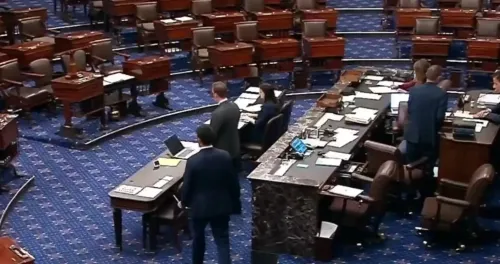
Washington, March 25 (NationPress) A fierce political battle unfolded in the US Senate as Republicans charged federal investigators with conducting a significant abuse of authority in their probes concerning Donald Trump, comparing the situation to a “modern Watergate.” Meanwhile, Democrats dismissed these allegations as baseless, asserting that the investigations are normal law enforcement procedures.
During a contentious Judiciary subcommittee meeting named “Arctic Frost,” Senator Ted Cruz, a Republican from Texas, stated that the Justice Department, under former President Joe Biden, had sanctioned an extensive investigation that invaded “approximately 100,000 private communications” and aimed at “more than a dozen Senators and thousands of individuals.”
“This is a modern Watergate,” Cruz declared, insisting that this inquiry exceeded previous scandals due to its “full authorization, formalization, and execution through the official powers of the United States government.”
He claimed that nearly 200 subpoenas had been issued, encompassing over 400 Republican-affiliated individuals and groups, including political entities, contributors, and legal representatives. Cruz noted that among the targets were organizations connected to Trump’s political sphere, including his campaign and associated groups.
Republicans emphasized the use of subpoenas to access phone “toll records,” including those belonging to lawmakers. Cruz alleged that the FBI had gathered data from “nearly 20 percent of the Republicans in the Senate,” describing it as an extraordinary intrusion. Senator Mike Lee of Utah referred to the investigation as “a development of staggering proportions,” while Senator John Kennedy of Louisiana questioned the compliance of telecommunications firms with the subpoenas.
Witnesses invited by the Republicans supported these concerns. Legal analyst Will Chamberlain pointed to reports that the FBI had recorded a phone conversation between Trump campaign adviser Susie Wiles and her attorney. If conducted without consent, he warned, “we are likely looking at an illegal wiretap.” He also criticized the internal FBI practices that limit access to certain files, suggesting that such actions could obstruct oversight.
In response, Democrats argued that the hearing was politically motivated and overlooked the justification behind the investigation into Trump and his associates. Senator Sheldon Whitehouse of Rhode Island remarked that subpoenas for phone records are a normal aspect of criminal investigations.
“Of course they did,” he said about investigators pursuing such records. “Virtually every investigation involves subpoenas for toll records for any number of reasons.”
Whitehouse contended that individuals like Kash Patel and Wiles were pertinent to the inquiry. Patel, he noted, had positioned himself as “a fact witness,” while Wiles was mentioned in the classified documents case concerning Trump.
Democrats persistently urged Republicans to summon Special Counsel Jack Smith—who oversaw the investigations—to testify under oath. “Why not call him? Hear it from the man himself?” Whitehouse challenged.
Another Democratic senator labeled the hearing as “a baseless partisan witch hunt,” while Senator Mazie Hirono of Hawaii accused Republicans of “milking a dead cow” by revisiting issues already scrutinized.
Christopher O’Leary, a former senior FBI official who provided testimony, defended the bureau’s institutional protocols and rejected accusations of a politically motivated conspiracy. He asserted that investigations rely on “facts, intelligence, and evidence, not ideology or affiliation.”
However, O’Leary cautioned that recent dismissals of FBI personnel had inflicted “generational damage” on national security capabilities, especially in counterintelligence operations.
Point of View
The ongoing Senate hearings highlight the deepening partisan divide in American politics. While Republicans express serious concerns about the integrity of investigations involving a former president, Democrats maintain that these actions are necessary for accountability. The repercussions of this clash will shape public trust in governmental processes.
NationPress
24 Sept 2026
Frequently Asked Questions
What was the main issue in the Senate hearing?
The main issue revolved around Republicans accusing federal investigators of abusing their power in the inquiries into Donald Trump.
How did Democrats respond to the accusations?
Democrats dismissed the claims as unfounded and defended the investigations as standard law enforcement procedures.
What did Senator Ted Cruz claim about the investigation?
Senator Ted Cruz claimed that the Justice Department's investigation intruded into private communications and involved numerous subpoenas targeting Republican individuals.
What are the implications of this Senate clash?
The implications could deepen the partisan divide and impact public trust in the investigations and law enforcement.
Who is Special Counsel Jack Smith?
Special Counsel Jack Smith is overseeing the investigations into Donald Trump, and Democrats have urged Republicans to summon him to testify.