How is S.Korea Planning to Lead the Quantum Industry?

Synopsis
South Korea's science ministry has laid out an ambitious road map to become the world's leading quantum chip producer by 2035. This initiative includes training thousands of specialists and creating collaborative clusters to harness the potential of quantum technology and AI. Could this move position South Korea as a global leader in the future of technology?
Key Takeaways
South Korea aims to lead the quantum chip industry by 2035.
10,000 experts will be trained in quantum technology.
The government plans to invest $5.6 billion in R&D.
Collaboration with major firms is a key strategy.
Quantum clusters will be established to drive innovation.
Seoul, Jan 29 (NationPress) On Thursday, South Korea's science ministry introduced a detailed plan to advance the quantum sector, with ambitions to become the leading producer of quantum chips globally by 2035.
The Ministry of Science and ICT outlined a strategy to cultivate 10,000 specialists in quantum technology and support the growth of 2,000 enterprises, aiming to secure indigenous quantum innovations that could revolutionize industries, particularly in the artificial intelligence (AI) domain, as reported by Yonhap News Agency.
By July, the government intends to identify five sites to create what are termed 'quantum clusters', which will spearhead the country's transition into a quantum future, according to the ministry.
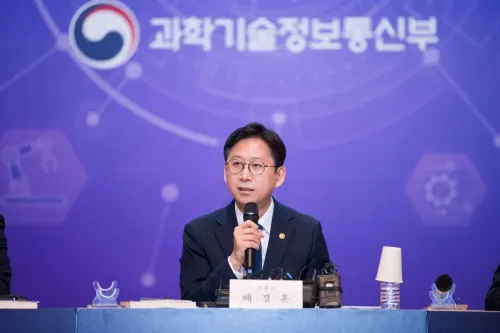
Science Minister Bae Kyung-hoon remarked, 'Quantum technology is a significant innovation that will define a nation’s competitive edge in the post-AI landscape.' He emphasized that the government will leverage all national resources across industries, academia, research institutions, and the public sector to establish South Korea as a global leader in quantum technology and industry through this comprehensive initiative.
Additionally, the ministry has signed a memorandum of understanding with the US-based quantum computing firm IonQ to facilitate the establishment of a joint research center in South Korea, with an investment of US$15 million over the next three years.
Leading South Korean corporations, including Samsung Electronics, LG Electronics, and SK Telecom Co., have also formed a quantum technology consultative body to enhance collaboration, as stated by the ministry.
Earlier this month, it was announced that the ministry plans to allocate $5.6 billion for research and development in science and information and communications technology by 2026.
This budget, which reflects an increase of 25.4% from the previous year, consists of 6.44 trillion won for science and technology and 1.68 trillion won for ICT, according to the Ministry of Science and ICT.
The ministry highlighted that this expanded budget aims to foster innovation-led growth amid global economic challenges and persistent low growth, while also propelling South Korea towards becoming one of the top three powers in artificial intelligence.
In the realm of science and technology, the government plans to enhance investments in future technologies, such as biotechnology and quantum science, while reinforcing core technologies to maintain a competitive advantage in essential industries like semiconductors and secondary batteries.
Point of View
I believe this initiative by South Korea is a forward-thinking approach to securing a competitive edge in the rapidly evolving tech landscape. The focus on quantum technology and AI is commendable, and it aligns with global trends that prioritize innovation and expertise. This could very well position South Korea as a leader in these critical fields.
NationPress
30 Sept 2026
Frequently Asked Questions
What is the goal of South Korea's quantum industry roadmap?
The goal is to become the world's leading producer of quantum chips by 2035, while training thousands of experts and fostering local businesses in the quantum field.
How much is the government investing in research and development?
The government plans to invest $5.6 billion in research and development for science and ICT by 2026.
What are quantum clusters?
Quantum clusters are designated areas where collaboration and innovation in quantum technology will be prioritized to enhance South Korea's capabilities.
Which companies are involved in this initiative?
Major companies like Samsung Electronics, LG Electronics, and SK Telecom Co. are actively participating by forming a consultative body on quantum technology.
What is the significance of the partnership with IonQ?
The partnership with IonQ includes establishing a joint research center in South Korea, which will enhance collaboration and investment in quantum computing.