Did South Korea's Defence Chief Apologize for Military's Role in Yoon's Martial Law Attempt?
Click to start listening
Synopsis
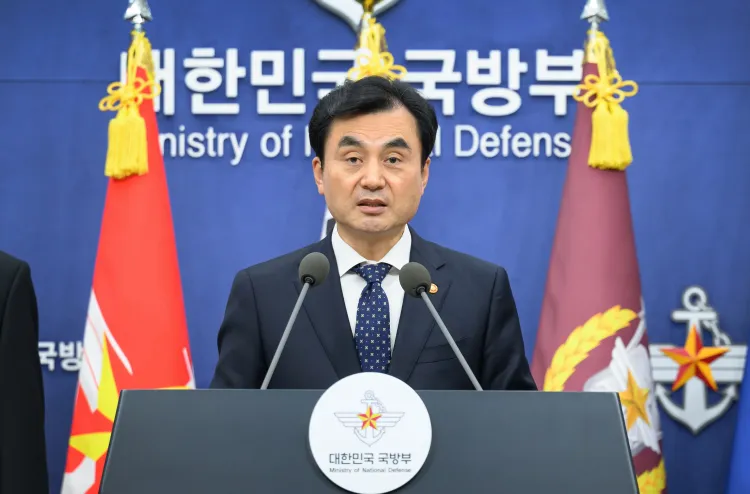
Amid the first anniversary of a controversial martial law bid, South Korea's Defence Minister Ahn Gyu-back has publicly apologized for the military's actions under former President Yoon Suk Yeol. This pivotal moment raises questions about military accountability and civil control in South Korea.
Key Takeaways
- Ahn Gyu-back apologized for military's actions during Yoon's martial law attempt.
- The military's involvement caused public safety concerns.
- Key generals are facing trial for their roles in the insurrection.
- President Lee Jae Myung emphasizes addressing unresolved acts of insurrection.
- Military reform is a priority for the current administration.
Seoul, Dec 2 (NationPress) South Korea's Defence Minister Ahn Gyu-back issued an apology on Tuesday regarding the military's participation in the unsuccessful martial law attempt by former President Yoon Suk Yeol last December.
This statement was made via a Facebook post, coinciding with the upcoming first anniversary of the brief martial law declared on December 3. At that time, the defence ministry was led by Yoon's predecessor, Kim Yong-hyun, as reported by Yonhap News Agency.
Ahn expressed, "I sincerely apologize on behalf of the military for jeopardizing public safety, causing significant distress among innocent service personnel, and for the severe transgression of encroaching on the National Assembly and the National Election Commission."
He mentioned that upon his appointment as the first civilian defence minister in 64 years, he pledged to transform the military into an entity dedicated to the public and to distance it from its previous role as a mere tool for enforcing martial law.
"My commitment has been unwavering from the outset, as I believe that each action we undertake will mark a significant step in quelling insurrection and reinforcing civilian authority," he added.
During the night martial law was enacted, military and police forces were dispatched to the National Assembly to obstruct lawmakers from voting against the decree.
Key generals appointed by Yoon, including Army Chief of Staff Gen. Park An-su, who oversaw the martial law operations, and former head of the Defence Counterintelligence Command Lt. Gen. Yeo In-hyung, are facing trial for their pivotal roles in the insurrection.
On Monday, South Korean President Lee Jae Myung emphasized the necessity of addressing unresolved "insurrection acts" linked to last year's martial law initiative, to prevent future occurrences as the anniversary approaches.
Lee shared his thoughts on X, referencing an article claiming that South Korean troops had distributed leaflets towards North Korea prior to any response from the North.
“We were on the verge of war, and it was the people of the great Republic of Korea who averted it,” stated Lee.
"(They) sought to instigate a war under the guise of martial law, even issuing orders for troops to release balloons towards the North," he cautioned, asserting that if such insurrection acts remain unaddressed, they will "inevitably resurface in the future."
Point of View
I believe this apology reflects a critical moment in South Korea's commitment to democratic values. Ahn Gyu-back's acknowledgment of military overreach underlines the need for accountability in governance and the importance of civilian control over military actions. This incident serves as a reminder of the delicate balance between security and democratic freedoms.
NationPress
02/12/2025
Frequently Asked Questions
What prompted Ahn Gyu-back's apology?
Ahn Gyu-back's apology was prompted by the military's involvement in former President Yoon Suk Yeol's failed martial law bid last December, which raised concerns about public safety and military accountability.
What are the implications of the apology?
The apology signifies a commitment to reform within the military and a recognition of the importance of civilian oversight, which is essential for the health of South Korea's democracy.