Trump Calls Communism 'Enemy of July 4' in Independence Day Message

Synopsis
On Independence Day 2026, the White House posted President Trump's declaration that communism is 'the enemy of free people everywhere' and the enemy of July 4, 1776. The statement invokes America's founding principles to frame an unambiguous ideological stance, consistent with Trump's long-held foreign policy positions on communist-led states.
Key Takeaways
The White House posted President Donald J.
Trump 's Independence Day statement on 4 July 2026 .
Trump declared communism 'the enemy of free people everywhere,' the enemy of the U.S.
Constitution , and 'the enemy of July 4, 1776 .' The statement anchors its argument in the Declaration of Independence , adopted on 4 July 1776 , which established individual liberty and consent of the governed as American founding principles.
Trump's 2017 National Security Strategy and his Warsaw speech established the same ideological framing against communist states.
The message carries strategic significance for democratic allies, including India , given deepening US-India defence and technology ties amid shared concerns about communist-led states in the Indo-Pacific.
Analysts will watch for follow-on executive actions, sanctions, or Pentagon posture shifts directed at communist-governed states.
The White House posted a sharp ideological statement by President Donald J. Trump on 4 July 2026, declaring communism the enemy of free people, the Constitution, and the founding ideals of the United States. The post, shared on the official White House X account, drew on the symbolism of Independence Day to frame an unambiguous ideological position ahead of the national holiday's celebrations.
Context
In the post, President Trump stated: 'Communism is the enemy of free people everywhere. It is the enemy of the Constitution. Above all, it is the enemy of July 4, 1776.' The statement anchors its argument in the date of the adoption of the Declaration of Independence, the foundational document establishing individual liberty and self-government as the bedrock of the American republic. U.S. presidents have long used Independence Day addresses to contrast American founding principles with competing political systems, a tradition that intensified during the Cold War era.
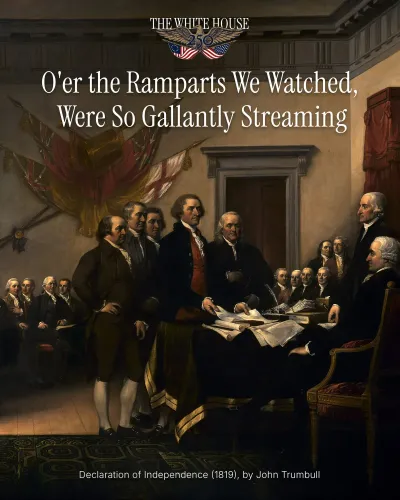
The invocation of 1776 is deliberate. The Declaration of Independence, adopted on 4 July 1776 by the Second Continental Congress, articulated that governments derive their just powers from the consent of the governed — a principle directly at odds with communist political theory, which historically subordinates individual rights to the collective authority of the state and the ruling party.
Policy Backdrop
Trump's rhetorical framing is consistent with positions he has held across his political career. His December 2017 National Security Strategy explicitly labeled China a strategic competitor and placed ideological competition with authoritarian communist states at the centre of U.S. foreign policy. In a landmark July 2017 Warsaw speech, Trump similarly framed the defense of Western civilisation against competing radical ideologies as a core presidential duty.
The broader pattern of such messaging serves a dual purpose: mobilising domestic audiences around patriotic themes and sending a clear signal to foreign governments led by communist parties. China and Cuba remain the most prominent communist-governed states in the current geopolitical landscape, and any escalation in rhetoric from the White House is closely watched by policymakers and allies alike.
Stakeholders and Impact
For American citizens, the statement reinforces a nationalist, constitutionalist framing of Independence Day, one that situates contemporary great-power competition within the moral vocabulary of the founding era. For democratic allies — including India, which shares a strategic partnership with the United States — such declarations from Washington carry weight as signals of ideological alignment in multilateral forums.
From an Indian strategic perspective, the statement lands at a time when New Delhi and Washington have deepened defence and technology ties, partly driven by shared concerns about the influence of communist-led states in the Indo-Pacific. Indian policymakers and strategic analysts will note the White House's willingness to use explicit ideological language rather than purely transactional foreign-policy framing.
What's Next
Observers will watch for follow-on executive actions, sanctions designations, or Department of Defense posture statements directed at communist-governed states in the weeks following Independence Day. Congressional hearings on ideological competition, export controls, or patriotic education initiatives are also possible in the near term. The statement sets an ideological tone for the remainder of the summer legislative calendar and could shape the framing of upcoming bilateral engagements with both allies and adversaries.
Point of View
Not merely strategic. For Indo-Pacific partners like India, such language from Washington reinforces the normative dimension of the alliance architecture being constructed against communist-led revisionist powers. The timing on Independence Day maximises domestic resonance while ensuring the message reaches foreign capitals at a moment of heightened symbolic attention.
NationPress
3 Oct 2026
Frequently Asked Questions
What did Trump say about communism on July 4 2026?
President Trump, via the official White House X account, declared that 'Communism is the enemy of free people everywhere. It is the enemy of the Constitution. Above all, it is the enemy of July 4, 1776.' The statement was posted on Independence Day 2026.
Why did Trump invoke July 4 1776 in his anti-communism statement?
July 4, 1776 is the date the Declaration of Independence was adopted, establishing individual liberty and self-government as America's founding principles. Trump used this date to argue that communism is philosophically incompatible with the core values on which the United States was founded.
What is the White House's position on communism?
The White House, under President Trump, has consistently framed communism as an existential ideological threat to American institutions. This position was formalised in the 2017 National Security Strategy, which labeled communist-led China a strategic competitor and placed ideological competition at the centre of U.S. foreign policy.
How does Trump's communism statement affect India?
India, as a democratic partner deepening defence and technology ties with the United States, will note the White House's explicit ideological framing. Such statements reinforce the normative basis of the US-India strategic partnership, particularly given shared concerns about communist-led states in the Indo-Pacific region.
What actions could follow Trump's Independence Day anti-communism statement?
Analysts expect possible follow-on executive actions, sanctions designations, or Pentagon posture statements directed at communist-governed states. Congressional hearings on ideological competition or patriotic education initiatives are also considered likely in the near term.