Could Trump’s Concerns Signal Antitrust Issues for Netflix's Acquisition of Warner Bros.?
Click to start listening
Synopsis
US President Donald Trump warns about potential antitrust challenges associated with Netflix's acquisition of Warner Bros. This deal, valued at up to $83 billion, poses critical implications for the streaming landscape, particularly in fast-growing markets like India. How will regulators respond to this significant shift in media ownership?
Key Takeaways
- Trump warns of potential antitrust issues.
- The merger could create a 30% market share in streaming.
- Valued at up to $83 billion, it’s a significant acquisition.
- Regulatory scrutiny is expected from Justice Department and FTC.
- India is vital for both companies' strategies.
Washington, Dec 8 (NationPress) US President Donald Trump highlighted the potential antitrust challenges surrounding Netflix’s proposed purchase of Warner Bros., cautioning that the streaming service’s already extensive reach “could pose a problem.”
These remarks have intensified global focus on a deal that carries major ramifications for India's rapidly growing digital entertainment sector, where both entities have made substantial investments.
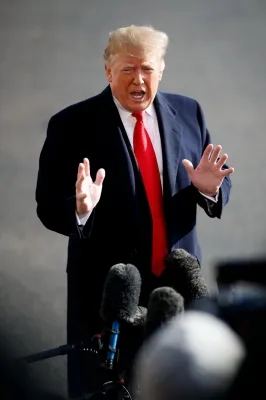
While on the red carpet at the Kennedy Centre Honours, Trump remarked on Netflix: “They have a substantial market share. When they acquire Warner Bros., that share increases significantly. So, I’m not certain. This is something for economists to evaluate, and I plan to be involved in that decision as well. They have a considerable market presence.”
When reporters pressed him further regarding the merger, the president reiterated his caution. “That’s something for economists to analyze… It is a significant market share. It could be a concern,” he stated to journalists lining the entryway.
On Friday, Netflix finalized a deal to acquire the Warner Bros. Discovery studio along with the HBO/HBO Max streaming franchise, outbidding competitors like Paramount/Skydance and Comcast.
Reports from the Washington Post and Wall Street Journal suggest the agreement is valued between $72 billion and $83 billion, making it one of the largest media mergers in recent history. This transaction would consolidate the Warner Bros. film and television library, HBO’s premium content, and related digital assets under one global streaming platform.
Trump confirmed on Sunday that Netflix co-CEO Ted Sarandos met with him in the Oval Office last week. While he praised Sarandos personally—“I think he’s fantastic. In Hollywood’s history, there’s hardly anything comparable to his achievements”—the president once again returned to competitive concerns: “But it is a significant market share; there’s no doubt about that. It could be an issue.”
According to the Washington Post, Sarandos “didn’t indicate what steps he was prepared to take to secure the merger’s approval.”
The Wall Street Journal reported that following the acquisition, Netflix and HBO Max would capture approximately 30% of the US subscription streaming market, raising significant questions for regulators at the Justice Department and the Federal Trade Commission.
Antitrust attorneys cited in those reports anticipate a comprehensive review, with Netflix having pledged a $5.8 billion breakup fee should the deal fail due to legal challenges.
During his extended appearance at the red carpet event—where he also commented on architecture, his musical tastes, and the evening’s honorees—Trump emphasized that he would personally engage in the decision-making process. “I’ll be involved in that decision,” he stated.
Though the president’s comments were made at a cultural event, the potential regulatory scrutiny immediately resonated in global markets where Netflix and Warner Bros. hold significant distribution power.
India, recognized as one of Netflix’s fastest-growing non-US markets, is crucial to both companies’ long-term strategies. Netflix has heavily invested in Hindi and regional-language originals.
Simultaneously, Warner Bros. Discovery is broadening its South Asia studio network and distribution reach, particularly focusing on high-performance franchises and pay-TV content.
Should the merger be approved, the Netflix–Warner collaboration would rank among the most significant media transactions of the decade. It has the potential to revolutionize content distribution, international release schedules, and global investments in original production.
Point of View
It’s crucial to approach this significant merger with an unbiased lens. The potential antitrust implications raised by President Trump underline the complexities of this high-stakes acquisition. With both companies heavily invested in India, where digital entertainment is booming, the global ramifications of this merger could be profound. Stakeholders must navigate these challenges carefully, balancing growth opportunities with regulatory scrutiny.
NationPress
09/12/2025
Frequently Asked Questions
What are the potential antitrust issues with the Netflix-Warner merger?
The merger raises concerns due to Netflix's already significant market share, which could increase substantially with the acquisition of Warner Bros., prompting regulatory scrutiny.
How much is the Netflix-Warner Bros. deal valued at?
The deal is valued between $72 billion and $83 billion, marking it as one of the largest media acquisitions in decades.
What impact could this merger have on the US streaming market?
Post-acquisition, Netflix and HBO Max could command approximately 30% of the US subscription streaming market, intensifying competition and regulatory focus.
What is the significance of the merger for India?
India is a critical market for both companies, with Netflix investing in regional content and Warner Bros. expanding its distribution, making this merger crucial for future growth.
What steps are being taken to evaluate the merger?
Antitrust lawyers expect a thorough review process, with Netflix committing to a $5.8 billion breakup fee if the deal collapses for legal reasons.