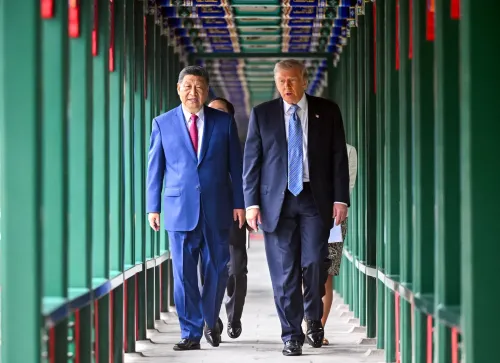
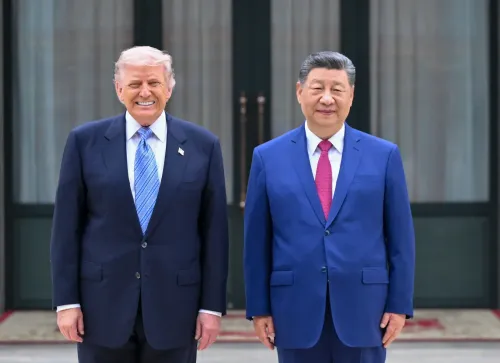
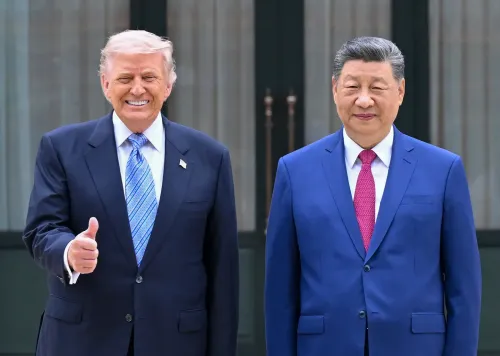
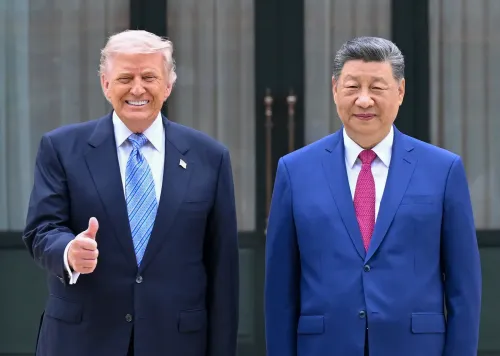
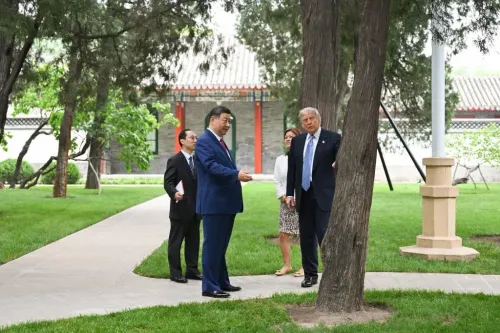
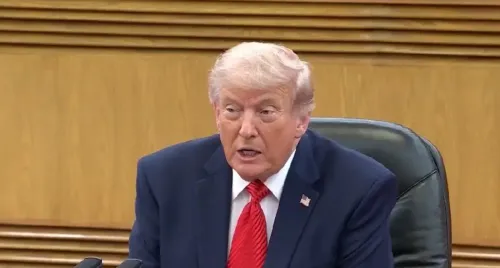
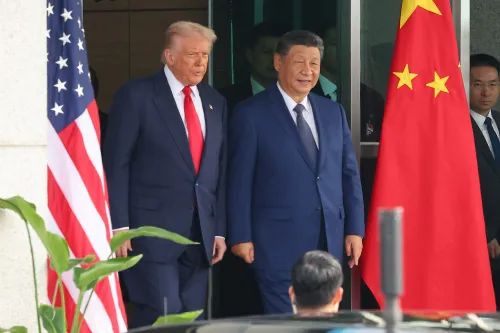
Trump, Xi begin high-stakes 3-day summit on trade, AI and security
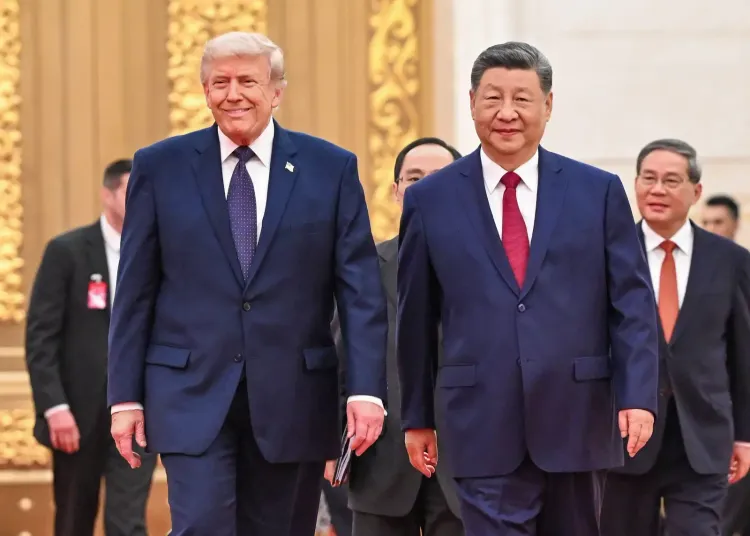
Synopsis
For the first time in over a decade, Xi Jinping is at the White House — and the stakes could not be higher. Trade, AI chip controls, Indo-Pacific security and human rights are all on the table, while US lawmakers are publicly warning Trump not to give Beijing an inch on advanced technology. India, caught between its Quad commitments and its China border dispute, is watching every word.
Key Takeaways
US President Donald Trump hosts Chinese President Xi Jinping for a three-day state visit beginning 24 September 2026 in Washington DC — the first such visit in over a decade.
Key issues include trade, AI and semiconductor export controls, Indo-Pacific security, and human rights.
The White House has not confirmed any specific agenda or anticipated agreements.
Democratic senators, led by Chuck Schumer and Elizabeth Warren , are pressing Trump to hold firm on AI chip and semiconductor export controls, backing three bipartisan bills: the AI OVERWATCH Act , MATCH Act and Chip Security Act .
Senator Dick Durbin has urged Trump to demand the release of named political prisoners, including Jimmy Lai and Gulshan Abbas .
The summit outcome is being closely tracked in India , given its Quad membership and ongoing border dispute with China.
US President Donald Trump is set to welcome Chinese President Xi Jinping for a three-day state visit beginning Wednesday, 24 September 2026, with trade, artificial intelligence, security and human rights expected to dominate the closely watched talks in Washington DC. The summit is the first time Xi and his wife, Peng Liyuan, have visited the White House in over a decade.
Arrival and Ceremony
Xi and Peng are scheduled to land at Joint Base Andrews on Wednesday afternoon, where President Trump will receive them at the military facility outside Washington. The formal state visit opens on Thursday at the White House, with an arrival ceremony on the South Lawn hosted by Trump and First Lady Melania Trump.
The ceremony will feature 479 military personnel drawn from all branches of the US armed forces, national anthems of both countries, remarks by the two presidents, a military review, and a flyover by a B-2 Spirit bomber and four F-22 Raptor fighter jets. Bilateral talks are expected to follow the ceremony.
What Is on the Table
The White House has not publicly outlined a formal agenda or confirmed any agreements that could emerge. However, the visit arrives against a backdrop of deep and persistent friction — spanning tariffs, Taiwan, the South China Sea, advanced technology transfers and China's treatment of ethnic and political minorities.
Democratic senators, led by Senate Democratic leader Chuck Schumer and Senator Elizabeth Warren, are scheduled to hold a news conference on Wednesday urging Trump to treat controls on exports of advanced AI chips and semiconductor manufacturing equipment as non-negotiable. Their message, in their own words: “Don’t Hand China The Technology It Needs To Win The AI Race.”
The senators are also pushing for congressional action on three bipartisan technology-export bills: the AI OVERWATCH Act, the MATCH Act and the Chip Security Act.
Security, Human Rights and Political Pressure
Senator Tammy Duckworth has separately accused Trump of weakening US alliances and conceding ground to Beijing through what she described as an erratic trade policy, urging the administration to seek firm commitments on AI, human rights, supply-chain security and Indo-Pacific deterrence.
Other Democratic senators have called on Trump to confront Xi over allegations that China provided intelligence and satellite assistance to Iran — support they say placed American service members at risk. Senator Dick Durbin has specifically asked Trump to press Xi for the release of named political prisoners, including Gulshan Abbas, Jimmy Lai, Gao Quanfu, Pang Yu and Ekpar Asat.
On the human rights front, Congressman Jim McGovern, the top Democrat on the Congressional-Executive Commission on China, plans to appear alongside representatives of Tibetan, Uyghur, Hong Kong and Chinese diaspora groups before the visit concludes. McGovern is demanding that any cooperation with Beijing be tied to tangible improvements in human rights conditions.
Cultural Programme and State Dinner
Beyond the political discussions, a parallel cultural itinerary is planned. Melania Trump and Peng Liyuan will visit the Smithsonian’s National Museum of Asian Art on Thursday to view works connected to centuries of artistic exchange between China and the United States. A formal state dinner will be held in the White House East Room on Thursday evening.
On Friday, the two presidential couples will meet for tea in the Red Room before travelling to the National Archives, where they will view historical records linked to the story of US-China relations. The farewell ceremony will take place at the National Archives.
Why India Is Watching Closely
The outcome of the Washington summit carries direct consequences for India, which is a member of the Quad — alongside the US, Japan and Australia — while simultaneously locked in a long-running border dispute with China. Any agreements or understandings reached between Washington and Beijing could reshape Indo-Pacific security architecture, technology supply chains and global trade flows, all of which bear directly on New Delhi’s strategic and economic interests.
Point of View
The critical read is not the ceremonial optics but any quiet understanding on Taiwan, the South China Sea or supply-chain decoupling — each of which directly recalibrates the strategic value of the Quad.
NationPress
23 Sept 2026
Frequently Asked Questions
What is the Trump-Xi state visit about?
US President Donald Trump is hosting Chinese President Xi Jinping for a three-day state visit beginning 24 September 2026 in Washington DC, with trade, artificial intelligence, security and human rights expected to dominate the talks. It is the first White House visit by Xi in over a decade, arriving amid deep bilateral tensions over tariffs, Taiwan and technology.
What are US lawmakers demanding ahead of the summit?
Democratic senators led by Chuck Schumer and Elizabeth Warren are urging Trump to treat AI chip and semiconductor equipment export controls as non-negotiable, warning against handing China the technology it needs to win the AI race. They are also backing three bipartisan bills — the AI OVERWATCH Act, the MATCH Act and the Chip Security Act — to tighten technology export oversight.
Which political prisoners have senators asked Trump to raise with Xi?
Senator Dick Durbin has asked Trump to press Xi for the release of Gulshan Abbas, Jimmy Lai, Gao Quanfu, Pang Yu and Ekpar Asat. Congressman Jim McGovern is also demanding that any cooperation with Beijing be linked to tangible human rights improvements.
Why does the Trump-Xi summit matter for India?
India is a Quad member alongside the US, Japan and Australia, and is simultaneously engaged in a long-running border dispute with China. Any agreements reached in Washington on Indo-Pacific security, technology supply chains or trade could directly affect India’s strategic and economic calculus.
What is the ceremonial schedule for the state visit?
Xi and Peng Liyuan arrive at Joint Base Andrews on Wednesday. Thursday features a South Lawn arrival ceremony with 479 military personnel, bilateral talks, a Smithsonian museum visit, and a state dinner in the White House East Room. On Friday, the two couples will share tea in the Red Room, tour the National Archives, and conclude with a farewell ceremony.