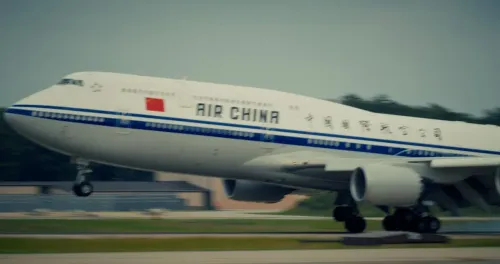
Trump Hosts Xi Jinping at White House for State Visit
Synopsis
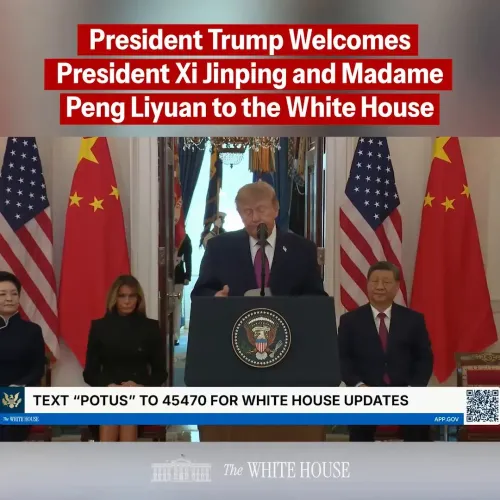
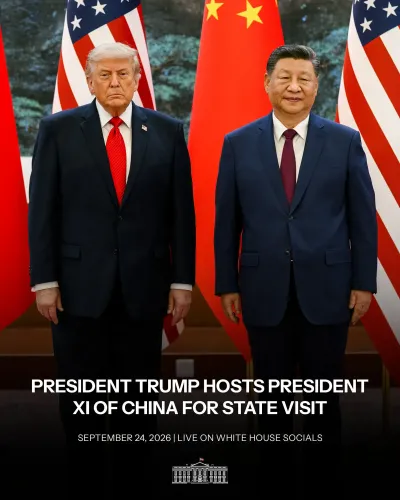
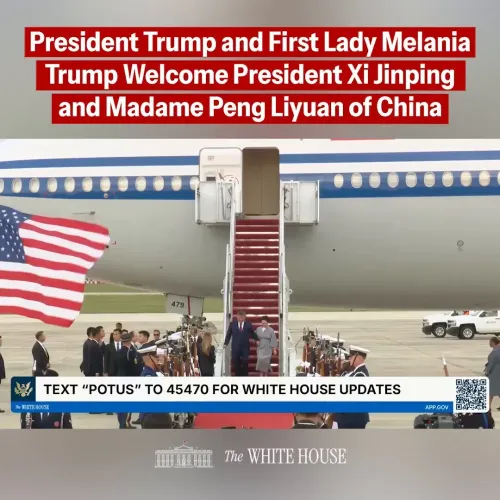
President Donald Trump and First Lady Melania Trump received Chinese President Xi Jinping and Madame Peng Liyuan at the White House on September 24, 2026, for a formal state visit — the highest diplomatic ceremony Washington can extend, carrying enormous implications for global trade, technology, and security.
Key Takeaways
President Trump and First Lady Melania hosted President Xi Jinping and Madame Peng Liyuan at the White House on September 24, 2026 .
The event is a formal state visit — the highest diplomatic tier Washington accords a foreign leader.
The previous Trump-Xi summit was held at Mar-a-Lago in 2017 , focused on trade and North Korea .
US-China state visits have historically addressed tariffs, technology transfer, and regional security disputes.
Outcomes — joint statements, framework deals, or renewed negotiations — will be closely watched by allies including India , Japan , and European partners.
The visit lands against a backdrop of years of trade-war tariffs, semiconductor export controls, and South China Sea tensions.
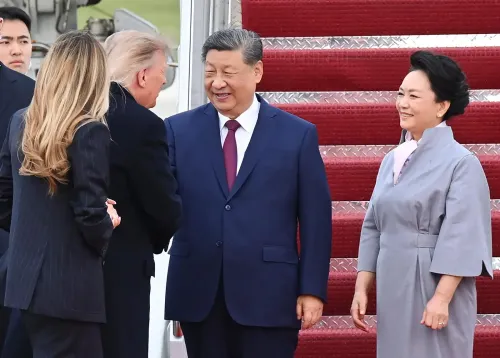
For the first time in years, the leaders of the world's two largest economies stood together on the steps of the White House — a moment laden with the weight of trade wars, technology rivalries, and geopolitical fault lines stretching from the South China Sea to Taiwan. President Donald J. Trump and First Lady Melania Trump on Thursday, September 24, 2026, welcomed President Xi Jinping of the People's Republic of China and Madame Peng Liyuan to the White House for an official state visit.
Summit at Pennsylvania Avenue: The Scene on the South Lawn
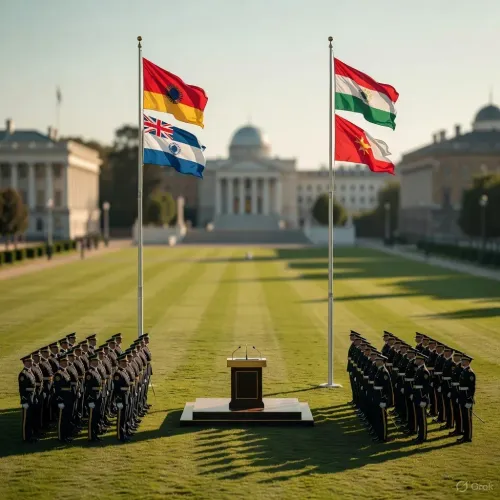
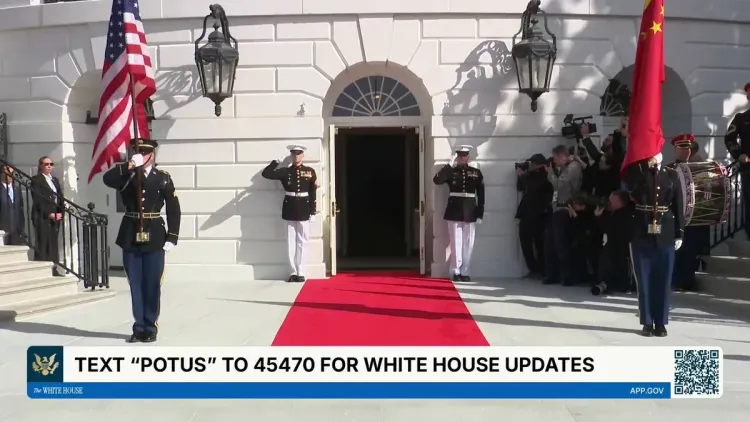
A formal state visit to the White House is the highest diplomatic honour Washington extends to a foreign head of government — full military honours, an official greeting ceremony, and the symbolic weight of the world's cameras fixed on two leaders who rarely agree. Trump and Melania received Xi and Peng at the White House, a setting that signals Washington's intent to engage Beijing at the highest possible level. The last time the two sides convened at this register of ceremony, it was 2017 and the venue was Trump's Mar-a-Lago estate in Florida, where trade and North Korea's nuclear programme dominated the agenda.
Nine Years of Tariffs, Technology Bans, and Tactical Pivots
The arc from Mar-a-Lago to the White House has not been a smooth one. The first Trump administration launched sweeping tariffs on hundreds of billions of dollars of Chinese goods, triggering retaliatory measures from Beijing and a years-long trade war that reshaped global supply chains. Restrictions on Chinese technology firms, export controls on advanced semiconductors, and escalating disputes over Taiwan and the South China Sea deepened the structural rivalry between the two powers. Each summit since has been both a pressure valve and a negotiating table — leaders talking while their governments competed fiercely.
State visits of this nature have historically served as forcing functions: officials on both sides spend weeks pre-negotiating outcomes so that leaders can announce agreements or at least set guardrails. What matters most is not the pomp but what emerges from the closed-door sessions — whether on tariff schedules, military communication channels, or technology-transfer rules that affect businesses from Mumbai to Seoul to São Paulo.
Why This Visit Matters Beyond Washington and Beijing
For India, which sits at the intersection of US-China strategic competition and shares a contested border with China, the temperature of any Washington-Beijing summit carries direct consequence. A détente that stabilises trade flows eases pressure on global commodity prices; a breakdown sharpens alliance pressures on New Delhi to take sides. The Quad framework — bringing together the US, India, Japan, and Australia — exists partly as a hedge against an unchecked China; how Trump and Xi define their relationship will shape how much urgency Washington attaches to that grouping. The world does not just watch this summit. It calculates from it.
Any joint statement, framework agreement, or even a scheduled follow-on negotiation will be scrutinised by capitals from Tokyo to Brussels for signals about whether the two superpowers are edging toward managed coexistence or deepening confrontation.
Point of View
At least momentarily, that managed dialogue serves their interests better than open confrontation. For the Trump administration, hosting Xi at the White House rather than a resort conveys institutional gravity; for Beijing, accepting the invitation signals a willingness to re-engage at the highest level. India will watch the economic agenda closely: any tariff relief or technology-sharing framework between the US and China reshapes the competitive landscape that Indian manufacturers and tech firms navigate. The real test is what concrete deliverables, if any, follow the handshake on the South Lawn.
NationPress
24 Sept 2026
Frequently Asked Questions
What is a White House state visit and why does it matter?
A state visit is the highest diplomatic honour the United States extends to a foreign head of state, involving full military honours, a formal welcoming ceremony, and high-level bilateral talks. It signals that both governments regard the relationship as a top-tier strategic priority.
When did Trump last meet Xi Jinping before this 2026 visit?
During his first term, President Trump hosted President Xi at Mar-a-Lago in April 2017 , where discussions centred on trade imbalances and North Korea's nuclear programme.
What issues are expected to be discussed at the Trump-Xi summit?
Based on the established pattern of US-China summits, the talks are likely to cover trade tariffs, technology transfer restrictions, semiconductor export controls, and regional security issues including Taiwan and the South China Sea.
How does the US-China summit affect India?
India sits at the strategic intersection of US-China competition, shares a contested Himalayan border with China, and is a member of the Quad alongside the US. The outcome of any Washington-Beijing summit directly shapes alliance dynamics, trade flows, and the diplomatic pressure on New Delhi.
Who is Madame Peng Liyuan?
Peng Liyuan is the wife of Chinese President Xi Jinping and serves as the First Lady of China. She is also a celebrated folk singer and a People's Liberation Army arts ambassador, and is one of China's most prominent public figures.