How Will US-Australia Enhance Indo-Pacific Defence Cooperation?
Click to start listening
Synopsis
In a significant diplomatic engagement, the US and Australia have reinforced their commitment to Indo-Pacific security through enhanced defense cooperation and strategic initiatives within the Quad. This partnership highlights the importance of collective security and technological collaboration to address regional challenges.
Key Takeaways
- US and Australia emphasize Indo-Pacific security.
- Strengthened Quad role with India.
- Focus on critical minerals for supply chain security.
- Advancements in military capabilities under AUKUS.
- Enhanced cooperation in cybersecurity and technology.
Washington, Dec 9 (NationPress) On Monday, the United States and Australia prioritized the Indo-Pacific region during their ministerial discussions, highlighting an elevation in defence collaboration, expanding force posture initiatives, and reaffirming the significance of the Quad, with India as a key element of their regional strategy.
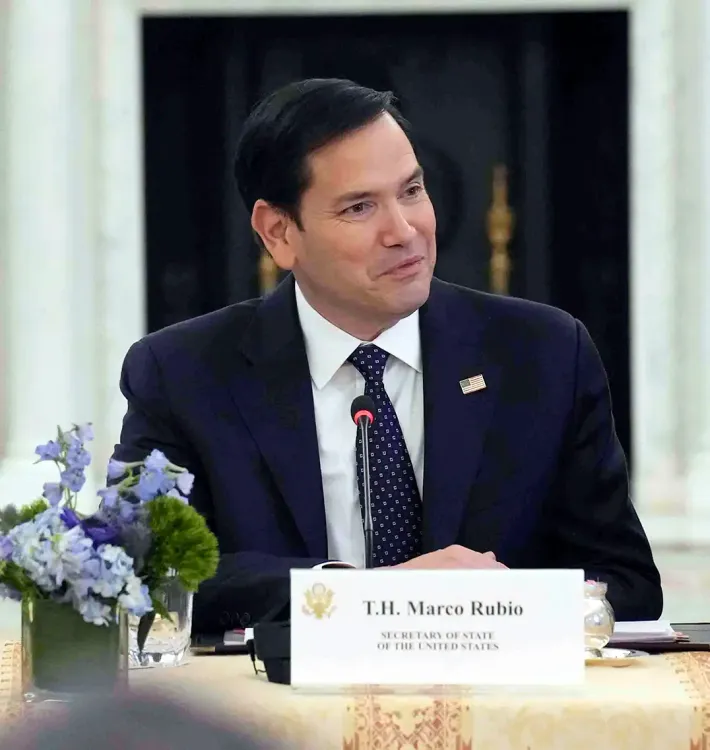
Secretary of State Marco Rubio initiated the talks by referring to Australia as an “incredibly strong ally” and noted it as “the only partner that has stood alongside us in every conflict over the last several decades.” He remarked that the momentum generated from Prime Minister Anthony Albanese's visit in October laid out clear objectives for the Indo-Pacific.
Rubio emphasized the Quad, comprising the US, India, Japan, and Australia, as central to the administration’s Indo-Pacific strategy. “We are... firmly committed to the Quad,” he declared, describing it as a collaborative effort alongside Japan and India to strengthen this framework, recalling that “it was in this very room that I held my inaugural event as secretary of state with the Quad.”
He connected the enhanced role of the Quad to mutual technological and economic security challenges, drawing attention to the newly established critical minerals agreement with Canberra. He asserted that dependable supply chains are vital for “defending our nations, our allies, or one another,” stressing the importance of diversifying investments to avoid becoming overly reliant on a single source that could be leveraged against them.
Foreign Minister Penny Wong asserted that the Australia-US alliance is “essential for a peaceful, stable, and thriving Indo-Pacific,” reiterating that “the United States is our primary ally and strategic partner.” She emphasized the continuity of this partnership since the inception of AUSMIN in 1985, stating that “today, Australia and the United States are more interdependent than ever.”
Wong highlighted that AUKUS, the trilateral security pact involving the US, UK, and Australia, is fundamental to maintaining regional balance. “We are moving forward with full momentum,” she stated.
Defence Secretary Pete Hegseth elaborated on an extensive Indo-Pacific military strategy aimed at expanding the US' operational capabilities and joint initiatives with its allies. “We are enhancing our force posture,” he mentioned, referring to upgrades at “air bases in Queensland and the Northern Territory,” increased “US bomber rotations,” and improved logistics in Darwin to support more rotational deployments of US Marines and pre-positioning of MV-22 Ospreys.
Hegseth also discussed collaborative production and maintenance strategies for advanced weapon systems, emphasizing their importance in deterring conflict in the Indo-Pacific. He highlighted “joint efforts on items such as GMLRS... precision strike missiles,” and progress towards “co-production and co-sustainment of hypersonic attack cruise missiles... air-to-air missiles,” along with collaboration on “Mark 54 torpedoes.”
Critical minerals, a sector where India is rapidly forging alliances with both nations, remain a vital connective tissue within this partnership. Hegseth described them as “crucial for ensuring both nations can operate effectively in the region and globally.”
Deputy Prime Minister Richard Marles characterized the discussions as crucial for navigating “a significantly more competitive world where it is essential to reinforce bonds with friends and allies.” He noted that AUKUS is proceeding “at full speed” and emphasized advancements concerning the Submarine Rotational Force West by 2027. Australia, he pointed out, is already facilitating “the most extensive maintenance that a US nuclear submarine has carried out outside of the United States.”
Marles indicated that Australia is broadening access for US assets across “air, sea, and land, as well as space and cyber,” indicating a united Indo-Pacific deterrent strategy. He highlighted the strong integration within US commands, mentioning that “nearly 900 Australian personnel are embedded within the United States armed forces,” and that deputy commanders of the US Army, Navy, and Air Force in the Pacific are now institutionally Australian.
The reinforced alignment between the US and Australia occurs against a backdrop of escalating competition in the Indo-Pacific, where both nations closely collaborate with India through the Quad, defense drills, maritime domain awareness programs, and emerging technology partnerships.
The Quad has transformed into a strategic platform connecting the US, India, Japan, and Australia on matters of supply chains, maritime security, cybersecurity, and critical technologies, complementing bilateral and trilateral frameworks aimed at bolstering stability throughout the Indo-Pacific region.
Point of View
It is clear that the deepening partnership between the US and Australia is pivotal for regional stability in the Indo-Pacific. The commitment to collaborative defense initiatives, particularly through the Quad, reflects a proactive approach to emerging global challenges. This alignment is not only strategic but essential for maintaining peace and prosperity in the region.
NationPress
09/12/2025
Frequently Asked Questions
What is the significance of the Quad in Indo-Pacific strategy?
The Quad, which includes the US, India, Japan, and Australia, serves as a strategic platform for collaboration on security, supply chains, and technological advancements, enhancing regional stability and countering potential adversarial actions.
How does the US and Australia partnership affect regional security?
The partnership enhances military readiness, promotes joint operational capabilities, and solidifies alliances, all of which are crucial for ensuring a stable and secure Indo-Pacific environment.
What are critical minerals, and why are they important?
Critical minerals are essential resources for advanced technology and defense systems. The agreement between the US and Australia aims to secure reliable supply chains, which are vital for national security and economic stability.
What advancements are being made under AUKUS?
AUKUS focuses on enhancing security cooperation among the US, UK, and Australia, with significant advancements in submarine technology, cyber capabilities, and defense production.
What role does India play in the Indo-Pacific strategy?
India is a key partner in the Quad, contributing to collective security initiatives, joint military exercises, and collaborative efforts to address technological and economic challenges in the Indo-Pacific.